
Home » Articles posted by T h e o • p h i l o g u e (Page 3)
Author Archives: T h e o • p h i l o g u e
Book Review: Symbol & Sacrament: A Contemporary Sacramental Theology by Michael G. Lawler
Lawler, G. Michael. Symbol and Sacrament: A Contemporary Sacramental Theology. Omaha, Nebraska: Creighton University Press, 1995. 293 pp.
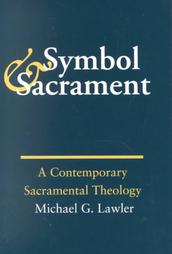
Two foundational principles guide our author in his exploration of sacramental theology in his book Symbol and Sacrament. First, Lawler has a practical edge faithful to the ancient maxim that Sacramentum propter hominem (sacraments are for people). This helps inform his approach to the subject matter with insights from the anthropological investigation of ritual (which involves a synthesis of psychology, sociology and semiotics). Second, the author encapsulates the richness of his synthetic approach with his categorization of sacraments as prophetic symbols, successfully recontextualizing relevant findings of the modern science within a thoroughly Catholic framework. Lawler first grounds his sacramental theory solidly on both a sophisticated knowledge of semiotics (that challenges modern assumptions about what is “real”) and a historically sensitive theological framework, he then addresses each sacrament individually with a view to practical concerns without shying away from controversy.
On the basis of contemporary symbolic analysis, Lawler claims that every genuine human symbol goes beyond a mere one-to-one signification (as with simple signs) to actually concretize the reality they signify, or “make concretely present what they symbolize” (22).[1] Lawler makes the following transition: If this is true of human symbols in general, it is also true of prophetic symbols in particular, which are meant to be provocative—that is, to effect a change or response of the whole person (not just the intellect). In fact, “the most clear-cut result” of symbols is that they move people to “action and reaction” (13).
A symbol and its meaning are related correlatively and are so organically connected that they “coexist for a human interpreter, or neither really exists at all” (17). Symbols do not convey their meaning in a simplistic way, however, and this is the case for at least two reasons. First, the meaning of symbols, unlike simple signs, is multivalent. There is a certain effervescent ambiguity in the meaning of symbols; their meaning is at the same time mysterious and yet revealed in a concrete way through the symbol. These meanings are related to the symbols “only through the thoughts, the feelings, the actions and the reactions of [people]” (16). Science disinterestedly asks and answers only questions of so-called “facts” (which really turn out to be theory-laden rather than bear facts); symbols, on the other hand, ask and answer questions about meaning that can be expected to excite not only the intellect, but “arouse desires and feelings,” powerfully speaking to the whole human (intellect, will, emotions, imagination, etc.)—not merely a person’s intellect (18).
The author warns that this “subjective dynamism” by no means necessitates that true knowledge cannot be mediated through symbols (19). In fact, the author argues that “these subjective elements vitiate the objectivity of the meaning” (27). In a courageous polemic against the dominance of Western epistemological reductionism, Lawler defends symbol as “a way of knowing” that may be counter-intuitive to the indoctrinated Western mind that is prejudiced against any form of knowledge that is not Cartesian (i.e. clear, objective, scientific, etc.). “If such a personal approach to knowledge seems strange,” writes Lawler with wit, “it is only because the dominant Western scientific paradigm of knowledge has judged rational, clear, and distinct, objective knowledge to be all there is to knowledge” (19). He borrows Maeterlinck’s contrast between the brain’s “Western lobe, the seat of reason and science,” and the brain’s “Eastern lobe, the seat of intuition and symbol” (20). The goal of the Western-lobe is a meager one: to increase knowledge; the goal of the Eastern-lobe is more ambitious: “to deepen the personality of the knower” (26). Symbols do lead to abstract conceptions and determinate ideas—meanings that clustering around the “ideological” pole of meaning—but they are grasped “personally and socially” through meanings that cluster around the oretic pole (15, 22). This starts the book’s eloquent presentation off with an epistemological bite that immediately both overcomes the “classical dichotomy” between objective knowledge and religious symbols while challenging the presumptions of Western prejudice. This makes the treatment more appealing and relevant to the book’s Western audience.
The author makes many other distinctions concerning symbols before moving on to sacraments: symbol is a subunit of the larger category of ritual (which is a symbolic act); religious symbols are public symbols whose meaning “belongs” primarily to communities and secondarily to individuals; religious symbols only mediate powerful realities to those who “live into” them and thus have “the necessary disposition” to make them effective, etc. (25). In the end, symbol gets defined as a verb rather than a noun: “Symboling is a specifically human process in which meanings and realities, intellectual, emotional and personal, are proclaimed, made explicit and celebrated in representation in a sensible reality within a specific perspective” (16).
Sacraments are religious symbolic rituals. The author approaches the biblical witness with an admirable realism by not trying to eisegetically “find” the full Catholic teaching on the sacraments (or even the designation of them) in Scripture. After surveying the patristic witness (especially Augustine’s major contribution of defining sacraments as a “sacred signs” that are efficacious), our author believes the quest for a normative definition ended with Peter Lombard who defined a sacrament as “a sign of the grace of God and the form of invisible grace in such a way that it is its image and its cause” (33). In an attempt to exonerate the scholastic views of the sacraments from the mechanistic caricature, the author points out that the scholastics did not view the sacraments as efficacious in themselves even if they effected sanctification by virtue of the reality they signified—personal acts of God in Christ (34). On the one hand, Trent clearly viewed the sacraments’ efficacy as depending upon the one’s receiving the sacrament so as to not “place an obstacle” to its efficacy (which for an adult included personal intent), yet on the other hand the author laments that “the role of personal faith in its efficacy suffered detriment” in a reaction against the Reformation (37). The Council of Florence, however, balances this with a more positive affirmation that demands for the recipient of a sacrament to have a “disposition of self-surrendering faith” (40).
Our author clarifies the nature of causality in the sacraments with regard to grace: the sacraments contain God’s presence (uncreated grace) and thus as a byproduct, they result in the transformation of the worthy participant (created grace). After defining the grace of sacraments as primarily nothing other than God himself (and only secondarily in terms of created grace) the author complains that “it is no longer possible adequately to describe grace in impersonal terms like create quality, accident, habitus” (56). (This appears to be a cheap shot against scholastic theology, but why should it not be appropriate to have descriptors for both kinds of grace rather than just one?) The author’s concern is to steer us away from a mechanical understanding of causality in the sacraments and toward a deeply personal understanding of the sacraments so that we end up concluding that to relate to God through sacraments means, more or less, to relate to God personally.
After providing such a well-argued foundation for understanding the sacraments, our author proceeds to treat each sacrament with a similar command of his sources and practical sensitivity. He gives a concise and satisfying overview of certain relevant Scriptural passages along with the patristic witnesses (especially Augustine), scholastic contributions (especially Aquinas), and more recent insights from theologians such as Rahner and Schillebeeckx. These overviews have the practical intent to help the reader better understand the sacraments so that she can enjoy them more fully. The strength of his presentation lies in his command of sources (his ability to so concisely review historical developments and incorporate modern insights), his bold challenge to modern assumptions about “knowing,” his facing controversial questions with gusto,[2] and his practical considerations. Lawler’s contribution, although written almost two decades ago, is still a very helpful and stimulating introduction to Sacramental theology.
[1] For example, a man may have deep love for a woman without her even being aware of it, but when he writes her love letters, holds her hand and whispers in her ear “I love you,” or unites his body to hers in the act of sexual union, his love is not merely symbolized in and through such actions, for in some sense his love for her consists in these symbolic acts. Thus, although his love is not exhausted by such symbolic acts, these love rituals are his love for her in concrete form. The author also speaks of symbols as “participating” in the reality to which they point (23).
[2] For example, I found particularly enlightening his scuffle with French Dominican Paul Laurent Carle over whether the word transubstantiation is indispensible for expressing the Catholic perspective of the real presence of Christ in the Eucharist (122 ff.).
The Catholic Theology of Religions: A Genuine Doctrinal Development
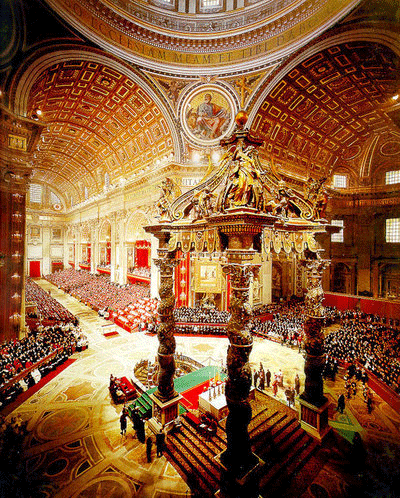
Many Catholics can perhaps still remember a time when the explanation from Catholic bishops and popes about the Catholic Church’s stance on salvation outside the church was little more than a reaffirmation of the traditional and literal understanding of the ancient Cyprian formula extra ecclesiam nulla salus [outside the Church there is no salvation]. Until the official progressive view endorsed by Vatican II, the traditional understanding of this ancient phrase was fairly straightforward—if you are not visibly a member of the Catholic Church you were excluded from salvation.[1] Cyprian’s analogy was of Noah’s ark—just like Noah’s contemporaries had to be inside the Ark to be saved from the flood, so one has to be “inside” the Catholic Church to be saved.
This interpretation of the Cyprian formula, however, in spite of its historical pedigree and centrality in the Catholic Tradition in per-modern history, was reinterpreted at Vatican II. Any genuine doctrinal development that takes place on the official level in the Catholic Church is preceded by progressive views. To understand this development, however, we must first understand not only the Cyprianic formula, but the theological rationale behind it. It was argued early on (most notably by Augustine) that since Jesus and the Apostles taught that saving grace came through the sacraments (Mk 16:16; Jn 6:53; Acts 2:38), the Church is therefore necessary for salvation, for she administers the sacraments as Jesus instructed. Thus the formula was tied initially to a sacerdotal soteriology. If the progressive view was going to reshape traditional Catholic beliefs about adherents of other religions, this sacerdotal logic had to be addressed.
Vatican II[2] still dogmatically echoes the tradition that salvation comes through Jesus Christ and that this salvation is mediated through the Church. For example:
Basing itself on scripture and tradition, [this holy Council] teaches that the Church, a pilgrim now on earth, is necessary for salvation: the one Christ is mediator and the way of salvation; he is present to us in his body which is the Church. He himself explicitly asserted the necessity of faith and baptism (cf. Mk. 16:16; Jn. 3:5), and thereby affirmed at the same time the necessity of the Church which men enter through baptism as through a door.[3]
The analogy used here is also similar to the traditional analogy of Noah’s Ark—baptism is the “door” one must go through to be saved. Nevertheless, whereas the Cyprianic formula was intended to be interpreted as meaning that visible membership in the Catholic Church was necessary for salvation, Vatican II only requires this as a precondition for the fullness of salvation, not salvation itself. In the Vatican II documents, different levels of incorporation into salvation are tied specifically to different ways non-Catholics can be incorporated into the Catholic Church without their knowing it.
Fully incorporated into the Church are those who … [are] joined in the visible structure of the Church of Christ, who rules her through the Supreme Pontiff and the bishops. …
Catechumens who, moved by the Holy Spirit, desire with an explicit intention to be incorporated into the Church, are by that very intention joined to her. …
•
The Church knows that she is joined in many ways to the baptized who are honored by the name of Christian, but who do not however profess the Catholic faith in its entirety or have not preserved unity or communion under the successor of Peter. … these Christians are indeed in some real way joined to us in the Holy Spirit for, by his gifts and graces, his sanctifying power is also active in them…
•
Finally, those who have not yet received the Gospel are related to the People of God in various ways. There is, first, that people to which the covenants and promises were made [Jews] … But the plan of salvation also includes those who acknowledge the Creator, in the first place amongst whom are the Moslems [sic] … Nor is God remote from those who in shadows and images seek the unknown God, since he gives to all men life and breath and all things (cf. Acts 17:25-28), and since the Savior wills all [people] to be saved (cf. 1 Tim 2:4). Those who, through no fault of their own, do not know the Gospel of Christ or his Church, but who nevertheless seek God with a sincere heart, and, moved by grace, try in their actions to do his will as they know it through the dictates of their conscience—those too may achieve eternal salvation. [4]
•
Since Baptism is necessary for salvation, all persons saved without a Christian baptism are considered incorporated into the Catholic Church by a baptismo implicitum (an implicit baptism). This way, the Catholic Church still holds to the wording of the Cyprianic formula without requiring the traditional literal interpretation, thus yielding the original formula dangerously misleading for Catholics unfamiliar with the developments of Vatican II.
This new inclusivist framework still holds that salvation is only through Christ and the Church, and views whatever goodness or truth inherent within other religions and their adherents as finding their true fulfillment in Christ.[5] In this sense, other religions can be seen as preparatio evangelica [a preparation for the fullness of the gospel].[6] Although whatever good found in other religions is “preserved … purified, raised up, and perfected” by the Catholic faith, the Church still “snatches them from the slavery of error” when she incorporates them more fully into Christ and “each disciple of Christ has the obligation of spreading the faith to the best of his ability.”[7] Gaudium et Spes nevertheless adds a comforting qualifier about the necessity of evangelism by teaching that “the Holy Spirit in a manner known only to God offers to every [person] the possibility of being associated with this paschal mystery.”[8]
Popes and Catholic theologians have given various assessments of Vatican II’s theology of religions. Karl Rahner’s theology of “anonymous Christianity” had a major influence on the question of whether other religions can have salvific potency. He believed Vatican II left the question “open” and does not finally resolve all ambiguity.[9] Kärkkäinen says Paul Knitter represents “one extreme” that sees mainstream Catholicism as implicitly affirming a pluralist position.[10] The majority of post-Conciliar developments, however, “usually hold the more restrictive view according to which followers of other religions may be saved but other religions as such do not have salvific structure.”[11] Theologians like Gavin D’Costa have become outspoken critics of the pluralist interpretation of Knitter and others.[12] Later encyclicals such as Pope Paul VI’s Evangelii Nuntiandi (1975) and John Paul II’s Redemptoris Missio (1990) can be seen as pastoral correctives against a de-emphasis on Christ and “the church’s central role in the history of salvation” and “practices of interreligious dialogue that stressed the commonalities among religions rather than Christian uniqueness.”[13]
In sum, the mainline Catholic interpretation of Vatican II can be recapped this way: “Followers of other religions can find salvation, but such salvation is found finally and fully in Christ and his church.”[14] In this manner, Catholics believe that because salvation comes through Jesus Christ via the Church, Catholics have an obligation and duty to proclaim the Christian faith and seek converts. On the other hand, because God desires the salvation of all people, his grace is at work outside the Church, leading people who remain in other religions to be nevertheless “incorporated” into the Church in various ways.
Bradley R. Cochran
[1] There were certain exceptions to this that one might easily anticipate. For example, if you had accepted the Church, embraced her, and were being prepared for baptism, then suddenly died before you were actually baptized, you were considered as baptized anyway (by a “baptism of desire”). Or if you had accepted the Catholic message but died a martyr’s death before you happened to be baptized, you could still be considered as baptized (by a “baptism of blood”). But these exceptions were for those who had explicitly accepted Catholicism or the message of Catholics but who were not yet baptized, not for people who followed other religions. There was a stronger precedent, however, for the doctrinal development that took place at Vatican II. Kärkkäinen, for example, notes that “as late as 1943, the highly acclaimed papal encyclical entitled Mystici Corporis (“the Mystical Body”) by Pius XII still held to the view that only ‘true’ Catholics are saved,” but he admits also that this same encyclical leaves open the door of salvation for those who have no access to the gospel. Veli-Matti Kärkkäinen, An Introduction to Theology of Religions: Biblical, Historical, and Contemporary Perspectives (Downers Grove, Illinois: InterVarsity Press, 2003), 111-12. Mystici Corporis taught that people who have no access to the gospel can “by a certain unconscious desire and longing” be “ordained to the mystical Body of the Redeemer.” Though initially applied only to those who have no access to the gospel, Vatican II would adopt and refine the logic used in this document in order to explain how people who remain as adherents of other religions might also still achieve eternal salvation.
[2] Vatican Council II: The Conciliar and Post Conciliar Documents, new revised edition, ed. Austin Flannery, O.P. (Northport, New York: Costello Publishing, 1975, fifth printing 2004). The documents most relevant to the Catholic theology of religions are: Nostra Aetate (NA), Ad Gentes (AG), Gaudium et Spes (GS), and Lumen Gentium (LG).
[3] Lumen Gentium (LG) 14.
[4] LG 14-16.
[5] This is generally known as a “fulfillment theory” of religions. “That is to say, other religions are ‘fulfilled’ (find their completion and perfection) in Christianity.” Paul Hedges, Controversies in Interreligious Dialogue and the Theology of Religions (London, UK: SCM Press, 2010), 23.
[6] Kärkkäinen, An Introduction to Theology of Religions, 117.
[7] LG 17.
[8] Kärkkäinen, An Introduction to Theology of Religions, 115.
[9] Ibid., 118.
[10] Ibid.
[11] Ibid., 117.
[12] Gavin D’Costa, ed. Christian Uniqueness Reconsidered: The Myth of a Pluralistic Theology of Religions (Maryknoll, New York: Orbis, 1990).
[13] Kärkkäinen, An Introduction to Theology of Religions, 120.
[14] Ibid., 120.
:: The Archbishop of Chicago Speaks at the evangelical Wheaton College ::
Yes. You heard it right. The Archibishop of Chicago, Francis Cardinal George, will be speaking at Wheaton College next month in an ecumenical dialogue. Although Wheaton is not sponsoring the event, they have graciously allowed ACT3 (who is sponsoring the event) to gather at the Edman Chapel for this land-breaking event.
My friend John Armstrong (president of ACT3) who recently published a book on Christian unity (Your Church is Too Small) is continuing his conversation with the archbishop of Chicago, Francis Cardinal George. The only difference is, now the conversation is going public and will be taking place in a public format at Wheaton College on March 26th, 7:00pm at the Edman Chapel.
If I were in Chicago, I would be nowhere else. But since I’m not, I will be viewing the event live from home via the internet by going to WETN, since they are vodcasting it live.
UPDATE: You can now view the dialogue at ACT3.

Rob Bell vs. Conservative Evangelicalism :: More Video Wars
In case you missed it, Rob Bell came out with a book last year that sparked immediate controversy before it ever even hit the shelves. How? Through this trailer video. It ruffled the feathers of what may be the largest stream of Christianity in America: conservative evangelicalism. Here is the original video:
::
::
Now part of what makes Bell’s videos so attractive to a postmodern age is his ability to communicate with probing questions and provocative stories instead of a traditional preachy format. Jefferson Bethke, the same guy that recently attained instant fame through his video “Jesus vs. Religion” made a response video to Rob Bell’s trailer expressing this conservative evangelical critique quite well. Here is that video:
::
::
Most people don’t have time to read lengthy written critiques of controversial perspectives, so the best they will ever get is an entertaining view of what I have labeled the “video wars.” Here is a better way: listen to two conservative Christians confronting Bell in a respectful but insistent way, to clarify his views on Unbelievable. Although clearly the interviewers appear to be antagonistic, and often interrupt Bell and dominate the discussion, this is a great dialogue. I was shocked when I realized that Bell’s response to Warnock on biblical texts left Warnock admitting his own ignorance of the biblical languages, whereas Bell had apparently studied the biblical texts more critically than Warnock.
Jesus vs. Religion: Catholic and Muslim responses ignite religious “Video Wars.”
Is evangelical Christianity non-religious? That’s what Jefferson Bethke seems to think. But don’t give him the credit for the idea; this evangelical dichotomization of “religion” vs. “Jesus” in sermons, music, blogs, and other forms of media is a matter of routine to a certain breed of evangelicals (although more discerning evangelicals see past this oversimplified dualism). But what Jefferson can be credited with is a well produced video that makes this characteristically evangelical dichotomy consumable for the masses in a rhetorical flourish set to religiously evocative music. One lessen we can learn from the overnight fame of the video is the power of savvy, impressionistic, sound-bite video production in the global village. In my personal opinion, anyone who is passionate about a cause ought to get busy producing aesthetically appealing media that makes their cause accessible in an impressionistic format. It’s simply the “language” of our day. He who wishes to reach the masses will speak their language. Jefferson’s video is at over 17 million views and counting.
Here is the video, in which the now famous Jefferson Bethke uses the word “religion” in a way that reduces its meaning to something like superficial, empty, and hypocritical self righteousness and draws a crass dichotomy between “religion” on the one hand and “Jesus” (read: evangelical Christianity) on the other.
::
Catholic Responses
There were lots of thoughtful Catholic responses to this video. Catholics (I have learned) tend to use the word “religion” to refer to true sincere spiritual devotion to Christ rather than empty, judgmental, hypocritical self-righteousness. It seems apparent from these videos that Catholics feel their faith has been attacked by Jefferson Bethke in some way.
::
A Muslim Response
Here is a Muslim who wisely takes the opportunity of the video wars to attack the doctrine of the Trinity and argue that Christianity is “religion without reason” and evidences the human tendency to idolatry (the worship of creation instead of God).
::
I haven’t seen any slick Orthodox responses yet. There was a very good atheist response that I thought expressed my own initial reactions to the video with wit and humor, but unfortunately it was full of vulgar obscenity and as the video drags on it turns into a bash against Christianity and was designed to be offensive so I decided not to share it.
Book Review: To Serve God and Wal-Mart: The Making of Christian Free Enterprise by Bethany Moreton
The following is a book review of Bethany Moreton’s To Serve God and Wal-Mart: The Making of Christian Free Enterprise (Cambridge, Massachusetts: Harvard Univeristy Press, 2009), 392 pp. In “It’s Religion Stupid: Emerging Historiographies” (PDF Catalogue) I review this book in tandem with Darren Dochuk’s book From Bible Belt to Sunbelt: Plain-Folk Religion, Grassroots Politics, and the Rise of Evangelical Conservatism (New York, NY: W.W. Norton and Company, Inc., 2011).

When Bethany Moreton first set out to learn about how the anti-monopolist heartland of America (the Ozarks) managed to eventually cook up the largest economic Leviathan the world has ever seen (Walmart), she was not pursuing a book in the religious genre.[1] Her investigation, however, led her straight to the backbone of Walmart’s labor force—conservative Christian women who also made up the largest portion of Protestant evangelicals in American Christianity. Building on Max Weber’s work on the Protestant work ethic, Moreton shows how the faith of these conservative Christian women helped them shape the new service economy by providing the motivation and ideology that made their work meaningful to them. The faith of Christian women made the trope of Christian service stick for the corporation on the popular level—from the bottom up, not from the top down. This powerful grassroots ideology eventually transformed the dominating corporate metaphors of ownership and authority into that of the “servant leader,” successfully integrating evangelical and economic trends.[2]
Since the burden of shopping for the family also fell to these same women, consumer demand also drove an increasing number of Christian products in the store, along with a “series of widely reported product purges that spot-cleaned this shopping zone” for Christians that were a part of the “literalist branches” of Protestantism (i.e. members of Southern Baptist, Church of Christ, and Assemblies of God churches).[3] Christian consumers new ability at Walmart to think of their consumption in terms of procuring wholesome goods for the family (rather than as splurging on unnecessary and sensual entertainment or fashion for oneself) suddenly fit neatly with the broader emphasis on “family values” in the religious right which came to mean (more or less) anti-abortion, anti-gay marriage, anti-pornography and anti-sensually driven or violent entertainment, etc.
Moreton does not think it a mere coincidence that entertainment-oriented megachurches downplaying rigid doctrine in favor of relationships and servant-driven models of ministry were sprouting up all around the Ozarks during the rise of Walmart where the Christian women glorified their “relationships” with customers and viewed it as Christian service. Walmart exploited the conservative family structure in the region by making the men managers on borrowed prestige and the women the servants of managers and customers. This made Walmart’s labor structure fit with the prejudices of the Ozark culture. The men, however, would eventually come to learn and glorify the servant ethos exemplified by the Christian women who became the “face” of Walmart. Exhortations from pulpits (and other forms of Christian media such as “Focus on the Family” with James Dobson) directed at husbands to lavish their wives with praise for their “role” in the home (the second shift) and to think of their own role as husbands in terms of service-leadership instead of mastery or authority are seen in Moreton as an outgrowth of the “feminized” service-economy.[4]
There is a shift in the latter chapters away from the store setting of Walmart itself to its role in the larger political movement of the conservative right for a pro-capitalist America and for spreading a message to the world that conflated freedom with free enterprise. Unique historical circumstances that cut funding for Christian Universities and regional schools helped them see the opportunity to create partnerships with Walmart in turn for financial support. This marriage between education and Walmart meant that University programs would favor free enterprise and brainwash students using the mythical “entrepreneur” pedagogy with a holistic emphasis on “the entrepreneurial function” that emphasized character development and business ethics marketed in the name of practicality.[5] These “Students in Free Enterprise” would not only become the next workforce of the capitalist system, but would reproduce on other campuses internationally to become a catalyst for the spread of capitalism. Schools of business thus became schools of politics more than hubs for serious academic research, adding momentum to the broader national movement of creative conservatism.
Some parts of Moreton’s grand narrative are more convincing than others.[6] Were women treated unfairly in many Walmart stores in more gender conservative regions? In spite of the failed class-action lawsuit (the type of those we hear about in real life – http://sideeffectsofxarelto.org/current-xarelto-lawsuits/), this seems hard to doubt. But was drag tradition a conspiracy to reinforce gender bias? I am not yet convinced. Did Walmart successfully market an impressive amount of Christian products and keep secular products “safe” for their niche of Christian consumers? This is irresistibly plausible historiography. But does this make Walmart a Christian Corporation? Probably not. Did Walmart use Christian concerts in stores to draw shoppers? Surely somebody in the higher management saw the opportunity. But does this make Walmart a “megachurch” that meets on Saturday night? Perhaps that is overstated. The Walton’s were not evangelical, born again, Pentecostal or fundamentalists, “let alone Christian activists outside their mainstream denomination” and the company (for the most part) did not seek a Christian identity.[7] Nevertheless, the aggregation of so many associations does have the cumulative effect of making her historical narrative an enticing argument and her focus on injustices makes her argument emotionally appealing. Her own concerns for the exploitation and undervaluing of women as key abuses of capitalism may cause her ambitious narrative to stretch the historical evidence as she paints a restrained but villainizing portrait of the corporation as drunk on the wine of opportunism, raping the livelihood of an entire generation and making them unwittingly cheer on their won decimation,[8] corrupting Christians institutions to brainwash their students to pervert the gospel into one of “Christian free enterprise,” etc.[9] Still, for all her overplayed associations, her book is fascinating, bold, nuanced, and well researched.
Although with much more subtlety and sympathy than Frank’s What’s the Matter with Kansas?, conservative Christianity is portrayed negatively in Moreton’s narrative as the key mechanism for reinforcing injustice. The gender bias that enabled Walton’s work environment to exploit women without offending cultural sensibilities is linked with evangelical complementarianism—one feature of a large constituency in American Protestantism. She also portrays evangelicals as naïve and myopic. The same people being oppressed by capitalism’s Leviathan are its most ardent supporters, spreading free enterprise fundamentalism through their institutional structures and “gleefully voting against their own material interests every time some hollered ‘abortion’ or ‘gay marriage’.”[10] The corporate homage for the “Christian service” of the lowest rung of undervalued Walmart workers was hypocrisy cloaked in evangelical idiom.
The reader is supposed to walk away from this book feeling outraged at the injustices done under the pretext of religion, as if we had just read a book about the Spanish conquest of the Americas with its brutal exploitations of slave labor. My own personal response is more ambivalent.[11] Her book offers a corrective to the axiom “It’s the economy, stupid” by showing the power of religion to shape economics, yet her depiction of religion’s power is disturbing.[12] Her argument seems to make American Christianity (or at least fundamentalist and evangelical Protestantism) out to be a worse than useless religion, except perhaps when making oppression bearable or even satisfying. Religion helps widen the gap between the haves and the have-nots. Her argument might be internalized as “a case study in the dangers of co-opting Christian principles for our own agendas—whatever they may be.”[13] There is a ready-made religious ideology waiting to be harnessed for justifying greed, sexism, Jihad, and probably just about anything.
::::: FOOTNOTES :::::
[1] Bethany Moreton, “The Real Paradox of Wal-Mart,” The Writing on the Wal (http://thewritingonthewal.net/?p=8022), accessed 11.15.11. Moreton summarizes for us the common theme highlighted in the business press at the time she began her research: “Wow, who would’ve believed a bunch of dumb hillbillies would have cooked up this economic Leviathan?”
[2] Bethany Moreton, To Serve God and Wal-Mart: The Making of Christian Free Enterprise (Cambridge, Massachusetts: Harvard Univeristy Press, 2009), 107.
[3] For example, it was only after the larger conservative resurgence in American life and politics that it become impossible to get CDs by Snoop Doggy Dog or Tupac Shakur at your local Walmart (or if by chance you could find some explicit rap CDs that had slipped through the cracks, they were too inundated with the ubiquitous bleep censer for enjoyable listening). Moreton, To Serve God and Wal-Mart, 92.
[4] Ibid., 100-124.
[5] Ibid., 155.
[6] Alexis McCrossen, for example, thinks Moreton has a tendency to “paint with too broad a brush stroke” and “marshals little direct evidence … yet draws conclusions about them and their motivations in confident tones.” Alexis McCrossen, Review of To Serve God and Wal-Mart: The Making of Christian Free Enterprise by Bethany Moreton,” Business History Review 85, no. 2, 2011: 421-423. Rob Horning thinks her evidence seems “suspiciously apt sometimes, considering the mass of corporate events, executive interviews, and incidents among the company’s many stores Moreton had available to work with. There’s no clear way to tell whether some of her anecdotes are typical or cherry-picked. And more generally, to focus strictly on ideological factors without acknowledging the hard numerical economies of scale that Wal-Mart could bring to bear against its competitors presents a picture of its rise that eventually starts to feel a bit myopic.” Rob Horning, “To Serve God and Wal-Mart by Bethany Moreton,” PopMatters (http://www.popmatters.com/pm/review/107658-to-serve-god-and-wal-mart-by-bethany-moreton, 2009), accessed 11.02.11.
[7] Moreton, To Serve God and Wal-Mart, 89-90.
[8] In her interview with Nancy MacLean for CSPAN2 she says emphatically that Walmart does not create jobs; it “cannibalizes” them. After Words, CSPAN2: BookTV (http://www.booktv.org/Program/10548/After+Words+Bethany+Moreton+To+Serve+God+and+WalMart+The+Making+of+Christian+Free+Enterprise+interviewed+by+Nancy+MacLean.aspx), accessed 11.24.11.
[9] As Moreton points out, in spreading this gospel, they do not say “this is how you become wealthy” or “this is how you take over the world through monopolizing” but rather “this is how you can change the world and make it a better place.” Ibid.
[10] Moreton, To Serve God and Wal-Mart, 4. Darren Dochuk criticizes historiographies that depict evangelicals as being “duped” into voting against their economic interests. “First of all, the ‘duped’ motif has its limitations. Some of the Wall Street types I include in my story could be classified as evangelical populist themselves whose own politics covered a range of issues beyond their pocketbooks; economic interests wasn’t their sole interest. … to say they were snookered into doing something against their wellbeing shortchanges their own capacity as rational political actors. … And ultimately, I’m hesitant to say someone is voting or acting against their best interests, as if I have some deep wisdom they don’t; I can’t even figure out what my own best interests are, let alone someone else’s, so I’m not that eager to pass judgment.” Darren Dochuk, “From Bible Belt to Sunbelt: An Interview with Darren Dochuk,” interview by Paul Harvey, Religion In American History: A Group Blog on American Religious History and Culture (http://usreligion.blogspot.com/2011/05/from-bible-belt-to-sunbelt-interview.html), accessed 11.18.11.
[11] The author’s response to the findings and interpretations of her research are also more ambivalent than the book reveals. In her interview for Nancy MacLean her incredible sympathy with all of the characters in the story is more pronounced. She takes a more positive tone about what was “accomplished” in Walmart’s service economy by women. After Words, CSPAN2: BookTV.
[12] The potency of religion to shape culture, politics, and the economy could be taken as the “larger” point of the book, offering a powerful critique of the axiom “It’s the economy, stupid.” McGowin, after reading Moreton’s book, concludes this “ground needs to be ceded to religion.” Emily Hunter McGowin, “Book Review: To Serve God and Wal-Mart by Bethany Moreton,” Think. Laugh. Weep. Worship. (http://thinklaughweepworship.blogspot.com/2011/11/book-review-to-serve-god-and-wal-mart.html) accessed 11.27.11.
[13] Chris Smith, “A Brief Review of To Serve God and Wal-Mart: The Making of Christian Free Enterprise,” Englewood Review of Books (http://erb.kingdomnow.org/brief-review-to-serve-god-and-wal-mart-by-bethany-moreton-vol-2-32/), accessed 11.24.11.

What is Fundamentalism? What is Evangelicalism? Different Approaches Examined
Martin E. Marty on Fundamentalism
Martin E. Marty, “Fundamentalistm,” Encyclopedia of Science and Religion, vol. 1. ed. J. Wentzel Vrede van Huyssteen, 2 Vols (New York, NY: Macmillan Reference USA, 2003): 345-347.

Although admitting that the term “fundamentalism” originated as a term to define a group of Protestants in the 1920’s, Marty wants to define “fundamentalism” most broadly as a phenomenon of aggressive conservatism that “fights back” in the face of change. Although with this definition fundamentalism is not restricted to religious adherents, Marty admits that the term is most often associated with religion. Fundamentalism is especially present in religions “of the book” (346).
The problem with Marty’s approach to the term “fundamentalism” is its incredible flexibility. For example, if Islamic fundamentalists became the majority in America and decided to overthrow our form of government in favor of a dictatorship, it would seem to be the case that conservative Americans who “fought back” in the face of such change could, by Marty’s definition, be dubbed as the “fundamentalists” all the same. In this definition, any group that fights back when their beliefs or culture are attacked are “fundamentalists,” regardless of context. This incredible flexibility of the term “fundamentalism” virtually strips it from its unique historical meaning and makes it synonymous with “conservative reactionaries.” Chinese citizens who “fight back” whenever their government suppresses local traditions would thus be fundamentalists, even if those local traditions include things like free speech, political gatherings, sports competitions, or religious pluralism.
The other problem is that Marty’s description of “fundamentalism” would not include Bible-thumping inerrantists who isolate themselves from mainstream culture and mainstream Christianity in a reactionary fight against pluralism and higher criticism, who also interpreted the Bible literally and work up their congregations into a doomsday frenzy about the coming end of the world—provided that they accept certain aspects of reality can be explained by science (e.g. Keplar’s laws of planetary motion, certain laws of relativity, the chemistry of diseases, plate tectonics, etc.). The reason they would not qualify in Marty’s description is because Marty defines fundamentalism as wholesale opposition to “the scientific worldview.” Marty explains:
Ordinary people can live with the two worldviews, which do not always have to be seen as competing. Religion can address some aspects of life and science can address others. But fundamentalists have great difficulty picturing how the two worldviews can coexist in the same mind and the same culture. To fundamentalists, one worldview must be right and the other wrong. One is of God and the other is anti-God, perhaps of Satan. (346)
Other moves Marty makes in his encyclopedic entry also seem counterintuitive for purposes of taxonomy. In agreement with a scholarly consensus that sees fundamentalism as a reaction to modernity, Marty argues that technology is the most significant impact of modernity. By associating technology with modernity, he is able to characterize fundamentalists as either “anti-technology” or as accepting the results of science while paradoxically denying the “scientific worldview” that enabled them. By defining fundamentalists as anti-science and anti-technology, he is forced to think of the fundamentalist who uses a cell phone as a walking “paradox” since fundamentalists are supposed to be anti-technology via anti-modernity. But does this fit with scholarly taxonomy of religious fundamentalist groups? Certainly fundamentalism is a reaction to modernity, but did the Protestant fundamentalists in the 1920’s reject all science wholesale or all scientific explanations of reality? Here it seems Marty’s approach to taxonomy is in need of more careful distinctions. Fundamentalists are typically opposed to Darwinism and philosophical naturalism, but Marty’s translation of this as wholesale anti-science (along with his humorous befuddlement that fundamentalists are comfortable with modern technology) reflects a problematic taxonomy.
Brenda E. Brasher on Fundamentalism
Brenda E. Brasher, “Introduction,” Encyclopedia of Fundamentalism, Brenda E. Brasher, ed. (New York, NY: Routledge, 2001), xv-xviii .

A more robust and helpful approach to fundamentalism as a historical movement is formulated by Brenda E. Brasher. In her Encyclopedia of Fundamentalism, she defines it as a popular means of revolt against modernism by traditionalist Christianity that has three distinct characteristics.
First, the movement was ignited by a struggle between liberal and conservative Protestants over how to define Christianity. In this struggle a conservative constituency banded together and over the period of fifteen years wrote The Fundamentals, a series of articles defining Christianity in terms of what they considered to be the most fundamental doctrines that constitute a uniquely Christian faith (e.g. the Trinity, the virgin birth, the incarnation of God in Jesus Christ, the inspiration and authority of Scripture, etc.). The articles also attacked trends in higher criticism and liberal theology, fearing these movements were inimical to orthodox Christianity. While others were defining Christianity in terms of social ethics or political action, the fundamentalists opted for a doctrinally oriented definition instead (xvi).
Second, fundamentalists identified the Bible as the inerrant and perspicuous conveyer of divine truth (xv). A corollary to this doctrine was a denial that higher education was necessary to understand the Bible, and attacks on modern intellectual trends perceived to threaten a literal interpretation of the Bible such as higher criticism, Darwinian evolution, egalitarianism and feminism (xvi). The historical event that did more than any other to turn the word “fundamentalist” into a synonym for “uneducated conservative” or “narrow-minded religious bigot” was the famous Scopes Trial of 1925 in which William Jennings Bryant defended Tennessee state law that outlawed the teaching of evolution. The journalists covering the story successfully exposed Bryant’s lack of familiarity with evolutionary science and depicted him as out of touch with the modern world.
Finally, in their defense of the “fundamentals” of the faith, fundamentalists advanced absolutist claims of religious truth that bred a spirit of intolerance in reaction to the new “Global Village.” They had a very negative view of ecumenical and inter-religious cooperation and dialogue, resisted it and “denigrated the tolerance of religious pluralism intrinsic to the civil society that modernity brought” (xv). “They maintained that the compromises of religious truth necessary for the modern state to exist were blasphemous, and must be rejected” (xv).
Brasher also distinguishes between two “waves” of fundamentalism. The first wave of fundamentalists had a separatist approach to the modernist controversy, along with an “internal orientation” that made it seem to the larger public that fundamentalism had all but disappeared (xvi). It would become quite evident, however, with the “second wave” of fundamentalism that the movement had simply went underground. The second wave of fundamentalists were “sophisticated players in contemporary media culture,” keen on public image, possessing charisma and engaging the mainstream culture (xvi). Although still holding to an inerrantist theology and sympathetic to the original “fundamental” doctrines that defined Christianity for the movement, they were engaging, less ideologically rigid and militant, politically active and savvy.
The hardest part in defining fundamentalism is explaining the relationship between this second-wave movement and evangelicalism. Is there really even a difference? Although admitting significant overlap, Brasher thinks “the easiest way to distinguish the two is by the adage that Evangelicals cooperate with other Christian groups, while Fundamentalists do not” (xvii). She also notes that fundamentalists do not consider the largest portion of evangelical Protestants (Pentecostals) as part of their movement. She later admits, however, that fundamentalists did engage in some “intra-religious cooperative ventures” (xvii).
William Trollinger on Fundamentalism
William V. Trollinger, Jr., “Protestantism and Fundamentalism” in The Blackwell Companion to Protestantism, eds. Alister McGrath and Darren C. Marks (Malden, MA: Blackwell Publishing, 2004), 344-354.

Historians are quick to admit the line between fundamentalists and evangelicals is more than a bit fuzzy. “The line here is admittedly quite blurred,” writes Protestant historian William V. Trollinger. “Fundamentalists shared and share with other evangelicals a commitment to the authority of the Bible, the necessity of a conversion experience for salvation, and the importance of sharing the good news of the gospel with others” (345). He then goes on to add, however, “what distinguishes fundamentalists from other evangelicals … is that they are stridently opposed to ‘modernism’ including theological liberalism, Darwinism, and secularism” (345). This way of parsing the difference between fundamentalists and evangelicals sound strikingly similar to Brasher’s way of distinguishing between first and second-wave fundamentalists. Are Brasher’s second-wave fundamentalists, then, the same as Trollinger’s “evangelicals”? It seems hard to distinguish them.
Alister McGrath on Fundamentalism
McGrath, Alister. Christianity’s Dangerous Idea: The Protestant Revolution—A History from the Sixteenth Century to the Twenty-First. New York: HarperCollins Publishers, 2007.
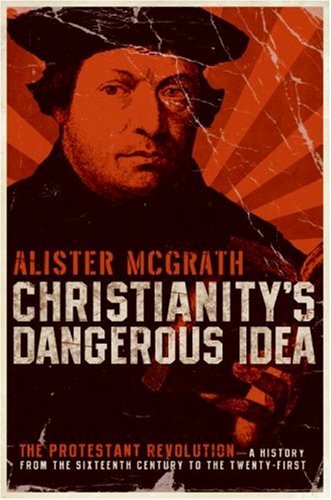
Alister McGrath, following academic trends in defining fundamentalism more broadly as “an oppositionalist mentality arising in response to a major threat,” distinguishes fundamentalism as a certain attitude not shared by evangelicals (392). The advantage of this genericizing of the term is that it makes for a definite distinction between evangelicals and fundamentalists. Nevertheless, this approach is also historically problematic. For example, historians like Trollinger believe this taxonomy reduces the difference between a fundamentalist and an evangelical as a mere personality difference. If it lies in a “certain mentality,” it may turn out to be a difference in the psychological makeup of the individual, which makes the judgment about whether one is a fundamentalist or evangelical very subjective. An evangelical is simply a fundamentalist with social awareness to modern sensitivities and a sophisticated smile. A hell-fire and brimstone pastor with a tendency towards biting rhetoric and polemical tirades may be only a personality away from another pastor with the same theology who has a certain charismatic optimism and a lighter tone to his preaching and teaching. Trollinger’s point is well taken.
Conclusions and Suggestions
So then, are we to despair of delineating the precise distinction between a fundamentalist and an evangelical? I would suggest that perhaps one frutiful key is in realizing that a different “posture” towards culture may entail certain beliefs also, not just a personality difference. For example, the posture of evangelicals toward the critical tools of modernity demonstrate that they believe these tools are legitimate tools of critical inquiry, and this compels them to “engage” those who are using the tools to undermine aspects of their faith. Here we have an agreement between the fundamentalists and the evangelicals about a problem—certain “fundamentals” are under attack by modernity—but different beliefs about the weapons of attack and how to respond. Fundamentalists isolate and disengage from these weapons, forfeiting the intellectual battle, whereas evangelicals, being less afraid of these tools, have come to believe that these modern weapons of ideological warfare can be enlisted and used in defense of the “fundamentals.” This goes beyond a personality difference to a substantial difference in beliefs about modern tools of critical inquiry. Thus in the evangelical tradition there exists a tradition of critical inquiry that started within the bounds of the “fundamentals.” This “posture” is both ideological and includes a tradition involving the practice critical inquiry and use of modern methodology. This makes evangelicals more “dangerous” and influential, for they are often able to best the skeptics at their own game and appeal to modern minds.
There is, however, a consequence to this posture. In a tradition that has adapted many forms of modern scholarship also has a tendency toward higher levels of tolerance for whatever differences exist between those who are on the same “team” and fighting the same battle using the chosen tools of modernity. It is more difficult, for example, to find evangelicals who believe all denominations except their own are going to hell (would such evangelicals really be evangelicals?). They have too keen an awareness of the astronomical difference that exists between believers in Jesus’ miracles and resurrection and modernists who have de facto ruled out anything supernatural under the philosophical assumption that such phenomenon are opposed to historical and scientific fact. Although no less confident perhaps in their own denominational convictions, they are often therefore less dogmatic about them, seeing more clearly than fundamentalists who the “real” enemy is.
Perhaps what is even more important, as evangelicals encourage the best and the brightest of their own intellectuals in the use of the critical tools of inquiry and to engage secular aids and writings, it often turns out that once committed evangelicals, after being immersed in modern methods, defect from their evangelical heritage and either significantly modify their heritage (thus challenging the boundaries of evangelical identity) or join modernity altogether. Having come from a tradition of outspoken zealots, evangelicals who defect and modify frequently become the most vocal critics of whatever part of their heritage they now reject. This means the boarders of evangelical identity are always being challenged as a result of their new posture towards modernity. Many evangelicals are prolifically critical of biblical creationism and defend more nuanced approaches to the interpretation of the creation narratives in Genesis, holding that evolution is not incompatible with these biblical narratives. Other evangelicals are also critical of traditional gender teachings in Christianity and champion an egalitarian theology. Perhaps this diversity of evangelicalism is part of what distinguishes it from fundamentalism’s more rigid anti-modern ideology. Evangelicalism has allowed for the use of critical tools in shaping evangelical faith and biblical interpretation. Those who go further than a modification of evangelical faith and defect to join forces with modernity likewise can become the most vocal critics against Christianity in general and evangelicalism in particular (e.g. Bart D. Ehrman).
If fundamentalism is defined by its “stance” toward modernity and the tools of modern inquiry, then evangelicalism’s new stance toward such tools seems to constitute something new and not merely a second “wave” of the same sort of people. It must also be said that evangelicals are not always primarily in a posture of attack against modernity, although they habitually use the very tools of higher criticism to undermine many any trends of such criticism unfavorable to their brand of orthodoxy. These critical tools are constantly shaping the variety of approaches evangelicals take to biblical truth, the art of hermeneutics, tones of disagreement, styles of argumentation, methods of apologetics, the production of literature, ideas of what makes a good “faculty” at a seminary, etc.
Critical forms of inquiry so characteristic of modernity have been, in other words, validated by evangelicals, even while being selective in choosing among varied conclusions drawn by the use of these methods. When choosing among positions to take with the use of these methods, evangelicals will characteristically choose and argue for the positions that favor their own ideology. For example, they will not allow for the conclusion that the Bible contradicts history, science, or itself. Among positions drawn by critical methods, these are off the table for most committed evangelicals in America whose identity is bound up with inerrancy.
:: Knowing and Flexing Your Legal Rights ::
We all know our legal rights … or … wait. Do we? Actually, the unfortunate fact is that most of us don’t know our rights. The woman on COPS who screams “I know my rights!” when a cop pulls her over usually proves my point because she is being put on national television for doing something stupid (and illegal). People who know their rights are more confident. They don’t have to say it, they show it by saying things like “I don’t consent to searches” or “Are you detaining me now or am I free to go?.”
Flexing your rights, however, can quickly annoy police officers who are already an edgy group because of the dangers and stresses of their line of work. These videos (especially the third one) show that police will often lie to intimidate you to get you to comply with their orders even when you have the right to refuse them. The first two videos are from FlexYourRights.org (a marketing idea to educate people on their rights). The second pair of videos are real life examples of citizens successfully flexing their rights. For more educational videos on how to both know and flex your rights, go to Flex Your Rights.org
Flex Your Rights :: The Right to Refuse Searches
Flex Your Rights :: Police Tactic of Compound Questions
Citizen Standing up Calmly For His Rights
Citizens Making a Statement About Their Rights
__–___–_B l o g s h o t__–____-10.27.11
John H. Armstrong, a personal friend and author of the book Your Church is Too Small has added his personal reflections to my recent post on Russell Moore’s charge against Pat Robertson (that Robertson’s view of divorce entails a denial of the Christian gospel). His post is entitled: How Evangelicals Misuse the “G” Word. Peter Lumpkins charitably chronicles the difference in perspectives on his blog SBC Tomorrow.
I stumbled upon some great Mark Knoll lectures on how the American civil war was (in large measure) a fight about how to interpret the Bible, and another lecture on the changing face of Christianity in the Global South. Fascinating (courtesy of Calvin College). If you don’t know who Mark Knoll is, here is the scoop: Mark Knoll is one of the most respected historians of Christianity in the United States. He now teaches at Notre Dame.
I enjoyed reading Al Mohler’s article Are Evangelicals Dangerous? on the CNN blog, one of the best pieces I’ve read from Mohler.
A surprising move by James MacDonald to create something called The Elephant Room, where conservative Reformed evangelicals actually decide to have a conversation with (rather than just criticize from a distance) people they disagree with, hoping to come to a better understanding of one another by talking about “the elephant in the room.” This is an interesting development that I was very pleased about. I began to wonder, however, whether these conversations are designed more to bring attention to a Reformed evangelical perspective on things in a way that could be seen as “outreach” to non-Reformed evangelicals (seen to be out-of-touch with sound doctrine in some way) by Reformed evangelicals. Controversy is brewing about the show already over James’s invitation to T.D. Jakes to be take the hot seat (note: T.D. Jakes does not adhere to a traditional doctrine of the Trinity, but something closer to one of the views labeled as heresy from the early stages of Christian theological development during the early ecumenical councils).
The Elephant Room: Round 2 from Harvest Bible Chapel on Vimeo.
 T h e o • p h i l o g u e