
Home » Articles posted by T h e o • p h i l o g u e (Page 26)
Author Archives: T h e o • p h i l o g u e
s i m p l e • g o s p e l ::: Eric L. Johnson’s Gospel
In the spirit of Trevin Wax’s helpful “gospel definition” posts, I offer Eric L. Johnson’s articulation of the simple gospel message from his impressive magnum opus Foundations for Soul Care:
The good news of the gospel is an articulation of the free gift of divine salvation and soul-healing, accomplished through Christ’s life, death and resurrection and offered to all who consent to it from the heart.
A few things are interesting about this definition. 1) it defines the gospel as “an articulation of” certain truths, 2) it includes what we would normally call sanctification in protestant lingo (“soul healing”), 3) rather than saying, “offered to all those who believe,” he spells out faith as “consent of the heart.” Very interesting.
Eric L. Johnson, Foundations for Soul Care: A Christian Psychology Proposal (Downers Grove, Illinois: IVP Academic, 2007), 33.
—————————–HT: Kingdom People——————————-
::: b l o g • s h o t ::: #3
Gerald Hiestand, pastor at Harvest Bible Chapel and President of the Society for the Advancement of Ecclesial Theology, calls men to the pastor-scholar paradigm.
Celucien L. Joseph appreciates Gregery Boyd’s thoughts on how racial reconciliation is an important aspect of the biblical gospel. In another post, he talks about race consciousness. Once anglo’s are no longer the dominant race in the U.S., perhaps they will give more attention to this topic. For now it seems like only a handful of anglo people even have this issue on their radar.
Owen Strachan is accused of “Legalism,” because of his post “The Twitter Debate,” on how he doesn’t think Twitter is a good use of his time. He defends himself here.
Treven Wax posts Martin Luther’s definition of the gospel, which shows that Luther didn’t always think of the core of the gospel message as including the doctrine of justification.
John Armstrong exposes us to the concept of “coerced consensus.”
Sex Sells ::: iMonk’s Rant Against Ed Young
What were Ed Young’s motives in the Seven Day Sex Challenge? Well … if we go by what Ed Young actually said himself, mostly just because he thinks it’s a biblical idea. But iMonk thinks he knows Ed’s true motives.
iMonk thinks he’s just a prideful typical megachurch pastor who’s intentionally using sex tactics to sell the gospel and promote male chauvinism. Read his rantpost Dear Ed Young. Based on his answers to the questions I asked him in the thread, he apparently thinks it’s a safe assumption that Ed’s biblical message is a subterfuge for church growth.
***Is that a fair and charitable assumption? ***
———————————HT: internetmonk——————————-
ETS Amendment • Embarrassing Loss or Strategic Success?
Although the ETS Amendment proposal was shot down by an embarrassing 130 to 47 vote (which means only 177 people of the 4000+ even showed up to vote), Denny Burk still claims it was a success. It appears that he thinks it is a success basically because although his particular amendment was rejected, he believes the issue will be taken more seriously by the Society now. Read his thoughts here.
A Presbyterian Arminian? ::: Book Review
As I mentioned in a previous post, I have some concerns about one of the required readings for my course in Evangelism at Southern Seminary, A Pastor’s Sketches by Ichabod Spencer. He was a Presbyterian minister in Brooklyn New York who journalized some of his evangelism encounters. My last post on this topic attempted to demonstrate that he confused Calvinism with the gospel.
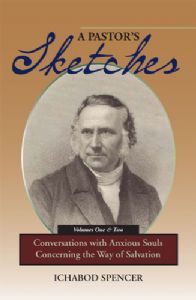
Oddly enough, although Ichabod is a Presbyterian minister and confuses the gospel with Calvinism, there is an Arminian principle from which Spencer seems to operate. It seems clear to me that he is either a Calvinist or at least very Calvinistic (he is after all a Presbyterian minister, see “Introduction to Spencer and his Sketches”). Yet, he seems from time to time to speak as though he believed in the sort of grace that lingers in the heart of an unbeliever just long enough to give them the chance to either accept that grace or resist it (137). This belief is confirmed throughout the book, especially when he bases the obligation of the unconverted to repent and believe, not only on the grounds of the divine command, but also in their supposed ability to obey the divine command because of the aid he indiscriminately assumes is given to them:
The Holy Spirit is their offered aid; and surely that aid is enough. They should know and feel it to their heart’s core, that they are now, on the spot, to-day, under the most solemn obligations to repent, not only because sin is wrong, but because God offers them the aids of the Holy Spirit: ‘In me is thy help.’ Their impenitence not only tramples under foot the blood of the covenant, but also does despite to the Spirit of grace (142).
When people are aware of a need for effectual saving grace, and they honestly evaluate themselves as yet unable to come to Christ, Spencer sees fit to remove any such impression from them as quickly as he can (161). Spencer seems to be convinced that unbelievers are all indeed able to come to Christ. As he said to the man who claimed he could not repent: “You say you cannot repent. He has not said so. He commands you to repent” (161). Spencer seems to be Arminian at this point, assuming that if the Lord commands it, we must be able. He argues that ability is the ground of duty. Or to say it another way—since it is the gracious work of the Holy Spirit that he assumes makes everyone able—he believes that grace is the ground of duty. He seems to operate on this principle more than once, but his belief in this is most clearly seen in his dealings with the man who claimed that he could not repent:
You reject his offered help—the help of the omnipotent Spirit. And for this reason you will be the more criminal if you do not repent. . . You can repent, just in the way that others repent—just because God is your help (164, emphasis mine).
Perhaps it is most abundantly clear in the following reflection:
Sinners certainly ought to repent, for God commands them to repent. But in my opinion, he does not design to have them understand his command as having respect only to their own ability to repent, and not having respect to the proffered aids of the Holy Spirit. Such aids constitute one grand ground on which his command is obligatory, and sweep away ever possible excuse (165, emphasis mine).
What I am calling Spencer’s Arminian principle conflicts with my understanding of grace. The scriptures do not teach that everyone has the ability to come to Christ, but only those who are effectually drawn by the power of the Father (John 6:44, 64-65). We should not assume in our evangelism (as Spencer does), that the Holy Spirit works on all in such a way that morally enables them to accept or reject the gospel. Unbelievers are responsible to repent and believe simply because God commands it, not necessarily because they are morally able. If moral ability is a prerequisite to duty, all those who are not under the regenerating power of the Holy Spirit would be exempt from their duty (hence the teaching of hyper-calvinism). However, Spencer never wants to let the unbeliever think that she is unable to come to Christ. This is the whole point of his chapter labeled “I Can’t Repent,” where he expends no little amount of time and energy to convince a man that he is indeed able to repent (161).
Another example of this principle at work can be seen when the man who struggled with the doctrine of election responded to his admonition for him to pray. He said, “But the prayers of the wicked are an abomination to the Lord” (233). Spencer rejects this claim as though it were not in the Bible:
‘That,’ said I, ‘is your own declaration. God has not said so. Such a declaration is not to be found in the Bible, though people often suppose it is, and though there may be some expressions which appear to resemble it (233).
Yet this man quoted a biblical passage almost word for word: “He that turneth away his ear from hearing the law, even his prayer shall be an abomination.” (Proverbs 28:9). This is not the only time Spencer seems to be embarrassingly ignorant of pertinent biblical texts.
ETS Amendment “Unanimously” REJECTED ::: And I’m Glad
Late news to most bloggers, but in case you missed it, the ETS Amendment proposal I blogged about before ETS meetings was “unanimously” rejected. I’m glad for several reasons. But the main one is this: I believe the term “evangelical” should be applied to all those who believe in the true evangel (i.e. the gospel). And I don’t believe that all the doctrinal convictions distinctive of the evangelical movement are essential to that gospel. Thus, I would love to see a broader evangelicalism that would allow for all true gospel-lovers to be considered of like mind and spirit with the evangelical movement (even if they don’t share all the other non-gospel convictions that have been identified with the evangelical movement). It’s good to be historically aware of the distinctives of a movement, but it’s OK to get beyond them too, and not allow ourselves to be defined by the past.
——————————-HT: Christianity Today——————————–
Mark Driscoll Confesses and Repents
Danny Slavich tells us about it right here.
::::::::::::::::::::::::HT: almanac of captivity:::::::::::::::::::::::::::::
::: Calvinism is not the Gospel ::: Book Review
If you go to Southern Seminary (like I do), you are required to take a class in evangelism, and it’s usually one of the larger classes since it’s mandatory for almost any tract. If you take Dr. Beougher, he requires you to read a book called A Pastors Sketches. It’s an old book written by a Presbyterian minister named Spencer who was known as the “Bunyan of Brooklyn.” It’s basically his journalism about evangelistic encounters he has with people around Brooklyn and beyond. The first “sketch” of an encounter was actually quite fascinating and helpful. But as the book drags on, it becomes onerous to the critical reader in a variety of ways. I will be exploring several dangers of this book that may be influencing and effecting seminary students at Southern in the next few posts.

Spencer, Ichabod. A Pastor’s Sketches. Vestavia Hills, AL: Solid Ground Christian Books, 2001. Reprint 2002. 285. $12.95.
Danger 1: Calvinism is Not the Gospel
Spencer believes that part of saving faith and understanding is to understand “the entire depravity of the heart” (127, emphasis mine). Reading between the lines that he is a Calvinist, believing the doctrines of grace, I assume he means by this that a person cannot be saved without an understanding of the doctrine of total depravity: “If he does not see that [the entire depravity of the heart], it is probable that he does not see his heart. And hence his repentance, his faith in Christ, and his reliance upon the Holy Spirit, will probably, all of them, be only deceptions” (127, emphasis mine). This perspective would explain why he is so intent on giving long indictment speeches to unbelievers (see “Election,” 230-255).
He seems to further imply that one must not only believe the doctrine of total depravity for there to be certainty of his true conversion, but also the other four doctrines of grace: “My observation continues to confirm me more and more in the opinion that to experience religion is to experience the truth of the great doctrines of divine grace” (127, emphasis mine). Because the following statement is made in the same context, it gives the impression that he considers these doctrines of grace, not as optional doctrinal positions, but as essential to Christianity: “And. . .I believed, and had always acted on the principle, that true experimental religion will always lead its subjects to a knowledge of the great essential doctrines of the Christian system—indeed, that to experience religion is just to experience these doctrines” (126). This principle is also evident when upon testing some young men who had supposedly been saved through a “camp meeting,” he questioned the validity of their experience because they did not have all the right answers to his questions (129).
I can’t help but think Spencer’s approach in this respect is legalistic and dangerous. Calvinism is not the gospel. While I myself believe that the doctrines of Calvinism are biblical, I do not believe any one of them is necessary to believe as a prerequisite to true conversion. If this were true, only Calvinists would be saved. (I’ve blogged about this before) Also, Spencer’s glib outlook on so called “revival” seems to result from this false notion. He says, “A true history of spurious revivals would be one of the most melancholy books ever written” (130). He appears at one point to attempt making a distinction between a person having a technical understanding of such doctrines (which he names as human sinfulness, divine sovereignty, atonement, justification by faith, regeneration by the power of the Holy Spirit, and the constant need of divine aid) and a persons being “substantially right” in their minds “on such doctrines” (130). However, it is not clear what the practical difference would be to him, especially since he was not satisfied with the answers given to him by the two young men in the chapter entitled “Excitement” (128-130). Also, Spencer almost seems jealous when members of his attend “revival” meetings or go to another church to be taught. In the section of his book entitled “Proselytying,” he immediately assumes that someone is “soliciting” them away from his preaching (182). He judges the situation too quickly, assuming that if these revival attenders are not immediately converted to Christ once they have changed churches that it is “manifest” that whoever they have gone to hear is simply “tickling their vanity and pride” with their attention (183). He seems pessimistic of all other churches but his own.
::: Doug Wilson Speaks About the Collision Documentary :::
Doug Wilson comments on the recent debates between him and Hitchens and about the Collision documentary, which he is very pleased about. He said that the production is done well and the editing seem to be creative but fair. Here is an excerpt.
I am really excited about this film, for a number of reasons, …
… Darren Doane has many, many active hours and angles to choose from, which means that it will not be a fixed camera or two and some talking heads. And it is plain from what I have seen thus far that the whole thing is being handled with real biblical integrity. Both Christopher and I are being given our clean shots, and nobody is going to be edited into a victory or defeat.
… some of the blog chatter has revealed a new category of individual to me. Everyone who has ever debated anything at all knows that debates are not like football games where the score is more or less objective. People come expecting their guy to win, and usually depart in the serene conviction that he has done so quite handily. That’s human nature, and the consequent nature of debates. But in all this there has been a handful of Christian folks who have been kinda sorta giving the palm to Christopher for various reasons best known to their mothers, and it gratifies me to know that this documentary will do absolutely nothing to fix any of that. A movie has got to know its limitations.
———————————–HT: Blog and Mablog———————————–
 T h e o • p h i l o g u e