
Home » 2010 (Page 4)
Yearly Archives: 2010
Book Review: The Beast of Revelation by Kenneth Gentry
The following is my Book Review of: Kenneth L. Gentry, The Beast of Revelation. Powder Springs, Georgia: American Vision, 2002.

Introduction
Although Kenneth Gentry has amassed considerable evidence from historical sources in his attempt to argue for the preterist position, he rightly complains that church tradition has played too large of a role in the dating of the book of Revelation while the internal evidence often is not given its proper weight (4-5). Although Gentry must assume an early date of Revelation for his position to carry any weight, he nevertheless organizes his book so that the internal evidence is given prominent importance.
The first half of his book is spent showing just how impressively the Roman Emperor Nero appears to satisfy all the prophecies of the Book of Revelation. The second half of the book, however, is given to strengthening Gentry’s position by exploring the different types of evidences for an early date of Revelation—including external evidence. While giving internal evidence the loudest voice for the dating of Revelation, Gentry by no means marginalizes external evidence. On the contrary, he gives a thorough look at the evidence used for a late date and engages late-date arguments with remarkable aptitude.
In this review I will attempt to mostly summarize Gentry’s reasoning, with words of appraisal more or less sprinkled throughout. Because the material on the evidence for a late date is more complex and difficult to summarize, my comments about the second half of the book will be selective. It is no wonder that the evidence and argumentation Gentry marshals for an early date and Neronic theory of the Beast has been compelling enough to cause those who still hold for future fulfillment of the prophecies of revelation to capitulate by granting an first century fulfillment of the majority of the events of Revelation—“though they attempted to argue for a double fulfillment of prophecies” (96).
The Neronic Theory: The Beast of Revelation
Gentry begins by listing all the biblical details about the beast in the book of Revelation (8-10). The beast
1) has a number—666—which is “that of a man” (Rev 13:18)
2) is an evil man of debased character (Rev 13, 17, 18)
a) depicted as a compound of three wild carnivores (Rev 13:2)
b) wages war against the saints (Rev 13:7)
c) demands worship for himself (13:8, 12, 15)
d) arrogantly blasphemes God (13:5-6)
e) carries with him a despicable harlot (Rev 17:3-4) that is drunk on the blood of the saints (Rev 17:6; 18:24)
3) possesses “great authority” (Rev 13:2, 7)
4) is one of John’s contemporaries (Rev 1:1, 3; 22:6, 10)
5) is relevant to first century Christians (Rev 1:3-4, 11, 13:8)
Based on this criterion for identification of the beast, Gentry disagrees with Leon Morris that possibilities for identifying the beast are endless (10). He calls the shift in imagery from identifying the beast as a kingdom in some places (Rev 13:1 cf. 17:10-11) and an individual in other places (Rev 13:8; 17:11) a shift between the “generic and the specific” and admits it is a frustrating aspect of the description of the beast: is it a kingdom or a man? (10).
Rather than picking between the two, Gentry identifies the beast “generically considered” as the Roman Empire, and the beast individually considered as a first century Roman Emperor: Nero Claudius Caesar (13). The seven heads, which the book of Revelation interprets as the “seven mountains” (Rev 17:9) undoubtedly refers to the Rome, “the one city in history distinguished by and recognized for its seven mountains” (12). What is more, “both secular and ecclesiastical history record that the first imperial persecution of Christianity began in this seven-hilled city under the emperor Nero Caesar in A.D. 64.” (12).
A brief historical survey of Nero’s life—without explicitly pressing any analogy to the beast of Revelation—leaves the reader half-way convinced before the book really gets into the details of argumentation (11-19). If nothing else, the reader is convinced that Nero fits the description of an evil man of debased character.
He castrated the boy Sporus, tried to make a woman out of him, then he “married” him with the usual wedding ceremonies of the day (16); he covered himself in wild animal skins and attacked the private parts of men and women bound to stakes as a game; he murder his own mother (who was the one responsible for bringing him to power!) and ordered Seneca to commit suicide (which he did!); he divorced his wife to marry his mistress Poppaea; he banished Octavia to an island upon Poppaea’s orders and had him beheaded, then later kicked Poppaea to death while she was pregnant and ill; he exhausted the imperial treasures for “self-glorifying building projects and profligate living,” and falsely accused Roman nobles of various crimes in order to confiscate their estates; he is said by Suetonius to have “showed neither discrimination nor moderation in putting to death whomsoever he pleased on any pretext whatever”; he accused Christians of starting the fire that burnt Rome and persecuted them mercilessly; he neglected his rule of Rome for a two year visit to Greece to appear in their musical festival—because he vainly fancied himself as one of the world’s greatest musicians (16-17)!
His wickedness was so great, his own subjects and military leaders rebelled against him, and when he heard they were going to put him to a cruel and shameful death, he rammed a sword through his own neck with the assistance of his secretary Epaphroditus (18).
In his chapter, “The Relevance of the Beast,” Gentry drives home the “strategic placement of the time references” (John carefully brackets Revelation with bold time references) and the “frequent repetition” of these time references (24). In at least eleven verses John warns his audience of the nearness of the events prophesied in the book (Rev 1:1, 3; 2:16; 3:10-11; 6:17; 10:6; 22:6, 7, 10, 12, 20). John’s varied expression of the temporal references makes it difficult to doubt his meaning (24-25). These temporal references parallel the temporal references in the other New Testament books (Mt 23:36; 24:34; 26:64; Mk 9:1; Acts 2:16-20, 40; Rom 13:11, 12; 16:20; 1 Cor 7:26, 29-31; Col 3:6; 1 Thess 2:16; Heb 10:25, 37; Jm 5:8, 9; 1 Pt 4:5, 7). A helpful comparison with Daniel shows that while Daniel seals his prophetic work because its events were far off in the distant future, John, on the other hand, was commanded not to seal his work on account of the nearness of the time (Dan 12:4; Rev 22:10).
Interpretations that understand John’s warning that “the time is near” (Rev 1:3) to be telling his persecuted audience that “when help comes it will come with swiftness—even though it may not come until two or three thousand years later” (e.g. Walvoord and Ice) or “the events are always imminent—though the readers and their great, great grandchildren may never experience them” (e.g. Mounce and Johnson) or “God will send help soon—according to the way the Eternal God measures time” (e.g. Swete and Morris) would be tantamount to a cruel mocking of the circumstances of the churches to which John wrote (27-28). Gentry believes that these approaches are “destroyed by the very fact that John repeats and varies his terms” for temporal proximity (27). He also reminds his readers that Revelation functions as an “occasional epistle” to first century Christians (28).
In light of the temporal references in Revelation (not to mention the obvious references to first century entities), why would anyone have trouble understanding the prophecies of Revelation to be fulfilled in the first century A.D.? The most obvious answer is this: the temporal references also apparently apply to the second coming of Jesus Christ, which does not appear to have occurred: “Behold, He is coming with the clouds and every eye will see Him, even those who pierced Him” (Rev 1:7); “I am coming quickly” (Rev 3:11).
This leads less conservative handlers of the biblical revelation to conclude that John’s expectancy—like that of the early church in general—was simply mistaken, much like religious enthusiasts throughout Church history that expected Christ to return in a certain year during their lifetime (26). This seems to force those who believe in the doctrine of inspiration to find some other way to interpret the temporal references like Walvoord, Ice, Mounce, Johnson, Swete, Morris, and many others have done. However, Gentry offers a much easier and viable alternative: rather than mustering up strained interpretations of the temporal references, Gentry’s approach is to understand the language about Christ’s “coming” on the clouds from the vantage point of apocalyptic symbolism (28-29).
This cloud-coming of Christ in judgment reminds us of Old Testament cloud-comings of God in judgment upon ancient historical people and nations (Pss. 18:7-15; 104:3; Isa. 19:1; Joel 2:1, 2; Hab. 1:2ff.; Zeph. 1:14, 15). For example, Isaiah 19:1 speaks of an historical, Old Testament judgment upon Egypt: “The oracle concerning Egypt. Behold, the Lord is riding on a swift cloud, and is about to come to Egypt; the idols of Egypt will tremble at His presence, and the heart of the Egyptians will melt within them” (29).
Just as this cloud-coming imagery is employed when God used the armies of the ancient empires to bring his judicial judgment upon whatever people he desired in the Old Testament, including Israel, so John, operating within the Jewish tradition, employs similar language to prophesy judicial judgment upon “those who pierced him” (Rev 1:7). Who are those who pierced him? “The New Testament emphatically points to first century Israel as responsible for crucifying Christ (John 19:6, 15; Acts 2:22-23, 36; 3:13-15; 5:30; 7:52; 1 Thess 2:14-15)” (29). What is more, Jesus also warned the Jewish leaders that they would witness this coming judgment (Mt 26:64 cf. 23:31-36; 24:30, 34). Not only did the Jewish War with Rome bring about the slaughter of 1.1 million Jews according to Josephus, but historians record “the utter devastation of Jerusalem, the final destruction of the temple and the conclusive cessation of the sacrificial system … [which was] a unifying national symbol” (30).
God’s using Rome to execute his punishment on the Jews reminds us of the devastation God brought upon Israel by means of the ancient Assyrians and Babylonians, but “the covenantal significance of the temple’s demise stands as the most dramatic outcome of the war” (31). It brought an end to Torah-keeping Judaism because without the temple keeping the details of Torah is impossible (31). “The loss of the temple was an unrepeatable loss, for it has never been rebuilt … any Jewish calamity after A.D. 70 would pale in comparison to the redemptive-historical significance of the loss of the temple” (31). Because the prophecies of the Beast are entwined with the prophecies of soon-to-come judgment of the Jewish nation—which was fulfilled in 70 A.D. when Rome sacked Jerusalem—the Beast must be a first century figure. “To assert that the Beast is any contemporary figure existing in our own time (or in our future) absolutely misses John’s entire point” (32).
As satisfying as Gentry’s hermeneutics are compared to those whose interpretations do not do the temporal references justice, his arguments for the number of the Beast are even more satisfying and fascinating. He does not regard the number 666 as an uncertain mysterious riddle, but a number that John expected his contemporaries to understand (Rev 13:18). The practice of cryptogram—using the double function of alphabets to assign a given name a numerical value—was a common phenomenon in Ancient cultures. “Archaeologists have discovered many illustrations of cryptograms as graffiti on ancient city walls” (38).
For example, the Greek inscription “I love her whose number is 545” was found in an excavation at Pompeii (38). Thereby, “the name of the lover is concealed; the beloved will know it when she recognizes her name in the sum of the numerical value of the 3 letters” (40). More relevant to our topic, “anti-Nero cryptograms were already circulating when John wrote Revelation” (40). Consulting the Babylonian Talmud and other ancient Rabbinic writings shows that the practice of cryptogram was also used by Jewish Rabbis. “The ancient Christian sibylline Oracles has Jesus’ name as equivalent to ‘888’ and makes use of number values to indicate initials of various Roman emperors, including Nero” (40).
John’s reducing the name of the Beast (“the number of a man”) to the numerical value of the letters of his name, then, was a common practice of his day—not our own. “Several scholars of the nineteenth century—Fritzsche, Holtzmann, Benary, Hitzig and Reuss—each stumbled independently upon the name Nero Caesar almost simultaneously” (42). The spelling of Nero’s name as it is found in Hebrew spellings in archeological finds turns out to yield exactly the number 666 (42). Giving even more confirmation is the fact that a significant number of manuscript variants have 616 rather than 666. Such a variant is not easily dismissed as a copyist error, but is widely believed to have been intentional. Gentry reasons:
When Revelation began circulating among those less acquainted with Hebrew, a well-meaning copyist who knew the meaning of 666 might have intended to make its deciphering easier by altering it to 616. It surely is no mere coincidence that 616 is the numerical value of “Nero Caesar,” when spelled in Hebrew by transliterating it from its more common Latin spelling. This conjecture satisfactorily explains the rationale for the divergence: so that the non-Hebrew might more readily discern the identity of the Beast. Even late-date advocate Donald Guthrie, who rejects the Nero theory, grants that this variant gives the designation Nero “a distinct advantage.” As renowned Greek scholar Bruce Metzger says: “Perhaps the change was intentional, seeing that the Greek form Neron Caesar written in Hebrew characters (nrwn qsr) is equivalent to 666, whereas the Latin form Nero Caesar (nrw qsr) is equivalent to 616.” Such a possibility offers a remarkable confirmation of the designation of Nero (43).
One of the major objections to this view of the mark of the Beast is the silence of the early church fathers (44). But Gentry points out that Irenaeus admits ignorance on the matter rather than proposing an alternative designation for the cryptogram (44-45). Arguments from silence are the weakest kind (45). After exploring several arguments against the Nero theory, Gentry concludes: “Only with great difficulty may we discount the many ways in which Nero fits the expectations of Revelation. [Nero] is the only first-century historical figure that can possibly fulfill all of the requirements.”
In chapters four through seven, Gentry shows how Nero, the Beast specifically considered, sufficiently and uniquely fulfills the depictions of the character, war, worship of the Beast, and how the Roman Empire of the first century, generically considered, fulfills the depiction of the death and revival of the Beast. Gentry shows how Nero more than qualifies to fulfill the expectation of the character depicted of the beast in the book of Revelation. Nero was of such a beastly nature, he was given the nickname “beast” by a pagan writer Apollonius (53). The Sibylline Oracles refer to Nero as “a destructive beast” and “the great beast” (53). Corresponding to Revelation’s imagery of the Beast as one who is given “power to make ware against the saints” (Rev 13:7) for forty-two months (Rev 13:5), Nero removed Christianity from the protected status of religio licita and began the first Roman imperial persecution of Christians, setting a legal precedent that undoubtedly influenced future persecutions of Christians by other Roman emperors (62-63).
What is more, a cacophony of historians witness that Nero’s assault on Christians was arguably the most severe, consisting of “public butcheries frequently recurring on a colossal scale” (65-66). As if this were not enough, the Neronic persecutions lasted from the latter part of Novermber in A.D. 64 to June A.D. 68—exactly the length of time (but for a few days) the writer of the apocalypse of Revelation prophecies! In contrast with this, the Domitianic “persecution” is scarcely even documented—not even mentioned by a single secular historian of the era (69). Corresponding to the imagery of the worship of the Beast (Rev 13:4), Nero received and demanded worship while still alive—a practice even bolder than the imperial cult of emperor worship that was a familiar feature of Rome’s imperial history which allowed for emperors to be worshiped only after they were dead (81-82). “Nero himself actually demanded such worship in a way unsurpassed by any previous emperor, except, perhaps, for Caligula” (84).
The manner of Nero’s death—suicide by sword—corresponds to the prophecy of Revelation 13:10 (89-90). The chaos that ensued after Nero’s death corresponds to the mortal sword wound inflicted on the head as a wound that should have been fatal to the Beast generically considered in Revelation 13:3-4 (91). With the death of Nero, “the Julio-Claudian line of emperors perished from the earth,” and the civil wars that followed were of such great ferocity and of such dramatic proportions that they almost destroyed the empire (92). However, what might have been the death blow of the Roman empire was rescued when the Flavian family firmly established a new royal line (95). This unexpected bounce back was enough to add to the Roman prestige. “The relevant verses in Revelation reflect the death and revivification of the Beast, that is, the earth-shaking historical events of the late 60s wherein Rome died (A.D. 68), as it were, and returned again to life (A.D. 69).
The seven heads of the Beast represent seven kings, and the Beast is herein considered generically as the Roman Empire with its line of emperors: “Five have fallen, one is, the other has not yet come; but when he does come, he must remain for a little while. The beast who once was, and now is not, is an eighth king. He belongs to the seven and is going to his destruction” (Rev 17:9-11). Because “the beast” imagery in this passage represents the Roman Empire—not an individual Emperor—the eighth king refers “to the revival of the Empire itself under one [Vespasian] who is outside of the originally specified seven kings. … In addition, the number eight appears to be the number of resurrection” in first century Jewish thought because “the eighth day is the beginning of a new week” (97).
The Dating of Revelation: Internal and External Evidence
In the second half of his book, Gentry focuses on the dating of Revelation. He underscores its importance for interpretation. The early date outlook views Revelation as having been written prior to the destruction of Jerusalem and the temple—Gentry opts for sometime between A.D. 64 (after the Neronic persecutions broke out) to early 67 A.D. (just prior to Rome’s attack against the Jews known as the Jewish Wars). “The position one takes on this issue has a great bearing on the interpretive possibilities available” (106). Gentry’s basic argument is that the early date allows for Revelation to contain the appropriate level of relevance to its immediate audience while the late date lends the prophecies of Revelation to “be opened to an endless series of speculative scenarios, which could be extrapolated into the indefinite future” and minimizing original audience relevance (110-111).
The broad consensus about the theme of Revelation strengthens Gentry’s argument because the theme is the soon “coming” of Christ, which was intended to comfort the first century churches undergoing persecution (116-117). Comforting the early church by prophesying a soon coming of Christ against “those who pierced him” makes little sense if such a “coming” lie millennia away and would in no way alter the situation of the early church. “Only a pre-A.D. 70 date fits the circumstances” (127). Furthermore, the “tribes of the earth” who “morn” at this coming refer to the Jewish tribes because the Greek word translated “earth” is better translated “land,” in which case the theme verse of Revelation would read:
Behold, he is coming with the clouds, and every eye will see Him, even those who pierced Him [i.e. the Jews: John 19:6, 15; Acts 2:22-23, 36; 3:13-15; 5:30; 7:52; 1 Thess 2:14-15] ; and all the tribes of the land will mourn over Him. –Revelation 1:7
When the word “the land” occurs with the definite article and without any modifiers in the Bible it signifies the Promise Land—namely, Israel (120-121). Couple this with Jesus’ seven woe’s and warnings that to the Jewish leaders, saying “upon you will come all the righteous blood that has been shed on earth … All this will come upon this generation. … Look, your house [i.e. the temple] is left to you desolate” (Mt 23:35-36, 38). The Christians, then, who had experienced persecution from the Jews and imperial Rome, would be comforted by the prophecies of Revelation that assured them of the coming destruction of both the Jews (Rev 1:7) and the Beast [Nero] (13:10; 17:11) “must soon take place” (Rev 1:1). In light of this, any understanding of these prophecies that anticipate their fulfillment over two millenniums beyond the persecuted Christians to whom John wrote to comfort is hard to understand.
The theme of Revelation, then, and the very reasons for being written, are internal evidence in favor of a pre-A.D. 70 date. In the book of Revelation, the “sixth king” is the one who “now is” (i.e. is presently reigning). If Gentry’s interpretation is correct, then, this would have to refer to Nero. It just so happens, that Nero was the sixth ruler of the Roman Empire (139). But there is yet more. “Historically the next ruler of the Empire reigned only briefly. … The next ruler to appear after Nero was Galba, who reigned only seven months. … By almost any standard, Galba’s brief rule of seven months was a ‘little while’—Nero’s immediately preceding rule had exceeded thirteen years” (139). Although some object that Nero was actually the fifth ruler of the Roman Empire on the grounds that Julius Caesar was technically not an emperor and that John is talking about “kings” and not emperors, the audience of John’s day—including Roman and Jewish historians—unanimously understood Julius Caesar to be the first of the line of Emperors, and the ancient writers had the tendency to call the emperors “kings” (141-42).
The most compelling evidence against the early date is a statement by the early church father Irenaeus:
We will not, however, incur the risk of pronouncing positively as to the name of Antichrist; for if it were necessary that his name should be distinctly revealed in this present time, it would have been announced by him who beheld the apocalyptic vision. For that was seen no very long time since, but almost in our day, towards the end of Domitian’s reign.
“The late-date advocate argues that this serves as compelling evidence that John ‘saw’ the Revelation ‘at the end of the reign of Domitian’” who ruled after, not before A.D. 70 (205). However, several problems with this argument are apparent upon closer examination. Among such problems, and arguably the most serious challenge for late date advocates is this: the understanding of the words “that was seen” is disputed because it could be translated “it was seen” also, in which case it would refer to John himself, not the apocalyptic revelation which John saw (206). “Either one will work grammatically,” but this puts Irenaeus’ statement as evidence for a late date in serious doubt, for it must assume a disputable translation (206).
Conclusion
The sheer amount of specific ways Nero seems to fit the prophetic imagery of Revelation—his character, his being the sixth emperor of Rome, his death by sword, his number, his being relevant to the situation of the original audience, his ability to fit the time limitations of the prophecies, his extreme vanity and demand to be worshipped, his establishing the first and most severe official imperial persecution of Christians, his coming from the city of “seven hills,” his reigning just before the civil wars of Rome that threatened the empire’s power, his affiliation with the power entity that destroyed Jerusalem and the temple that ceased Torah based Judaism—is historically verifiable evidence that hits the reader like a “river that no man can cross” (18).
Never in my life have I read or heard more persuasive argumentation for the interpretation of the Book of Revelation than in Gentry’s book. Although some of the pieces of Gentry’s position are less persuasive, his approach as a whole makes more sense of the internal and external evidence while providing satisfying confidence about the biblical prophetic imagery.
Book Review: The New Concise History of the Crusades by Thomas F. Madden
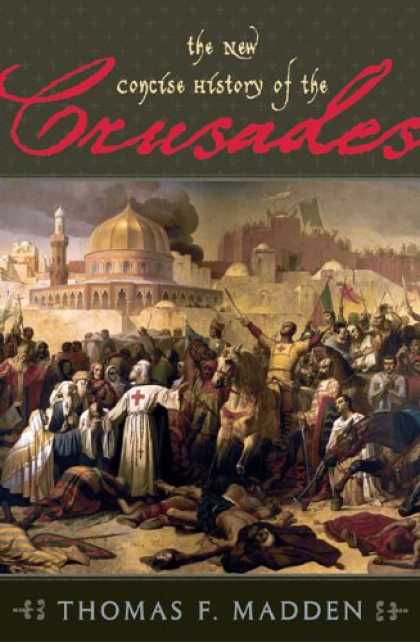
The following is a book review of the following book: Thomas F. Madden, The New Conscise History of the Crusades (Rowman & Littlefield Publishers, 2005), 280 pgs.
Madden’s Concerns and Emphases
Madden is driven by the concern that popular histories retell myths about the Crusades long dispelled by historians, an error which he hopes to correct with his own popular treatment that will be more reflective of the “fruits of half a century of modern scholarship” (x). He also desires to emphasize that the “numbered crusades” approach (which only analyses the crusades’ “peaks”) oversimplifies the complexity of the historical situation, fails to account for the broader phenomenon of crusading that transcends pilgrimages to the Holy Land (in which case “there is no reason its history should abruptly end in 1291”), and tends to give the curious impression that Europe simply “periodically exploded with crusading zeal” (xi). The author is concerned to show that the crusades were first and foremost a reaction to Islamic expansion—the Spanish reconquista was equal in sanctity to the eastern expeditions (xii).
One of the myths the author wants to dispel is the colonial/imperial theory based on a certain interpretation of demographic evidence. Europe’s population may have soared during the tenth century (and this might have created a need for more land), but to think of the crusades as Europe’s first colonial wars (in Madden’s informed opinion) fails to take into account Jonathan Riley-Smith’s studies that show “solid evidence” to the contrary (11-12). Madden thinks Sir Steven Runiciman’s three-volume work History of the Crusades (1951-54) “single-handedly crafted the current popular concept of the crusades” which he hopes to correct (216).
Only miniscule percentage of noble knights even accompanied the crusade. The vast majority of these knights were not “spare sons” looking for lands to rule because they were already “lords” of their own estates back home (11-12). Furthermore, just to go on the crusades meant in many cases spending up to six years of annual income (i.e. to impoverish one’s family) and the pope made clear that “all lands captured were to belong to the ‘prince’ in command at the time” (12). The vast majority of crusaders “returned to Europe with neither riches nor land” (12). Therefore, it is unsound to suppose these crusaders were basically aristocrats (and their armies) inspired at the idea of acquiring land and wealth. They may not have been saints (and war crimes no doubt occurred), yet “most noblemen who joined the crusade did so from a simple and sincere love of God” (13).
Madden tells of Godfrey of Bouillon, for example, to show how the crusade leaders were motivated more by religious hopes than material hopes, for Godfrey’s efforts to join the crusade inverted his hard earned gains to losses, yet he went anyway and “clearly planned to come home after the crusade” (20). On the other hand, he depicts the Byzantine Emperor Alexius as a manipulative and “cunning” ruler (22). Richard the Lionheart is perhaps another example, for while he sacrificed his time and talent to the enterprise on the Levant, his lands back home were being taken by Philip the August (94). Richard had no plans to stay in Jerusalem for personal gains.
Locating Madden in Historiographies on Crusades
In the big picture, Madden sees his own historical approach to the crusades as “a middle course between the traditional and revisionist constructions” (xiii). By this, he basically means that: 1) like the traditional constructions he spends the majority of his time focusing on the foreign expeditions (although he believes the phenomena of crusading transcends these “numbered” crusades) yet 2) as a revisionist he extends his treatment beyond the fall of Acre in 1291 “until the point that (it seems to [him]) that Europeans themselves lost interest in” crusading (xiii). Rather than going by the traditional periodization of through the ninth crusade, he typically divides the crusades according to imperial investment (e.g. the crudes of Fredrick II, 143; the crusades of St. Louis, 167) or century (e.g. the crusades of the fourteenth century, 192; crusading the fifteenth century, 201).
Madden’s Discernable Assumptions
He thinks post-Enlightenment ideology wrongly tends to lead to the conviction that religious beliefs are largely irrelevant (1), which tips off the reader that the author himself must believe that religious beliefs are in fact relevant. When Madden claims that the nature of war is basically constant, with only peripheral details fluxing (such as technology, tactics, etc.), this unfortunately gives the reader the impression that distinctions between just war and unjust war are superficial, since the nature of just and unjust wars alike are, to the author, only different in their use of weapons and tactics (1).
In other words, the author’s comments on page one seem to suggest that he disdain’s war—regardless of context. Given this impression, when the author notes that Christianity was a peaceful religion from its inception and Islam was a war-making religion from its inception (1-3), the reader is left to guess that Madden probably favors Christianity over Islam—or at least that it has more potential. His notice that it is human nature to fight for what is most dear to them (whether secular or religious) does not relieve this tension (223), for given his earlier statements, the implication is still this: whether just or unjust, religious or secular, war is all basically the same.
By commenting on the violence of the anti-Jewish crusade leaders, the author uses only one word to describe their nature—“infamous” (18). Not surprisingly, by describing the events this way and failing to defend the “justness” of these raids, he implicitly concedes of their embarrassingly shameful character.
When Madden tells the reader that the medieval widespread belief of “right made might” (a crafty turn of phrase inverting ethical relativism’s maxim “might makes right”) would receive a blow during the crusading movement, he appears to hint at the naïveté of the maxim and its inability to explain reality (15). This is further reinforced when the author, in spite of victory against all odds, summarizes the entire first crusade as a “naïve enterprise” (34). The reader gets the impression that the crusaders won their victory against all odds not because God was with them, but out of sheer luck.
Complementing this, the author is not satisfied to let the “visions” seen by crusaders in desperate times be explained apart from anthropological considerations: “It is not surprising,” he says, “that in such desperate straits, the visions that were always a part of the crusade increased in frequency” (29). This short comment may reveal that the author is skeptical about the claim that these visions really came from divine revelation since they are sufficiently explained in light of human desperation. The author also appears skeptical about the interpretation of astronomical signs that gave hope to the crusaders (33).
Conclusion
Most of the detail in Madden’s book was new to me. The summaries of the crusades in previous overviews of church history were only enough to give me a general impression of what the crusades were like. Madden’s general retelling of the history did not contradict this initial impression but rather further confirmed it.
In spite of Madden’s warnings against seeing the crusades as a colonial/imperial enterprise, I could not help but notice how many times (from the beginning to the end) internal factions over who ruled what, booty distribution, and other purely secular concerns often took precedence over the initial/formal/religious reasons for the enterprise of the crusades.
For example, Behemond of Taranto appears to fit something like the colonial theory. He was a son of the Normal leader Robert Guiscard and had lost his hopes for power, so was “ambitious for personal gain” (22). Immediately after taking Antioch, Bohemond and Raymond begin to squabble over who “deserved to have the city” (30). As Baldwin IV rots of his leprosy, Count Raymond III of Tripoli, Archbishop William of Tyre, Agnes of Courtenay and Reynald of Chatillon, as well as Joscelin III of Courtenay and Guy of Lusignan all composed factions vying for control (71). After Sibylla was crowned queen of Jerusalem and outmaneuvered the party to get Guy on the throne with her, Raymond, in his bitterness over his loss of power, made an alliance with Saladin (74).
These sorts of internal factions and betrayals over power are so commonplace in Madden’s recounting of the crusades and the history of the crusader states, one begins to see how easy it would be for the crusades to be fashioned by historians as something like a colonial enterprise. While there is no doubt that Christians were reacting to Muslim aggression and that the Muslims were anything but peaceful (as Madden laments they are depicted in Sir Walter Scott’s novel The Talisman, 214), at the same time, this reader laments the extent to which Christianity’s reputation has been so marred by the historical reality of the crusades–myths aside.
Book Review: Jesus of Nazareth by Pope Benedict XVI
The following is a book review of the pope’s book on Jesus: Joseph Ratzinger, Jesus of Nazareth: From The Baptism In the Jordan To the Transfiguration (San Francisco: Ignatius, 2007). In this book Ratzinger applies a methodology he discusses more fully elsewhere, I have attempted to describe Ratzinger’s methodology before reviewing the book, asking whether he is true to his own methodology. Thus a full bibliography and all footnotes appear at the end of the post.
THE REQUEST FOR AUTHENTIC EXEGESIS: RATZINGER’S PROPOSAL
The quest for the historical Jesus has led to a dizzying “jungle” of contradictory reconstructions that make the possibility of having friendship with Jesus seem like “clutching at thin air.”[1] Ratzinger thinks there is an urgent need for “a criticism of criticism”—that is, a criticism of historical criticism.[2] He offers an alternative approach that he hopes will, in the end, make Jesus more “intelligible”[3] than the litany of speculative reconstructions. Ratzinger wants to take us from the quest for the historical Jesus to the request for authentic exegesis.

Proposing the Methodological Synthesis
Ratzinger only articulates what he considers a viable alternative methodology for biblical interpretation after first criticizing what he considers to be the dominant methodology: the exclusive use of the historical-critical method. Thus, his articulation has two aspects: a negative critique and a positive alternative. The latter should be understood in light of the former. The problem, as Ratzinger sees it, with the dominant methodology is at least twofold. First, the historical-critical method, although yielding great insights, has an inherent limitation: it must limit itself only to the past, and therefore has an inability to speak to the present,[4] and 2) it excludes a priori the supernatural and thereby “determines in advance what may or may not be.”[5] If the former negative critique is self-explanatory (the historical method is proper concerned, not with making a text “speak” to today, but only with history) the latter needs more explanation.
Ratzinger believes that the dominant methodology in biblical interpretation, taking its direction from the historical-critical methodology, attempts to impose the scientific method of natural sciences on biblical interpretation. He believes the most influential application of this methodology has taken the form of a “simplistic transferal of science’s evolutionary model to spiritual history.”[6] Although the details of biblical interpretation are debated, Ratzinger believes the dominant methodology for modern exegesis is the same.[7] The presupposition of this “scientific” (read: naturalistic) method is that all reports of supernatural phenomenon in the Bible must be assumed to be non-historical and explained by way of evolutionary development of some sort from the simple to the complex.[8] That is, the Bible is divided into pieces that come from various hypothetical sources, which pieces contradict each other because they are snapshots of the different stages of the development of Christology.[9] Because this application depends on the naturalistic presuppositions of the historical-critical method—and on the Kantian premise that “the other” is unintelligible or unknowable—the “debate” over exegesis is not so much about history, Ratzinger argues, but more about philosophy. “Faith itself is not a component of this method, nor is God a factor to be dealt with in historical events.”[10]
Once one understands this negative critique, Ratzinger’s proposal for an alternative methodology is more easily apprehended. First, the exegete cannot exclude the possibility that God could “speak” in human words and also “act” in history.[11] To do so would confuse the distinction between a naturalistic methodology (explaining history in purely naturalistic ways) and a naturalistic worldview (that excludes the possibility anything supernatural).[12] Second, one must supplant the assumption of discontinuity (derived from the evolutionary model) with one of “organic continuity” between the Old and New Testaments.[13] Ratzinger calls this the analogia scripturae (the analogy of scripture) in which one assumes that Bible is indeed a unified book, coherent and intelligible. After all, this is the way the church—who accepted the canonical literature as a whole—understood it.
With these principles at work, the process of exegesis is twofold. First one must interpret the text in light of its historical origins and proper historical context. This part of exegesis is indespensible because “it is of the very essence of biblical faith to be about real historical events.”[14] Second, one must go beyond this to understand the texts in light of what Ratzinger calls “the total movement of history” and in light of Jesus Christ as the center of that history.[15] This second step involves what Ratzinger calls a “Christological hermeneutic.”[16] It also involves the aforementioned analogia scripturae which Ratzinger understands to be based in practice of canonical exegesis. He also believes this canonical approach allows for human utterances to have more meaning than what the human author may have been “immediately aware of at the time.”[17] Only by combining these two steps in a methodological synthesis can one arrive at an authentic understanding of the Bible.[18]
I will now limit my critique to just three chapter’s of Ratzinger’s book.
Chapter 1: The Baptism of Jesus
The first thing to note about Ratzinger’s first chapter in Jesus of Nazareth on Jesus’ baptism is that Ratzinger has certainly employed a Christological hermeneutic. He understands the genealogies, as well as the baptism of Jesus, to have a universal scope—and this places Jesus as the centerpiece of real history. Ratzinger makes the case that Jesus’ baptism should be understood as a repetition of all of world history (both past and future) where Jesus wins a cosmic battle with the Devil who holds all people captive.[19] Since his baptism is an anticipation of the cross and resurrection, it is Jesus’ descent into the inferno (the underworld) and his taking on the sins of the whole world as one who is equal with God[20] which also makes him and “the true Jonah.”[21]
Ratzinger gets to these sorts of conclusions, however, by a complicated series of claims and associations that he does not sufficiently ground. He himself appreciates how easily it could appear that he has strayed from the text, for he asks “Has this ecclesiastical interpretation and rereading of the event of Jesus’ Baptism taken us too far away from the Bible?” He then seeks to show how this is not the case by arguing that John’s “lamb symbolism” includes all this.[22] He appeals to Joachim Jeremias briefly in support. To be fair, the imagery that connects Jesus with the Passover lamb may establish Jesus as the one who, through his death, saves Israel, and on Isaiah and John the Baptist’s words, “the whole world.” Yet it is not clear how this necessarily entails the gospel writer’s wanting us to see Jesus’ baptism as a recapitulation of all of world history and a descent into hell. There is a considerable gap, then, between the ambitious exegetical points that Ratzinger wants to make here, and the legwork he exercises to establish his points well. Other problems appear with his exegesis. For example, he supports his claim that Jesus descended into hell by citing Cyril of Jerusalem,[23] but this is neither a responsible Christological hermeneutic or historical-critical method—it is an appeal to a church father.
Ratzinger also fails to seriously engage the historical-critical method. When he seeks to support his claims by appealing to others scholars, this is the exception. In fact, it is so rare that it appears random. Why, for example, does he appeal to Gnilka to support his association of the Spirit with the dove of Jesus’ baptism, but not offer any scholarly backing on the rest of his analysis of the symbolism of John’s baptism or his suggestion that Jesus and John were possibly close to the Qumran community? For the most part, he simply makes all sorts of associations and claims about the text without taking the time to carefully explain how he is confident that his interpretation is well supported. For example, he tells us the key to understanding Jesus’ response to John (about fulfilling all righteousness) is in understanding the word “righteousness” as this: Jesus’ “Yes to God’s will” and his expression of solidarity with all mankind—even a “confession of guilt and a plea for forgiveness.”[24] Exactly how Ratzinger knows all this is unclear, for he does not offer any lucid exegetical argumentation.
He bases a great deal of his analysis on his understanding of the ritual of Baptism during Jesus time.[25] He asserts that baptism, through its water symbolism, had at least six different meanings (death, life, purification, liberation, new beginnings, resurrection). He does not take the trouble to give the reader indication of whether there are differences or uncertainties among biblical critics about the symbolism of baptism in Second Temple Judiasm or among the Essenes. The way he makes so many claims about the meanings of John’s baptism one is left to assume Ratzinger must believe there is simply unanimous agreement about such questions. He treats them as certain and uncontroversial, then bases his further conclusions on them. He simply tells us that the water of baptism was a symbol of death because the waters were associated with the destructive powers of ocean floods, and yet it was also a symbol of life since rivers were a source of life. But how do we know that this is how John the Baptist was likely to understand his baptism? How likely is it that John the Baptist—possibly being an Essene—would have incorporated all these possible symbolisms (some of which are opposite in meaning) into his water baptism? Ratiznger gives us no confidence that he is grounding what he says on careful study. He simply continues to add more and more meaning to the symbolism—it also means “purification” (in what sense?), liberation from the past (how do we know?), and therefore new birth.[26]
Finally, in terms of the more critical questions about the legitimacy of gospel authorship, the authenticity of the texts he quotes from, whether the gospel writers might be giving a “supernatural” spin to natural events—all these sorts of critical questions are ignored. The answers to these questions, however, are assumed: the gospel writers are to be trusted. Not once does Ratzinger really call into question the truth of their accounts. For example, he makes passing mention of Jesus being equal to God.[27] He simply notes in passing (and with excitement) that all the anticipations of Jesus baptism have “now become reality”![28] While Ratzinger remains faithful to his promise to go beyond the historical-critical method and take a faith-posture to the text, those who expected a serious engagement with the historical-critical method are likely to be very disappointed by his neglect to establish his assumptions.
Chapter Six: The Disciples
Chapter six is full of digressions that do not appear to relate to the text Ratizinger hopes to exegete. After pointing out that Jesus sent the disciples to preach and cast out demons, he somehow winds up making the point that when we belong to Jesus the allure of everything else in the world looses its power.[29] Ratzinger then makes the point that to “exorcise” the world is to establish “reason,” which reminds him of a passage from one of Paul’s letters and a quote from Heinrich Schlier about the threat of the “anonymous atmosphere.”[30] These points all seem miles away from the concern of the text. They are more like devotional meditations than an exegesis of the passages under consideration. That is not to say that I cannot see the purported connections that Ratzinger is trying to make—they just do not seem appropriate for someone attempting an exegetical approach to scripture (read: they are not, strictly speaking, points from the text).
I find him in a similar excursion when after noting that Jesus gave the apostles power to heal the sick and blind, he explains how becoming spiritually one with God is true healing, which is a process.[31] One must also, in this process of healing, use her power of “reason.”[32] Now is all that really the point of Jesus’ giving the disciples power to heal the deaf, dumb, and blind in the gospels? If so, it is not obvious, and Ratzinger does not make any such argument.
This is not to say that Ratzinger makes no effort at interacting with scholarly work in this chapter. For example, he appeals to recent scholarship to clarify that “the Cananaean” means “the Zealot”; he shows knowledge that some manuscripts have Christ sending out seventy two disciples to preach and heal (rather than seventy); he dismisses some scholars who argue that “Boanerges” indicates that John and James were associated with the Zealot movement, etc.[33] However, overall, his treatment of the text does not seem very focused. He deviates from the exegetical task so often and for so long that he has to keep writing: “Let us return to our text” (because there is no other smooth transition back to the text![34]). This makes his engagement with exegesis superficial. One sometimes gets the impression that he only interacts with exegetical points long enough to springboard into a devotional thought.
Chapter Nine: Peter’s Confession and the Transfiguration
Chapter nine betrays a more sustained focus and better interaction with historical-critical scholarship. The gospel writers, Ratzinger argues, want us to see Peter’s confession only in tandem with the his suffering on the cross. He grounds this premise in the structure of the synoptic gospels, and therefore in the text.[35] He also places his understanding of the confession in John on the structure of John’s gospel.[36] I find his meditation about world religions having a “correct” but inadequate understanding of Jesus much closer to the text than some of his other detours.[37] He sustains a meaningful interaction with Pierre Grelot in which he gives arguments and reasons for concluding that Grelot’s historical reconstruction is “on the wrong track” and asserts that “scholarship overplays its hand” in such reconstructions.[38] Also, Ratzinger gives us an idea of different ways people have interpreted the time references in the story of the transfiguration before revealing which understanding he favors.[39]
Nevertheless, pieces of the exegesis in chapter nine are still debatable, and some of them lack serious interaction with the historical-critical method. His assumption that the disciples understood Jesus’ divinity before his resurrection is debatable, and engagement with differing opinions of scholars on this issue would have been more helpful.[40] In his discussion of the Feast of Tabernacles, he does not give his sources for the three aspects of Jewish feasts.[41] Is this threefold designation the way Jews summarize the meaning of all their feasts or is this simply expedient for making a Christological point? One is left to wonder. Also, his point that Jesus’ glow during the Transfiguration came from “within” whereas Moses came from “without” is not in the text.[42]
Conclusion: Practicing The Methodological Synthesis
One might agree with Ratzinger’s methodological proposal as stated above, yet be unhappy about the way he performs this method. One can understand the “rules” of a game and still loose that game by not playing well. Whether Ratzinger has the right rules for properly authentic exegesis is one question, whether he has played the game well by them well is quite another. In order for Ratzinger to play well by the rules he has set out, he must first do justice to the insights of the historical-critical method (step one) and then surpass these insights through a faith-wrought Christological hermeneutic that does justice to the analogia scripturae. As my analysis shows, Ratzinger delivers on his promise to employ a Christological hermeneutic (step 2). Still one might wish at times that he would employ this hermeneutic more responsibly, and it should be clear that there will be a wide range of understandings about how this part of his synthesis is to be executed.
The question of whether he delivers on his promise to give serious attention to the historical-critical method is more debatable. Since according to Ratzinger’s own categories, the historical-critical method does not require faith, it should be noted that the majority of Ratzinger’s insights assume and require faith on the part of the interpreter. This indicates that the bulk of his book is an attempt to harvest the fruits of his understanding of the Christological hermeneutic. Since whatever insights appear to require faith, according to his terms, should not be counted as insights proper to the historical-critical method, it should be clear that while Ratzinger has included this step in his methodology, he has used it only sparsely.
This raises a further question. Does Ratzinger intend to ground his Christological method in some way on the historical-critical method? Since the methodology as Ratzinger lays it out has numbered steps, we should be inquiring about whether he applies these steps in their numerical order. In fact, however, it does not appear that he has even remotely attempted to systematically begin with the historical-critical method before moving to draw his Christological insights. Therefore, either he has failed his own method or—what is more likely—the numbering of his steps was not intended to be understood as an ordering of the steps. If this is the case, given Ratzinger’s performance as evaluated above, it seems appropriate to ask: Can the authentic exegete get carried away with drawing all sorts of Christological points in his exegesis while paying scarce attention to the historical-critical method?
—————————–
BIBLIOGRAPHY
Crandall, G. Allan. Review of Jesus of Nazareth: From the Baptism in the Jordan to the Transfiguration, by Joseph Ratzinger. Dialog 47, no. 1 (2008): 82 – 84.
Hays, Richard B. Review of Jesus of Nazareth: From the Baptism in the Jordan to the Transfiguration, by Joseph Ratzinger. First Things, no. 175 (Ag-S 2007): 49 – 53.
Johnson, Luke Timothy. Review of Jesus of Nazareth: From the Baptism in the Jordan to the Transfiguration, by Joseph Ratzinger. Modern Theology 24, no. 2 (2008): 318 – 320.
Morgan, Robert. Review of Jesus of Nazareth: From the Baptism in the Jordan to the Transfiguration, by Joseph Ratzinger. Expository Times 119, no. 6 (2008): 282 – 283.
Ratzinger, Joseph. “Biblical Interpretation in Crisis: On the Question of the Foundations and Approaches of Exegesis Today.” This World: A Journal of Religion and Public Life. Reprint N.p., Summer 1988.
________. Jesus of Nazareth: From The Baptism In the Jordan To the Transfiguration. San Francisco: Ignatius, 2007.
—————————–
FOOTNOTES
[1] Joseph Ratzinger, Jesus of Nazareth: From The Baptism In the Jordan To the Transfiguration (San Francisco: Ignatius, 2007), xvi.
[2] Joseph Ratzinger, “Biblical Interpretation in Crisis: On the Question of the Foundations and Approaches of Exegesis Today,” in This World: A Journal of Religion and Public Life, Reprint N.p. (Summer 1988): 6.
[3] Ratzinger, Jesus of Nazareth, xxii.
[4] Ibid., xvi.
[5] Ratzinger, “Biblical Interpretation in Crisis,” 16.
[6] Ibid., 10.
[7] Ibid., 8. “It goes without saying that the form-critical works of Dibelius and Bultmann have in the meantime been surpassed and in many respects corrected in their details. But it is likewise true that their basic methodlogical approaches continue even today to determine the methods and procedures of modern exegesis. Their essential elements underlie more than their own historical and theological judgments and, to be sure, these have widely achieved an authority like unto dogma.”
[8] Ibid, 13.
[9] Ibid., 14. “It is with this basic conviction that Bultmann, with the majority of modern exegetes, read the Bible. He is certain that it cannot be the way it is depicted in the Bible, and he looks for methods to prove the way it really had to be.”
[10] Ibid., 4.
[11] Ibid., 16. “He may not exclude a priori that (almighty) God could speak in human words in the world. He may not exclude that God himself could enter into and work in human history, however improbable such a thing might at first appear.” This also corresponds to Ratzinger’s language about giving equal weight to both “word” and “event.” Ibid., 17.
[12] Ibid. “Such evidence is admissible only under the presupposition that the principle of scientific method, namely that ever effect which occurs can be explained in terms of purely immanent relationships within the operation itself, is not only valid methodologically but is true in and of itself.”
[13] Ibid., 17.
[14] Ratzinger, Jesus of Nazareth, xv.
[15] Ratzinger, “Biblical Interpretation in Crisis,” 17.
[16] Ratzinger, Jesus of Nazareth, xix.
[17] Ibid.
[18] Ratzinger, “Biblical Interpretation in Crisis,” 17.
[19] Ratzinger, Jesus of Nazareth, 20.
[20] Ibid., 20.
[21] Ibid., 18.
[22] Ibid., 21.
[23] Ibid., 19.
[24] Ibid., 17.
[25] Ibid., 15-16.
[26] Ibid., 16.
[27] Ibid., 20.
[28] Ibid., 18.
[29] Ibid., 174.
[30] Ibid., 174 – 175.
[31] Ibid., 176 – 177.
[32] Ibid., 177.
[33] Ibid., 177 – 179.
[34] Ibid., 172, 177.
[35] Ibid., 287.
[36] Ibid., 289.
[37] Ibid., 291.
[38] Ibid., 303.
[39] Ibid., 306.
[40] Ibid., 304 – 305.
[41] Ibid., 307.
[42] Ibid.,310.
Book Review: How on Earth Did Jesus Become a God? Larry W. Hurtado
The conventional answers to questions about how Christianity began cover a wide spectrum of unverifiable beliefs. How did such a small band of Jesus followers turn the world upside down so quickly? Of course, most Christians would say that the bodily resurrection and outpouring of the Spirit had a lot to do with it. But secular studies that cannot explain Christian origins by recourse to “faith” or the supernatural tend to have quite different stories about how Christianity originated and about who Jesus really was as a historical figure.
The most popular version of Christian origin theories accounts for Christian beginnings by proposing that Jesus was probably just a prophet, but, over time, his followers who admired him so greatly began to worship him as a god. Making this sort of narrative even more historically credible, the Jews who were spread far and wide throughout the Roman Empire in the ancient world (far away from the “orthodox” center in Jerusalem) were more susceptible to pagan influence. This makes the story easy to tell: Jesus was a charismatic Jewish prophet who, when many Jews in the diaspora became convinced that he was the Messiah and inaugurated the Kingdom of God, began to worship him as a god contrary to Jewish Orthodoxy. This was the inevitable influence of pagan religiosity among the Jews of the diaspora: a syncretism of Jewish Messianic theology and pagan religion.
This narrative is easy to follow and quite believable. But does it fit the earliest evidence for Christian beginnings?
Larry W. Hurtado doesn’t think so, and he’s made it his life-long labor of blood, sweat and tears to show how such a narrative simply does not take the evidence seriously. But don’t judge him too quickly: he’s not just some Bible-thumping evangelical out to scorn the unbelief of secular historians. Hurtado is also a serious historian of high caliber who sticks to the historical-critical method. He seeks to offer an alternative narrative that he claims fits the evidence much better, but without appealing to anything supernatural. The following is a summary and review of the most compact version of his argument in the following book:
Hurtado, W. Larry. How on Earth Did Jesus Become a God?: Historical Questions about Earliest Devotion to Jesus. Grand Rapids: Eerdmans, 2005. Pp. vii + 234. $20.00, pb.
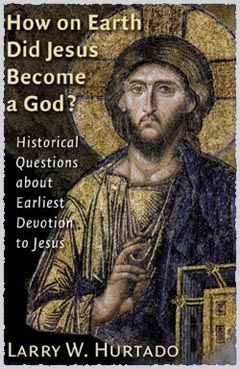
Hurtado’s book, How on Earth Did Jesus Become a God?: Historical Questions about Earliest Devotion to Jesus, contributes to modern studies in Christian origins. That is, it seeks to investigate Christian origins strictly on historical grounds and provide an explanation for how and when devotion to Jesus—as a historical phenomenon—originated. Systematically avoiding what he calls a “theological” or “religious” evaluation of the validity of such early Christian devotion, Hurtado consciously limits himself to a historical method (2). Hurtado’s historical method includes analysis and interpretation of the sources that provide the earliest evidence for Christianity (roughly the first and early second centuries c.e.). His work therefore demands an overlap with New Testament scholarship (5).
The original setting for the first four chapters of this book was the Deichmann Annual Lecture Series at Ben-Gurion University of the Negev in Israel. The chief aim of these lectures was to show how the study of the New Testament in Israel is important for historical analysis of the Jewish religion in the Roman period (ix). However, Hurtado has combined the content of these Deichmann lectures (chapters 1-4), along with journal articles that provide further support for his positions (chapters 5-8), in order to provide a widely accessible version of his contributions (x).
The author’s main argument is that devotion to Jesus alongside the one God of the Old Testament (which included not only doctrine about Jesus but remarkable religious devotional practices) not only developed surprisingly early, but emerged as a “binitarian” mutation of Second-Temple Jewish monotheism within circles of Jewish Christians. On the one hand, since the worship practices of this binitarian monotheism involved an unprecedented level of devotion to Jesus as divine, this sets it apart from the more common “principal agent” speculations of Second-Temple Judaism (these agents were never the object of multiple worship practices as was the case with early Christian devotion). On the other hand, it was still binitarian monotheism with the kind of exclusive bent typical of the Jewish Shema in Deuteronomy 6:4 (“The Lord is our God, the Lord is one!”). These Jewish Christians did not add Jesus to a pantheon of deities or divinize him after the apotheosis model of pagan religion but rather worshiped Jesus as subordinate to the one God who they believed willed him to be worshipped in this way.
This is why Hurtado’s work has a sharp focus on establishing a few major points, such as: 1) the evidence for a high Christology is surprisingly early within the Christian movement, 2) it is only when one gives full attention to devotional practices (and not just doctrinal formulations) that the distinctness of the development of early Christian devotion can be fully appreciated, 3) this development is adequately understood only as a mutation of Jewish monotheism and not as the result of pagan religious traditions, 4) the evidence for early Jewish hostility toward Jewish Christians is most adequately and naturally accounted for if we understand Christian devotion to have offended Jews because they saw it as a serious deviation from monotheistic worship (understandably so), and 5) this significant religious mutation is sufficiently explained by analogy to the broader phenomenon of religious experiences that are perceived to be divine revelations and tend to create remarkable innovations within religious traditions.
Placing Hurtado’s Proposal Among Approaches to Christian Origins
Modern scholarship and historical investigation has produced various and conflicting approaches to Christian origins. While Hurtado is quick to acknowledge his “enormous debt” to previous studies (xii), he also aims to criticize historical proposals intended to explain the emergence of Jesus-devotion that in his view are problematic and “unsatisfactory” (6). In his first chapter, he places these approaches under three categories and gives proponents of each: 1) evolutionary proposals (e.g. Wilhelm Bousset, Burton Mack, Maurice Casey, James Dunn), 2) Jewish messianic and martyr cult proposals (e.g. William Horbury) and 3) theological inference proposals (e.g. Timo Eskola, Richard Bauckham). While he offers only preliminary critiques of these positions in this first chapter, the rest of his book sets out to marshal the evidence for his criticisms.
First Hurtado sets his approach against evolutionary proposals, particularly the religionsgeschichtliche Schule of the nineteenth and twentieth centuries that sought to explain the emergence of devotion to Jesus as divine primarily as a late first century development resulting from the inevitable influence of pagan religions once Gentile converts outnumbered Jewish Christians (15-16). Wilhelm Bousset, for example, argues that worship of Jesus began with “Hellenistic Gentile” circles with a background of pagan demigods and divinized heroes (16). Bousset concludes that while the apostle Paul himself was influenced by such groups, such a “Christ cult” was not characteristic of the original Jewish Christians in Judea (16). In spite of Bousset’s impressive scholarship and what Hurtado calls the “intuitive appeal” of his position, the author complains that Bousset’s view of early Christianity and Roman-era Jewish traditions is “inaccurate and simplistic” (17).
While Maurice Casey and James Dunn differ from Bousset by rejecting the idea that Paul could have countenanced the worship of Jesus alongside God, as Hurtado sees it, their unwavering commitment to a late date for Jesus-devotion (late first century C.E.) puts them at odds with the earliest evidence (17-18). As his argument develops throughout the book, Hurtado points especially to Paul’s letter to the Philippians (ca. 60 C.E.) in which worship of Jesus as divine appears to be already developed enough for Paul to quote a Christological hymn or ode with remarkable claims about Jesus’ status in relation to God—claims that are tantamount to viewing Jesus as divine (83-106). He also invokes Pliny the Younger’s letter to the Roman Emperor Trajan (ca. 112 C.E.) in which he reports that Christians “chant antiphonally a hymn to Christ as to a god” (13). Furthermore, Dunn’s claim that there is no evidence of Jewish hostility toward Christians earlier than the Gospel of John is, by Hurtado’s estimation, “simply incorrect” (20).
For example, the synoptic gospels (understood to have been written before the Gospel of John) depict hostile Jewish authorities that accuse Jesus of blasphemy (154). Hurtado appeals to the work of D.R.A. Hare who urges that the gospel of Matthew’s “central point” in depicting such persecutions reflects tensions between Jewish authorities and the church (156). Dunn’s view is commendable to Hurtado in at least one respect, however: he is at least ready to grant more plausibility to the proposal that Christianity spawned from religious dynamics already operative within Second-Temple Jewish monotheism (19).
The second approach to fall victom to Hurtado’s critique is represented by William Horbury’s approach to Christian origins: the Jewish messianic and martyr cult proposal. By arguing that Jewish worship of messianic figures and martyrs was already well established before the rise of Christianity, Horbury explains Christianity as simply a variation of this cultic form of Second-Temple Judaism (21). Although, like Dunn’s approach, Horbury’s attempt has the commendable quality of locating the development of Christianity within the Jewish matrix (as opposed to a pagan one), Horbury’s definition of “cult” blurs the distinction between the kind of reverence shown to figures of God’s entourage (even when they are heavenly beings that appear to share attributes of God) and the kind of unprecedented devotional practices that characterize the innovations of the early Christian movement (21).
He makes the case for six distinctive devotional practices that underscore his point (28): 1) singing hymns about Jesus in worship gatherings, 2) praying to Jesus and to God through Jesus, 3) calling on Jesus’ name in baptism, healing and exorcism, 4) practicing the eucharist that invoked Jesus as “Lord” of the gathered community, 5) ritually confessioning Jesus in worship, and 6) attributing prophetic oracles to the risen Jesus (or to the Holy Spirit understood as the Spirit of Jesus). Not only is there no parallel to any one of these peculiar practices in Horbury’s examples (argues Hurtado), “the cumulative pattern of devotional practice is even more striking” (28). This is why Hurtado enumerates such practices: to show that the analogy fails miserably.
Timo Eskola and Richard Bauckham represent the third approach Hurtado finds inadequate, in which these worship practices are understood as simply the logical “next step” in light of Jesus’ exalted status, a legitimate theological inference fully appropriated (22). Eskola draws comparisons with Jewish merkavah mysticism in which God is seen to share his throne with another figure. In Eskola’s analysis, Christians simply drew the inference that if Jesus shared the divine throne with God, worship befitted this unique status. While Bauckham’s approach is more elaborate (entailing what he describes as Jesus sharing in the “divine identity” by taking on the role of creator and cosmic ruler), his account is similar to Eskola’s. Once Christians were convinced that Jesus was the creator of all and ruled over all, they were obliged to worship him as God (23).
Although this third category of “theological inference” receives praise from Hutrado inasmuch as it does justice to the early evidence for unprecedented cultic devotion to Jesus, he still finds this proposal deficient in on at least two accounts: 1) they do not explain how such remarkable convictions about Jesus arose in the first place and 2) they fail to account for why Jews did not find it logical to worship “God’s throne-companions” in other figures of Second-Temple Judaism who also shared in God’s rule and creation (e.g. God’s Wisdom or Word, 23). While Jews of this time often portrayed figures in the most lofty of terms, never did they take the “momentous step” of making them the object of cultic devotion that “in any way” comes close to the Jesus devotion of early Christians (23-24).
Evidence and Secondary Arguments
By his scrutiny of these three approaches to Christian origins, Hurtado establishes his chief concerns. The claims he makes in chapter one by way of pithy critique he develops and bolsters with further argumentation throughout the rest of his book. I will give a few examples to show how many of his subsequent points fit with the main concerns already mentioned.
Proposals of Christian origins must take seriously the dating of early Christian sources (especially Paul’s letters). They must also do justice to the high Christology that such sources demonstrate were already developed by the time these sources originated (one can almost see Hurtado rolling his eyes every time he mentions the chronological blind eye in approaches that see Christology as an evolutionary trajectory that culminates in John’s Gospel). To call attention to this point, he devotes chapters to a closer examination of Paul’s letter to Philippians (83-106) and to early sources that show hostility to Christian devotion from Jews and pagans (56-82)—both of which help to establish that worship of Jesus as divine developed (as far as Hurtado can tell) from the earliest moments of the Christian movement. In establishing this, Hurtado hopes to dissuade future studies from what he sees as futile evolutionary proposals that fail to take seriously the volcanic nature of Christian origins.
His examination of Philippians is packed with exegetical points. In this one chapter he manages to demonstrate the fruit of an “inductive” approach (89), explain why we should not expect the Christological ode to have poetic meter (early Christians imitated the style of the biblical Psalms, 84-85), shows how the existence of the Christological ode and Paul’s failure to explain it both reflect that it was already known and affirmed (87), argues against the Adam-Christology approach to the passage on several grounds (88), highlights the importance of recognizing the emphasis of the passage indicated by the “therefore” in verse nine (“therefore, God also highly exalted him,” etc.), and shows allusions to Isaiah 45 that amount to an early “Christological midrash” (92) that also demonstrates sensitivity to a Jewish mindset (they were providing scriptural justification for Jesus’ status, 93). This chapter considerably corroborates his contention that early Christianity developed in a thoroughly Jewish mindset—not some Gnostic redeemer-myth or apotheosis model. The way in which Jesus is carefully depicted as being humbly submitted to God and receiving his high status from God betrays a sensitivity to a thoroughgoing monotheistic framework (95-96).
Perhaps most importantly, however, he draws attention to the structure of the Greek that “practically requires” one to understand Jesus’ status before his abnegation as “being equal with God,” since “being in the form of God” parallels this phrase in a way that requires us to interpret one in light of the other (100-101). If Jesus’ pre-existence and divinity are fully developed in this Christological ode that was well known by the time Paul wrote his letter to the Philippians, such an ode must have developed between the time of Jesus’ execution and 60 C.E., which means that the most significant Christological development (Jesus’ equality with God) developed within the first half of the first century C.E. This is breathtakingly early.
Hurtado cashes in his distinction between Christian doctrine and Christian devotional practice (the latter of which must weight heavily in the discussion of Christian origins) in chapter two. Here he shows how it is precisely these devotional practices that distinguish Christianity from previous developments within Judaism and explains what provoked outrage among Jews (34). He further supports his claim for such devotional practices to have developed early by reference to phrases that go unexplained in Paul’s letters (e.g. Marana tha, Abba, 37). In support of his proposal that Christianity developed within Jewish circles, he rehearses widely acknowledged aspects of the earliest sources (e.g. Jesus’ own entourage were all Jews from Judea, other prominent figures in the movement were Greek speaking Jews, many Gentile converts were proselytes to the Jewish religion, even many of Paul’s fellow workers among the Gentiles were Jewish, etc., 38-39).
To add to his case that early Christianity was not likely caused by pagan influence, he argues that reasons exist for believing that after the Maccabean crisis, Jewish reaction to pagan religious influences became more hostile (41). There is no evidence, he claims, that the kind of influence non-Jewish religions had on Jews—such as seen in the often cited example of Philo who was influenced by Greek philosophy—was the kind of influence that led Jews to consciously overturn the core of their monotheistic tradition (40). His clincher is this: the earliest Christian sources show an antipathy towards pagan religion in general on the grounds of monotheism in particular (42-45).
If Hurtado will not accept the dominant theories of Christian origins, then he must explain a more plausible scenario in which such drastic innovations might have taken shape. To put it simply: if pagan influence is not the culprit that caused Jews to worship a human, what else could have caused them to do something so radically counter-intuitive? This is why Hurtado offers his last chapter to provide a social-scientific “conceptual model” that he understands to fit snugly with the type of innovations that characterized early Christianity (179-204).
Social-scientific studies that document how recipients of intense religious experiences tend to lead to reconfigurations of beliefs and practices of the “parent” religious tradition must be taken seriously because they provide a viable explanation for why Jewish monotheism went from one-person monotheism to two-person monotheism (“binitarian monotheism”) so swiftly after the execution of Jesus. In terms of the evidence, Hurtado suggests, the development of Christianity was less like a slow evolution and more like a Cambrian explosion. He contrasts the arguments of Anthony Wallace, Rodney Stark, Mark Mullins, Byron Earhart, and Werner Stark with other scholars who seem to arbitrarily restrict all religious innovation to “deprivation theory” in order to show that it is by no means obvious or necessary to deny religious experience a potential causal power in religious reconfigurations (186-191). He then attempts to recount how, according to our earliest sources, religious experiences seemed to be precisely the fountainhead of the innovations that caused the early Jewish Christians to start a new religion while understanding it as the further fulfillment of the previous Jewish monotheistic paradigm (192-204).
Reviews of Hurtado’s Book
As someone not in the field of Christian origin studies, I am in no position to evaluate Hurtado’s case with persuasive authority, yet his arguments appear lucid and even ingenious. Peer reviews reveal high praise but also several criticisms. As one might expect, many Christian reviews consider this book “a valuable and unique contribution” for the general interested reader even if they are partial to his more thorough book Lord Jesus Chirst: Devotion to Jesus in Earliest Christianity (Kruger, 370; Gooder, 34).
Common criticisms of his book are that “it makes for a rather ‘scattered’ read” or is repetitious (Kruger, 372; Gooder, 34; Parker, 376). One evangelical appears to be mildly criticizing the book for not having a chapter on how it was the bodily resurrection of Jesus that caused all the religious experiences (Stenschke, 177). This reviewer has apparently missed the point of Hurtado’s methodology. You cannot revolutionize a field of study like Christian origins by appealing to the supernatural—that is the whole genius of Hurtado’s labor, he has boldly ventured into an anti-supernatural field of study and managed to successfully point the evidence in the right direction (i.e., one that is congenial for recourse to the supernatural).
The most serious criticism I was able to find against Hurtado was by Nathaniel Morehouse of the University of Manitoba who appears to be lamenting when he writes that for those familiar with Hurtado “very little in this book will come as a surprise” (Morehouse, 615). His chief complaint is that Hurtado’s “razor-sharp focus” blinds him from exploring “other extra-Jewish options” as perhaps having a causal role in Christian origins (Morehouse, 616). He fails, however, to offer any convincing suggestions. He backs his criticism up with two points: 1) if the early churches were analogous to other Voluntary Associations they may have been persecuted for similar reasons as these groups—namely, for being illegal associations; 2) the theology that might have “resonated” with gentile Christians “might have been influenced by forms of non-Jewish religiosity” (Morehouse, 616). The first of these points escapes me. It is not clear to me exactly what part of Hurtado’s argument this necessarily undermines. The second point appears to be special pleading for a possibility that Hurtado has cast into doubt with a flood of arguments that will not easily be overturned.
Although Hurtado’s aim is to explain Christianity purely as a historical phenomenon by means of natural explanations and without providing any “religious” evaluation, by the time he is done using Ockham’s razor to cast doubt on the efficiency of theories that seek to explain the development of Christianity by going outside the community of Second-Temple Judaism, the Christian apologist would appear to have her work cut out for her. For Christians, the fountainhead for Christianity was the resurrection appearances of Jesus to the apostles (and many others) who subsequently proclaimed this resurrection with a reckless passion that compelled them even under guillotine-like pressure.
Hurtado’s historical backdrop for Christianity makes belief in the resurrection more plausible (what else would most easily explain the transformational impacts of the early Christian’s experiences and their explosive power through those who claimed to have seen the risen Jesus?). His study dignifies Christianity from the stigma of having been corrupted from its earliest decades by pagan religious influence. Ironically, it would appear that Hurtado’s approach to Christian origins, while being most strikingly in accord with recourse to the supernatural, however, happens also to be most strikingly in accord with the evidence in a way that meets the least amount of resistance from the historical-critical method. This is not to claim that his approach is without any difficulty, but his streamlining of the evidence appears much more historically intelligible than so many convoluted approaches to Jesus studies that seem to satisfy only a minority of skeptics. One hopes his persistent reinterpretation of the relevant evidence will revolutionize the field of Christian studies. Will the post-enlightenment anti-supernaturalist field of Christian origins be content with “neutral” evidence that explains Christianity purely on naturalistic terms while at the same time making a way for recourse to the supernatural appear to tell “the whole story”?
BIBLIOGRAPHY: REVIEWS CONSULTED
Gooder, Paula. 2007. Review of How on Earth Did Jesus Become a God?: Historical Questions about Earliest Devotion to Jesus, by Larry W. Hurtado. Journal for the Study of the New Testament 29, no. 5: 34.
Jurgens, David. 2007. Review of How on Earth Did Jesus Become a God?: Historical Questions about Earliest Devotion to Jesus, by Larry W. Hurtado. Reformed Review 60, no. 3 (Fall): 154-56.
Kruger, Michael, J. 2006. Review of How on Earth Did Jesus Become a God?: Historical Questions about Earliest Devotion to Jesus, by Larry W. Hurtado. Westminster Theological Journal 68, no. 2 (Fall): 369-72.
Morehouse, Nathaniel. 2007. Review of How on Earth Did Jesus Become a God?: Historical Questions about Earliest Devotion to Jesus, by Larry W. Hurtado. Studies in Religion/Sciences Religieuses 36 no. 3-4: 615-16.
Parker, David. 2007. Review of How on Earth Did Jesus Become a God?: Historical Questions about Earliest Devotion to Jesus, by Larry W. Hurtado. Evangelical Review of Theology 31 no. 4 (O): 376-77.
Stenschke, Christoph W. 2009. Review of How on Earth Did Jesus Become a God?: Historical Questions about Earliest Devotion to Jesus, by Larry W. Hurtado. Evangelical Quarterly 81 no. 2 (Ap): 175-177.
GRE Vocabulary :: G :: (yeah … I skipped F)
The emboldened words below are part of GRE vocabulary preparation. Do you know them? I have created sentences to give clues to their meaning.
—————-
When the family received the knock on the door from the Makeover crew, they began to gambol in the street.
His garrulous tendencies, though charming at first, became burdensome to Suzy because his conversation appeared to her to be so glib.
An alarming number of church plants die in the gestation process due to lack of funding and a failure to engender a committed core team.
The preachers bombastic flourishes seemed to be little more than glibness to the educated members.
Her impugning tone of voice was complemented by her glowering—and this was enough to send him into frenetic recrimination.
Bradley didn’t become sympathetic of Roman Catholics overnight; his research slowly engendered a gradation of sympathy the more he studied.
Timothy was the first of his kind; all previous class presidents had been gregarious and charming, but he was neither.
The general’s closest men had no respect for those who groveled at every opportunity.
It seemed that all the people around her had everything handed down to them with ease, while she inherited a hapless existence as though it were her inexorable destiny.
Germany’s hegemony did not last long; nor will America’s. History bears witness that such hegemony is evanescent.
The hermetic seals containing the dead sea scrolls were sold by a child who found them in a cave while playing.
Most seminaries are heterogeneous factories that produce pastors and preachers who carry on the tradition; few break free from the indoctrination process that inculcates the distinctives of each denomination or movement.
The hoary governing process smothered out any fresh blood so that the institution eventually faced death or revolution—neither of which they were ready to handle.
The empire was forced to husband their crops until the famine had come and gone.
GRE Vocabulary :: E ::
The emboldened words below are part of GRE vocabulary preparation. Do you know them? I have created sentences to give clues to their meaning.
—————-
The lethargic pastor was replaced with an ebullient young man fresh out of seminary who made several changes in the churches activity and policies within his first five years of his pastorate.
Effigy’s of George Bush were burned all over the world at various point during the war.
Insisting on his way, she took her effrontery to the manager and demanded he fire the worker that denied her what she wanted.
It was a controversy in the making when Billy Graham attended the elegy after 9/11 that included praises to Allah.
Plato wrote several encomiums on love and other virtues.
The Spartan war culture was endemic; the other Greek people groups only slightly above average war strategists.
The lengthy lectures were enervating rather than stimulating.
As someone who tries to capture air, the man’s dreams were ephemeral in the end and he spiraled into a depression.
He declined almost all that was offered him that day; the locals explained that he was an epicure and only ate certain foods.
The philosophy professor duped all the students by equivocating on certain key words.
The most powerful individuals involved in organized crime are often erratic and easily evade capture.
All the ersatz versions of clothing were impressive to the unsuspecting.
Such teaching posts were only distributed to the elite members of the erudite community.
Tending to eschew all things Christian, but not wanting to offend, the young man religiously feigned ill on Sunday mornings when others would ask him to come to church.
The Gnostic religion claimed to have esoteric knowledge through mystical experience.
Such brutal men were estimable in Roman culture and played a key role in securing the empire.
The Christian ethos is incompatible with American mainstream opinion on several ethical issues.
Rather than giving a eulogy after someone’s death like in American culture, the Jews mourned for days without eating.
Doctors learn to cushion harsh realities about the patient with euphemisms when breaking the bad news.
GRE Vocabulary :: D ::
The emboldened words below are part of GRE vocabulary preparation. Do you know them? I have created sentences to give clues to their meaning.
———————–
The host was pleasantly surprised by the decorum of the impecunious young lads.
Watching violent movies does not usually cause adults to go buy guns and hatchets to murder their neighbors, but some sociologist suggest that such activities are deleterious in nature, and their negative effects are often not unascertainable.
When chatting with his less educated friends about matters of politics, the astute law student was often forced to demur.
The sun desiccated what little water resources the desert creatures were used to fighting over, forcing them to migrate or die out.
Unable to finish any particular task, she was helplessly engaged in a desultory state of delusion.
Lit up from the diaphanous curtains, her living room provided enough light to allow her to save on her electric bill each month by doing her studying there.
GRE Vocabulary :: C ::
The emboldened words below are part of GRE vocabulary preparation. Do you know them? I have created sentences to give clues to their meaning.
————–
The consistent suppression of the voice of the people engendered an underground movement that culminated when a 1,000 troop cabal was formed armed with automatic weapons.
The sound of children, the city traffic and the music coming from the neighbors house created a cacophony that functioned as an alarm clock for the new urban dweller.
The vexing calumny in the newspaper sent the CEO into a frenetic disarray.
The calumny contained multiple canards that created a panic among the community and lowered the sales of beef.
The woman was very candid about her past, but he was still speaking in ambiguities.
He hesitated to commit himself to the project because he was acutely aware of the leaders capricious tendencies and had been burnt in the past.
Internet service has created a whole new field in cartography: convenient and free satellite images, street view, and road maps.
The caustic brunette intimidated the other attorneys by the way she charmed the managing partner and began a gradation of promotion for herself.
Mutual chicanery and unfaithfulness led to an abrupt divorce but did not surprise the families of the wedded couple.
The young students were circumspect when they walked home from school in their gang infested neighborhood.
Rather than split the cake into two pieces, they divided it into three because Sharon had warned them ahead of time of the cloying deserts.
When the two companies coalesced, it saved hundreds of jobs and boosted business.
Several contumacious activities forced the school district to rethink their disciplinary strategy.
The fraternity brothers made a collusion that strengthened their friendship and engendered the “inner circle” so infamous to outsiders.
The lawyer corroborated her case with several weapons that were found on the scene of the crime smothered in blood and tainted with finger prints.
It was her intention to cosset and discipline the abused women until they were old enough to work.
The small coterie followed his leadership until the group was large enough for non-profit status.
The craven boys admired the older men for enlisting themselves in the army during a time of war and hoped they would one day be brave enough to emulate their example.
After the third date, they were both struck with naïve cupidity.
The science professor scorned the young students who admitted they believed in God, accusing them of being inexcusably credulous.
The old curmudgeon wouldn’t even let the children play in his back yard out of fear they would ruin his grass.
 T h e o • p h i l o g u e