Home » Articles posted by T h e o • p h i l o g u e (Page 5)
Author Archives: T h e o • p h i l o g u e
Thomas Aquinas on Theological Virtues: Summa Theologica
I have herein summarized and quoted from articles 1-4 of question 62 “Of the Theological Virtues” in the Summa Theologica of St. Thomas Aquinas. This time I have organized my summaries more in tune with how Aquinas wrote them: 1) the sed contra (some authoritative statement Aquinas usually wishes to defend), 2) the respondeo (Thomas’s way of explaining things) and 3) adversus (Thomas’s responses to various objections). I begin, however, with IN SUM (my summary of Aquinas’s article). All quotations from the Summa are taken from the English Translation, Summa Theologica, trans. the Fathers of the English Dominican Province, 5 vols., rev. ed. 1948; repr., Notre Dame, Indiana: Ave Maria Press, 1981.

There Are Theological Virtues (ST I-II.62.1)
IN SUM: Faith, hope and love are properly called theological because: 1) they are not attainable by a human’s natural capacities; 2) they are only attainable through a certain participation in God’s nature; 3) they are infused by God and direct a person sufficiently toward God as the object of supernatural happiness; 4) they are known only through Divine revelation. They are properly called virtues because they are dispositions to that which is according to nature, even if this nature is only attainted through a certain participation in God’s nature.[1]
sed contra. The Divine Law has precepts about the acts of faith, hope and love; the precepts of the Divine Law concern virtue. Therefore, faith, hope, and charity are virtues directing us to God. Therefore they are theological virtues.
respondeo. There is a kind of happiness proportionate to human nature that can be obtained by a person’s natural principles. There is also a happiness “surpassing man’s nature, and which man can obtain by the power of God alone, by a kind of participation of the Godhead, about which it is written (2 Pt 1:4) that by Christ we are made partakers of the Divine Nature” (ST I-II.62.1). Natural principles will not suffice for this latter kind of happiness; God must give “additional principles, whereby he may be directed to supernatural happiness.” These principles are called theological virtues both because they are “infused in us by God alone” and because they direct us “aright” to God as end (i.e. God is their object). Furthermore, they are also called theological because they are only known through Divine revelation.
adversus. A thing may posses something by nature in two ways: 1) by it’s essential nature and 2) by participation. Thus the theological virtue can properly be called “virtues” since they are dispositions of perfect things to that which is best, namely, that which is according to nature, as the Philosopher says. For theological virtues are “proportionate to man in respect of the Nature of which he is made a partaker.” (ST I-II.62.ad.1)
These are called Divine virtues not because God is made virtuous by them, but because God makes us virtues by them and directs us to Himself. (ST I-II.62.ad.2)
Although man is directed to his first beginning and last end by his nature—his reason and will—these natural principles only allow man to attain to happiness in proportion to his nature; they are not sufficiently directed to God in so far as He is the object of supernatural happiness. (ST I-II.62.ad.3)
Theological Virtues are Distinct from Intellectual and Moral Virtues (ST I-II.62.2)
IN SUM: Theological virtues are distinct from moral and intellectual virtues because habits are distinguished by their objects and because whatever surpasses a human’s natural capacities is distinct from that which is attainable according to human nature alone.
sed contra. Whatever surpasses human nature is distinct from whatever is according to that nature.
respondeo. Habits are distinguished by their objects and the object of theological virtues is God Himself, an end that surpasses the knowledge of [unaided] human reason. Moral and intellectual virtues are comprehensible to [unaided] human reason. Therefore the theological virtues are distinct from moral or intellectual virtues.
adversus. Although wisdom is thought to be an intellectual virtue that directs humans to God, wisdom as defined by the Philosopher only considers Divine things insofar as “they are open to the research of human reason. Theological virtue, on the other hand, is about those same things so far as they surpass human reason” (ST I-II.62.2.ad.2).
Augustine defines the cardinal virtues as “the order of love” (ST I-II.62.2.ob.3). If Augustine is to be understood as referring to love “commonly so called, then each virtue is stated to be the order of love, in so far as each cardinal virtue requires ordinate emotions; and love is the root and cause of every emotion, as stated above” (Ibid.). If Augustine is referring to the love of charity, we must take him to mean that “all other virtues depend on charity is some way” (Ibid.). In either case, Augustine does not mean “every other virtue is charity essentially” (Ibid.).
“Though charity is love, yet love is not always charity” (ST I-II.62.2.ad.3).
Faith, Hope, and Charity are Fittingly Reckoned as Theological Virtues (ST I-II.62.3)
IN SUM: Virtues direct a person to an end either with respect to human reason or human will. Faith directs the human intellect to God and hope and charity direct the human will to God. Thus they are fittingly seen as theological virtues and they direct humans “in the same way” as the other virtues.
sed contra. “The Apostle says (1 Cor. Xiii. 13): Now there remain faith, hope, charity, these three.”
respondeo. Theological virtues direct man “in the same way” the other virtues direct man—namely, “in respect of his reason” and “through the rectitude of the will which tends naturally to good as defined by reason” (ST I-II.62.3). First the intellect receives supernatural principles held by a Divine light; these we call “the articles of faith.” Secondly, “the will is directed to this end, both as to the movement of intention … [and this belongs to] hope, and as to a certain spiritual union, whereby the will is, so to speak, transformed into that end—and this belongs to charity” (Ibid.).
adversus. Faith and hope are imperfect inasmuch as “faith is of things unseen, and hope, of things not possessed” and yet “faith and hope in things which are above the capacity of human nature surpass all virtue that is in proportion to man, according to 1 Cor i. 25)” (ST I-II.62.3.ad.2).
There are three theological virtues instead of just two. One might think there need only be one for the intellect and another for the will. However, “two things pertain to the appetite, [namely] movement to the end, and conformity with the end by means of love.” Therefore, with respect to the theological virtues we have one virtue for the intellect (faith) and two for the appetite (hope and charity). (ST I-II.62.3.ad.3).
In the Order of Generation, Faith precedes Hope and Charity (ST I-II.62.4)
IN SUM: With respect to the generation of acts, a person cannot hope in or love something unless she first apprehends it by either the senses or the intellect. Therefore faith, through which a person perceives the supernatural end, must precede hope and love. Nevertheless, it is true that in the order of perfection, charity always precedes faith and hope because faith and hope are “quickened” by charity and thereby receive their perfection as virtues.
sed contra. “The Apostle enumerates them thus (1 Cor. xiii. 13): Now there remain faith, hope, charity.”
respondeo. There is the order of generation and the order of perfection.
In a subject faith must precede hope, and hope charity with respect to their acts (“because habits are all infused together”), “for the movement of the appetite cannot tend to anything, either by hoping or loving, unless that thing be apprehended by the sense or by the intellect” (ST I-II.62.4). By faith the intellect apprehends the object of hope and charity, so it comes first. Likewise a person loves something only if he apprehends it as his good. If a person hopes to obtain this good through another person “for the very reason that a man hopes in someone, he proceeds to love him: so that in the order of generation, hope recedes charity as regards their respective acts” (Ibid.).
“But in order of perfection, charity precedes faith and hope: Because both faith and hope are quickened by charity, and received from charity their full complement as virtues. For thus charity is the mother and the root of all the virtues, inasmuch as it is the form of them all, as we shall state further on” (Ibid.).
“Charity is the mother and the root of all the virtues” (ST I-II.62.4).
adversus. When Augustine says that after believing and loving and doing good works, a person “ends in hoping” (ST I-II.62.4.ob.2), he is referring to hope in the meriting of eternal life, a hope already “quickened by and following charity” (ST I-II.62.4.ad.2).
Love is the principle of all emotions, and hope is a kind of emotion since it is a passion. Thus it might seem that charity, which is love, precedes hope. However, hope can regard its principle object (the good hoped for) or it can regard “the person from whom a man hopes to be able to obtain some good” (ST I-II.62.4.ad.3). With respect to the principle object (the good hoped for) love always precedes hope: “for good is never hoped for unless it be desired and loved” (Ibid.). With respect to the person one hopes in, hope precedes love because it is by reason of hope the person is loved and “from the fact that he loves him, he then hopes all the more in him” (Ibid.). Thus “hope is increased by love” (Ibid.).
[1] This last point is the easiest to call into question: Is Aquinas saying the theological virtues fit Aristotle’s definition because by participation in God’s nature, the Divine nature becomes a part of human nature via participation? If not, he seems to be defining virtues differently from Aristotle by equivocating on the word “nature.” Aristotle did not intend by this word anything other than human nature.
Dumitru Staniloae on The Fall :: Eastern Orthodox Theology
Staniloae, Dumitru. The Experience of God, Vol 1: Revelation and Knowledge of the Triune God. Reprint, Brookline, Massachusetts: Holy Cross Orthodox Press, 1998.
The Fall
“Goodness, friendship, noble aspirations, the hope for the immortality of the person—all these have remained like the rays of a sun that can never be totally covered over by the fleeting and ultimately rather insubstantial clouds of evil” — Dumitru Staniloae
“God’s grace has been withdrawn … the image of God in man has been weakened. Yet, this image in the human being has not been destroyed totally.” — Dumitru Staniloae
The Primordial State
Staniloae refers to the primordial state of the human. During the primordial state man, after first being created, had to choose to obey God and thereby progress toward deification, or else regress into a state of spiritual weakness. The primordial state of man was the initial state of our first created parents. During this state our first parents were innocent, yet during this time of innocence it was incumbent upon them to choose between good and evil. It appears, then, from Staniloae’s description, that during this primordial state, humans were neutral, having chosen neither good nor evil. Yet neutrality could not last forever, because choosing was inevitable. God breathed “spirit” into man that included a certain “potency” to act by free will (178).
The Tree of Knowledge
A great deal of this chapter revolves around interpreting the meaning of the trees in the Genesis story, especially the forbidden tree, “the tree of the knowledge of good and evil” in the creation account (175). Staniloae calls the latter the “tree of consciousness” (178). The Genesis account reads:
The Lord God formed man of dust from the ground, and breathed into his nostrils the breath of life; and man became a living being. The Lord God planted a garden toward the east, in Eden; and there He placed the man whom He had formed. Out of the ground the Lord God caused to grow every tree that is pleasing to the sight and good for food; the tree of life also in the midst of the garden, and the tree of the knowledge of good and evil. … Then the Lord God took the man and put him into the garden of Eden to cultivate it and keep it. The Lord God commanded the man, saying “From any tree of the garden you man eat freely; but from the tree of the knowledge of good and evil you shall not eat, for in the day that you eat from it you will surely die. Then the Lord God said, “it is not good for the man to be alone; I will make him a helper suitable for him.” –Genesis 2:7-9, 15-18 (NASB)
What is this tree of knowledge? A significant portion of Staniloae’s chapter on the Fall consists of a recounting the interpretation of the Fathers, interweaved with his own comments. It is therefore difficult at times to discern whether Staniloae is summarizing the fathers or adding his own color commentary on the patristic tradition.
St. Maximus the Confessor understood the forbidden tree to represent “the creation of visible things” (175). The dual imagery underscores the dual power of creation—it can either nourish the mind if used for spiritual purposes, or become a teacher of passions by enticing the senses. But if it had such great possibilities for good, why did God forbid it? According to St. Maximus, God desired simply to “postpone” man’s partaking of it until he was able to commune with it enough in grace to habituate himself into a spiritual state where his mind and senses could be “transfigured” and his will free from the passions, a state of deification. Given Staniloae’s quotation of St. Maximus’ interpretation, however, it is hard to understand how God could have postponed his partaking of the visible world on the one hand, while in the mean time Adam “communed” with it by grace. In other words, how is communing with the visible world itself not a “partaking” of the visible world? This same question could be raised of every other interpretation that sees the forbidden tree as the visible world. How could God “postpone” a physical creatures partaking of the physical world?
Nicetas Stethatos thought the tree of knowledge was “sensation applied to the sensible world or to the body” (176). For Stethatos, the danger of becoming unspiritual is avoided so long as man’s senses were guided by the mind. Thus, God wanted his partaking of the tree delayed long enough for man’s faculties to come under the direction of a mind that had become spiritual.
St. Gregory Palamas is “even more precise” according to Staniloae. God wanted to protect the first humans from things pleasant to the senses because they were volitionally vulnerable, “easily displaced toward good or its opposite” (176).
Offering a complementary interpretation of both trees in the Genesis account (the forbidden tree and the tree of life), Gregory of Nyssa understood the tree of life as every experience that advances man toward good, and the tree of knowledge of good and evil as representing every experience that leads man astray by causing him to believe something evil is actually good (179). The forbidden tree is a “mixed tree,” according to Gregory of Nyssa, because in and of itself creation is not evil. Only when creation is crassly enjoyed only by the senses does the human person become passionately inflamed for sensible beauty and pleasure (180). The tree is “mixed,” in other words, because it is a good experienced in a bad way when encountered by the sense-dominated human. It is also mixed because evil always shrouds its true nature by cloaking itself in “some good by which it lures those who are deceived into desiring it” (180). It makes evil seem good by virtue of some good aspect, for nothing is evil in an absolute sense, according to Gregory of Nyssa, but has some good aspect to recommend it (180).
Because the human still has “an indelible remnant of the good within himself,” he “must deceive himself by thinking that the sin he is committing has some justification through good” (181). Yet such justification forces the human to become dishonest with his own conscience and therefore willingly deceived (181). This dishonest justification Staniloae calls “a flimsy bridge” that allows evil to get into a person.
According to Staniloae, evil offers an initial pleasure that has subtle but destructive consequences. This initial pleasure, however, is enough to entice people to become willingly deceived. Evil entices all on its own without the devil, yet the devil’s role is to calm the human soul about the inevitable consequences of evil—“You surely will not die! … You will be like God” (Gen 3:4-5, NASB).
In Staniloae’s synthetic summary, the Fathers understood the “tree of life” and the “tree of knowledge” as referring to “one and the same world” (179).
Viewed through a mind moved by spirit, that world is the tree of life that puts us in relationship with God; but viewed and made use of through a consciousness that has been detached from the mind moved by spirit, it represents the tree of the knowledge of good and evil which severs man from God. (179).
The tree of life and the tree of knowledge are located at the “same central point” (189).
The meaning might be that one and the same world, when grasped exclusively by means of the senses and by reason placed at the service of the senses, is the source of the good that is not good; whereas, when grasped in its real significance by a reason that sees more deeply and instead places the senses in its own service, it becomes a source of life. (189).
St. Maximus the Confessor understood the forbidden tree to represent “the creation of visible things,” but if this is the interpretation, why would St. Maximus (or any other Father) say that God wanted to “postpone” the forbidden tree?
Causes of the Fall
St. Basil the Great also spoke of the primordial state and emphasized that mankind was not created “intrinsically evil,” but rather chose evil. God created man with free will, for he wanted the human to be strengthened in good “through his own cooperation,” rather than of necessity (177). Staniloae infers that the primordial state must have been abrupt. It didn’t have to be that way, however. If our first parents were simply obedient over a period of time, “they would have begun to be habituated to good” (176). Even then, however, the Fall would not have been impossible, but only “more difficult” (176).
It is important to remember that the human choice of evil was not brought about by any necessity, but by imprudence and lack of effort on the part of the human. Basil blamed the human’s first choice of evil largely on what he called aboulia [lack of wisdom or laziness of the will]. Human complacency was caused by a kind of anthropological spoil: humans had everything readily available to them without first growing spiritually by their efforts to win them. Our first parents preferred to choose the easy enjoyments that required little effort, rather than putting forth the effort to grasp the deeper spiritual enjoyments of the good. They were lazy. Staniloae’s summary here of Basil implies that humans failed to properly prioritize their enjoyments by preferring what was effortlessly at hand over the pursuit of a deeper and deeper enjoyment of the good, an enjoyment that would grow their spiritual strength. As Basil put it, they placed a full belly above spiritual enjoyments. This choice for evil was not of necessity, but rooted in aboulia [lack of wisdom or laziness of the will].
Results of the Fall
Before sin, “no separation existed between creation and the world of the divine energies” (187). Through sin, man was severed from God and introduced into “a state of sin” (192). The Spirit has “withdrawn both from the world and from the human person” (186). We might call this a pneumatological abandonment or divine withdrawal. Sickness and death are something like organic consequences to the withdrawal of the Spirit (191). Corruption of nature and death are brought about by “the impoverishment of the spirit” (197). Thus, the spiritual tragedy of the Fall (moral evil) and the material tragedy of the Fall (evils associated with natural evil) go hand in hand.
As a result of choosing evil the human being experienced interior detachment from God, affirming his autonomy to do as he wishes. This also results in the human’s “selfish confinement within himself” whereby he, presuming to become his own lord, in reality became his own slave (178-179). Staniloae here offers a peculiar way to think about human freedom:
The human person is free only if he is free also from himself for the sake of others, in love, and if he is free for God who is the source of freedom because he is the source of love. (179)
This change is a change of “motion.” Had Adam not sinned but obeyed God, he would have progressed in an ever-increasing motion towards love for God and neighbor where creation would become deified by being “overwhelmed by the divine Spirit” (185). This might be called a pneumatic momentum rooted in the movement of the Spirit. Instead, however, when our first parents chose evil, they set in motion a “decomposition” of creation (185). We might call this a hamartiological momentum rooted in the movement of man’s will toward sin and therefore away from God. Such a destructive momentum would only be reversed by the second Adam, Christ Jesus. Thus, “The return of the human being to communion with God delivers him from eternal death” (187).
As a result of the Fall, humans are now plagued with teleological opacity and epistemological reduction. They have a hard time seeing the ultimate meaning of existence, and their “restricted image of the world” leads to a “restricted knowledge,” for the human person becomes familiar exclusively with the bodily and sensible enjoyments of the world and therefore views the visible world as an “ultimate object possessed of no transparence or mystery that transcends it” (184). This teleological opacity “veils what is most essential in creation” and obtains only a “narrowly rational knowledge of nature and of his fellow humans” (184, 188). This is an epistemological perversion in which man comes to think of the world in almost “exclusively rational” terms (188).
Furthermore, man reduces the world to being “an object of the lower appetites” (191). This tragic reductionism is a basic way of understanding the nature of sin and the state of mankind after the Fall. Living under these conditions is a life lived in a “pseudo-reality” (191). Staniloae links this pseudo-reality with the doctrine of hell. “According to the Christian faith,” claims Staniloae, “the sinners in hell exist in the darkness that lies outside the real world” (190). The sinner becomes so obsessed with herself that she forgets about the rest of the world.
In the state of sin our very being can advance to such a condition of self-centeredness that it almost no longer knows whether creation really exists. Eternal death is the rendering of this state permanent (192).
Not only do humans become alienated from others and the world, but also from themselves:
The conscious creature could no longer understand even himself apart from his blind impulse toward biological satisfactions and began to look upon the spirit within himself as a curiosity, something disruptive of life and contrary to nature, an unnatural excrescence he did not have to take much into account. (198)
Through sin the soul becomes possessed by the lower passions and looses its sensitivity of conscience and also looses its transparency before God and others.
Staniloae is determined to make sure his readers understand that although death and corruption of nature are results of sin, they are not punishments from God. Suffering and death were “in no way” punishments from God to Adam (201).
Adam’s slavery is the natural consequence of his being vanquished; his suffering is the physiological result of the trauma he himself sustained when he turned aside from his path, and death follows upon alienation from God. To regard God as the cause of suffering and death is an essential error, a real affront offered to him. (201).
He considers such a notion “heretical” for it strips the cross of its glorious ring of victory and turns it into “a simple instrument of suffering and of the placating of God’s ‘wrath’” (202). “Neither corruptibility nor death, therefore, are punishments from God; they are instead consequences of our alienation from the source of life” (202). But it does seem, however, that our alienation from the source of life was divinely initiated or results from divine causality because of sin: “God’s grace has been withdrawn” (204). God’s chooses to withdraw his grace because of sin.
The Good in Man and in the World
It is also important that one notice that the Fathers attempted to maintain a certain kind of balance in their post-Fall anthropological outlook, seeing the human as neither fundamentally bad nor wholly good, but in a state of ambivalence. Staniloae stresses that the imago Dei [image of God] was overshadowed by sin, but not “totally erased” (200 cf. 204).
By himself the human person will certainly not be able to conquer the evil that was introduced within him, but neither will the evil do away entirely with the good in the human person. The human person will remain in an ambivalent state. (182).
This state of ambivalence could be thought of as a contradiction of anthropological tendencies. On the one hand, because man is created as spiritual, there is still a natural tendency toward good which evil must deceptively suppress. On the other hand, humans have an opposite tendency toward evil.
Although the world, along with its sensible pleasures, is seen myopically from a sensible perspective, nevertheless, God has ordered creation in such a way that it is capable of being the medium through which he speaks to human persons and initiates a “dialogue” between God and man designed to help man see the higher purpose of the visible world, thereby breaking out of his deficient worldview and uniting reason with love. Through their own efforts and their link with the divine energy, a minority of human beings can even overcome “natural causality itself” (186).
Further complementing this point, St. Basil the Great offers another perspective on the Fall of humanity that Staniloae argues is complementary to St. Gregory of Nyssa’s. Basil stressed that although the fall itself is evil, it brings about good, for evil awakened our first parents to repentance and led them to take action in curbing their fleshly impulses (182). God placed within man the “impulse” to fight against Satan (Gen 3:15). Staniloae also argues that work was given to man as a tool for healing (195). Suffering helps the spiritual development of man “to an even greater extent” (195).
Although man is no longer “completely” in the imago dei due to dark shadow cast by sin, “goodness, friendship, noble aspirations, the hope for the immortality of the person—all these have remained like the rays of a sun that can never be totally covered over by the fleeting and ultimately rather insubstantial clouds of evil” (200). Thus, in spite of the Fall, it appears that Staniloae has a rather optimistic view of human possibilities and considers the evil in the world relatively “insubstantial.” Even suffering and death has become God’s divine pedagogy to grow the spirit of man (202-203). “They are not meant to last forever, but God changes their role so that they become means of healing evil” (202). Staniloae’s comments here make more clear why Eastern theology has always tended to hold open the possibility for inevitable universal salvation.
Knowledge of the Good and Human Communion
There is a heavy polemic on intellectual autonomy and individualism in Staniloae’s discussion of the good. Essentially, Adam wanted to decide for himself what was the good. We might call this a tragic epistemological hubris of autonomy that severed the harmony between man and God by a breach of trust. The good was then accommodated to selfish and sinful interests and pleasures rather than being pursued in loving relationship with others. This propels the human into immense sadness rather than fulfilling her being. “In communion evil is overcome, for communion is a fulfillment of being” (193).
The good, then, has to do with a continual exercise of man’s responsibility toward his fellow humans (193). “Christian faith says that if I take my orientation from my reason only when I am deciding what is good for the other and for myself, then I am using my reason arrogantly and selfishly and am departing from both the true and the good” (193). Love is the source of good and love alone serves what is genuinely good. “The isolated decision made according to a rational norm established by the individual cannot do this,” warns Staniloae (194). In other words, Staniloae sees a connection between love and consulting the reason of others.
I must consult his reason also, for each one sets out from different concrete circumstances and needs, and in any case, the ultimate good is brought to light through dialogue with the other. … I must submit self-centered reason to the good, or to the higher reason found in the communion that grows from love. I must submit reason to love. (194)
The good also consists in meeting one’s duties and responsibilities to nature, not just looking at nature as an object to use for profit. The latter is a “good of a lower kind, fleshly and egoistic” (194). We also must be careful not to base our morality upon the way nature is, for “the good is what ought to be done, not simply what is” (195, italics added). “The good comes to be known only in loving dialogue with other persons, in the curbing of selfishness and pride” (195). In a subject who has become good, the good radiates outwards as a power. It is manifested as love for other persons. But the good shines forth most brightly from the “supreme Personal reality” (195). Through love of God a human becomes like God and humbles himself to love others and consult their reason rather than relying on his isolated insight.
Dumitru Staniloae on Natural Revelation :: Eastern Orthodox Theology
Staniloae, Dumitru. The Experience of God, Vol 1: Revelation and Knowledge of the Triune God. Reprint, Brookline, Massachusetts: Holy Cross Orthodox Press, 1998.
Natural Revelation
“Meanings are real and man cannot live without them”
–Dumitru Staniloae
“The Orthodox Church makes no separation between natural and supernatural revelation.”
–Dumitru Staniloae

Introduction
Dumitru Staniloae’s Neo-Patristic approach to theology is exemplified in his first chapter on natural revelation. He basically attempts to explore and elucidate what he understands to be the position of St. Maximus. Maximus believed that supernatural/biblical revelation was not essentially different than natural revelation, but only embodied it in historical persons and actions. Staniloae’s task is to explain what he understands this position to entail, and explain the facets of its truth. Ultimately, Staniloae appears to soften Maximus’s stark way of putting it. “This affirmation of Maximos must probably be taken more in the sense that the two revelations are not divorced from one another. Supernatural revelation unfolds and brings forth its fruit within the framework of natural revelation” (1). Confirming this interpretation of Staniloae, in his chapter on Supernatural Revelation, he concedes that without the light of supernatural revelation to accompany natural revelation, “serious obscurities of natural faith in God have occurred” (17).
In his patristic exegesis on natural revelation, although Staniloae quotes most often from St. Maximus, he also quotes from other Fathers of the church. For example, to illustrate St. Maximus’s point that man was made for God as his beginning and goal, he quotes from St. Augustine, who says “Inquietum est cor nostrum donec requiescat in te [our heart is restless until it rests in you]” (13). He also quotes Saint Isaak the Syrian who says “faith is higher than knowledge” (13).
Staniloae’s emphasis throughout his treatment of natural revelation is in stark contrast to Protestant theologies that tend to jealously guard a sharp distinction between natural and supernatural revelation while downplaying the former as insufficient for salvation. The point of this comparison is usually to show that natural revelation does not have the same value as supernatural revelation. Maximus said just the opposite. Therefore, Staniloae’s emphasis is on all the ways natural revelation and supernatural revelation overlap and have the same conclusion—that God is our ultimate end, and union with God is our ultimate meaning. Yet in spite of this, Staniloae still concedes that “faith based on natural revelation must be completed by the faith granted us through supernatural revelation” (13). Therefore, although the emphasis in his treatment of natural revelation is very un-Protestant, many of the affirmations of his chapter are nevertheless compatible with Protestant (and Catholic) beliefs about natural revelation.
Summary
The content of natural revelation has to do with man and the cosmos. Staniloae sees the cosmos as rational, and therefore “destined to be known” by man (2). This rational cosmos is understood to be the product of a rational creator being that also sustains its being. The cosmos was created precisely in order that man might come to know it, and that God might carry on a dialogue with man “through its mediation. This fact constitutes the content of natural revelation” (2). It is through natural revelation that God “makes himself known by the very fact that he created the world and man, and stamped on them certain meanings” (12). For Staniloae, natural revelation goes beyond a mere idea of a powerful creator because one of the “meanings” of natural revelation is that “the world has its highest point in the human person who moves toward union with supreme Person as towards his final goal” (12).
There is a certain mutual transformation between the cosmos and man, although the cosmos plays more of a passive role. By intentionally transforming the world to our own advantage, man also transforms himself. The more we know the world, the more we understand ourselves. Yet the world never comes to a point of consciousness of itself—only man. This means the world was created for man, not man for the world.
The inferior chemical, mineral, and organic levels of existence, although they have a rationality, have no purpose within themselves. Their purpose consists in constituting the material condition of man’s existence, and they have no consciousness of this goal of theirs. Within man, however, the order of certain conscious goals is disclosed. … He can project, like a great arch over them all, an ultimate and supreme meaning to existence. In contrast with the levels below him, man does not fulfil the goal of his own existence by serving another level above himself, for in the world no such level as this exists. (5)
The world is intended to be “humanized” and bear man’s “stamp” everywhere (4). If death is the definitive end of a human being, it would appear to Staniloae that humans would only be a “means within an unconscious process of nature” (7). Unless man is seen as the “final eternal purpose” of the cosmos, the world would seem “in its monotony, absurd” (6, 4, italics added). “Human life ended definitively by death destroys any meaning and, therefore, any value of the rationality existing in the world and, indeed, of the world itself” (10).
If man is the purpose of the cosmos, what is the purpose of man? For Staniloae, human consciousness implies a “search for the meaning of our existence,” and the human will desires to live forever (5). We desire most deeply to love and be loved, and we do not wish our quest for this to ever come to an end. These anthropological facets testify to the ultimate teleological function of man—to be in loving relation with an infinite, eternal, conscious Person, or better yet, “a communion of Persons” (6). This kind of relationship fulfills man’s deepest meanings because it provides “the means of an infinite progress in love and knowledge” (6). Man’s meaning must be higher than the monotonous repetition found in nature. “We do not aspire to being swallowed up within some impersonal plan which lies, for a while, at our limited disposal but only so that afterwards we may disappear into it” (8).
Our cruelest grief is the lack of meaning, that is, the lack of an eternal meaning to our life and deeds. The necessity of this meaning is intimately connected to our being. The dogmas of faith respond to this necessity that our being have some sense. Thus they affirm the complete rationality of existence. (10)
Although some would say this order of meanings is merely the product of the human psyche, Staniloae argues that “this order imposes itself on us without our willing it,” instilling these aspirations within us. Without these meanings, the universe is absurd and the rationality of the universe, irrational (11). Without a rationality higher than the rationality of the cosmos, Staniloae argues, rationality itself has no purpose (11).
Much like man is aware of the orders of meaning in the world, so God is aware of “the meaning of existence as a whole” (9). God is the “supreme Personal reality” (9). God created man as a free and conscious person, and does not suppress these facets of man, but rather fosters them. The communion between the human person and this supreme Person, therefore, must be something that still preserves the freedom of the human person.
Only when the rationality of the universe is considered to have its source in a rational person who “makes it serve an eternal dialogue of love with other persons” does rationality acquire its “full meaning” (11). Only through this communion (which is characterized by happiness) can a person’s ultimate “meaning” be “fulfilled,” and this is how deification takes place (11). Man “participates immediately in everything God possess” while nevertheless remaining a creature (11-12). This is a “meaning towards which our being tends” (12). Love between two persons requires that each move toward the other. Thus, in this communion of love between God and man, man moves toward God and God also “descends to be with us” (12). This “development” is eternal, in accord with man’s aspirations (12).
Staniloae makes a distinction between natural revelation and science:
But the meanings of existence, including its final sense, however evident they seem, do not compel the recognition of science in the way that natural phenomena do, for the latter occur in the same fashion repeatedly and can be subjected to experimentation. That is why the firm acceptance of these meaning has the character of faith. (13).
There is a certain paradox here. On the one hand, this is natural revelation that is “self evident,” yet on the other hand, it must be accepted by the human will. Acceptance of the truths of natural revelation, then, presupposes faith (13). The paradox lies in the fact that although acceptance of them depends on an act of faith, the truths themselves are self evident. This is why Saint Isaak the Syrian says “faith is higher than knowledge,” because it involves the domain of human freedom and human spirit.
Orthodox Reflections on Baptism and Grace: A Review of Timothy Ware’s Article
Ware, Timothy. “The Sacrament of Baptism and the Ascetic Life in the Teaching of Mark the Monk.” Studia Patristica 10 (1970), 441—452. You can view this review in PDF format here. (the PDF format allows me to use Greek fonts)
Ware begins his article by lamenting that while sacraments are officially acknowledged as important, they are scarcely treated in modern works on spirituality, or if they are, the sacrament of the Eucharist gets the spotlight while baptism gets only a “passing mention” (441). In contrast, St. Mark the Monk’s theology was dominated by the sacrament of baptism. Forever influencing Orthodoxy, this early ascetic writer became standard reading for the eastern monastic tradition (441, 451). Ware takes a close look at Mark’s doctrine of baptism and compares it to teachings of the Messalians, St. Macarius of Egypt, Gregory of Nyssa, and St. Augustine of Hippo. He highlights two important aspects to St. Mark’s doctrine of baptism: 1) the completeness of baptism, 2) the stages of baptismal grace. His comparison with the teachings of others demonstrates that the Fathers agree with St. Mark that baptismal grace was in some sense complete, but they did not follow Mark’s notion of completeness in which he taught that baptismal grace caused the termination of all sin in the baptized. This was thought to be removed only through growth in the virtues or “ascetic struggles.”

St. Mark’s Doctrine of Baptism
The Completeness of Baptism
First, for St. Mark, baptism is complete or perfect. Not even one’s growth in holiness—what St. Mark calls ascetic struggles—can add anything to the completeness of grace we receive at baptism (442). Such growth would only be a deeper and deeper revelation or manifestation of the grace we received at baptism.
In delineating the completeness of baptismal grace, St. Mark taught that baptism confers purification, liberty, and the divine indwelling. Through purification, baptism cleanses man completely from all sin—original, actual, and personal. There is no “residue” from the sin of Adam for the baptized (443). The liberty that baptism confers is freedom from the inherited inclination towards evil that causes persons to be dominated by their disgraceful passions. This baptismal liberation restores the “fullness and primal integrity of … free will” (443). The baptized can still, however, be “assaulted” by the devil, but this assault is not itself sinful but “simply an inevitable consequence of the fact that man is endowed with free will” (444). Whereas St. Augustine taught that baptism cleansed from the guilt of sin but not all of its evil effects, St. Mark teaches a comprehensive cleansing from both.
The divine indwelling is perhaps the key to understanding why Mark desires to teach that baptismal grace is complete. In baptism, the person baptized gets God. More specifically, Christ and the Holy Spirit descend into the innermost reality of the heart of the baptized (444). If baptismal grace includes God himself—how can anyone add to that?
The Stages of Baptismal Grace
If one receives the completeness of grace at baptism, how would St. Mark account for the various levels of growth in the faith of those who are baptized? Answering this question brings us to St. Mark’s distinction between grace present mystically or secretly and grace experienced clearly or actively. The former is a “seed of perfection” planted within us at our baptism, the latter is the growth of this seed. It is up to the recipient of baptismal grace to cause this seed to grow (445). If the baptized person fails to become more and more aware of her baptismal grace and make the seed of perfection grow, the Spirit will still remain present, but she will not “feel His presence nor become consciously aware of His activity” (445). If the baptized person does not obey the commandments, she also pollutes her baptismal cleansing (446). As Mark puts it: “Holy baptism is perfect, but it does not make perfect him who does not perform the commandments … Faith consists not only in being baptized into Christ but also in performing His commandments” (446).
According to Ware, Mark emphatically denies that anyone could ever merit baptismal grace—baptismal regeneration is a free gift. Repayment is impossible. God does, however, expect us to be fellow-workers with Him, and through such work the baptized “gradually discover the true implications of baptism” (446). The fullness of grace is received in baptism, but the full revelation of that grace awaits the experience of the baptized. One grows in his experience and revelation of grace inasmuch as he keeps the commandments. Also, Mark considers obedience to be a part of faith. He could say things like, “believe sincerely in Him by means of all the commandments” or “faith consists not only in being baptized into Christ but also in performing His commandments” (446, italics added). One also gains assurance that he has received baptismal grace “according to his fulfillment of the commandments” (446).
The peak of the Christian life, then, is not so much when one receives the fullness of grace in baptism. Rather, it is when the baptized come to a conscious experience or immediate awareness or fuller revelation of that grace. “The reality of grace is not simply coterminous with the conscious experience of grace” (447). According to Mark the Monk, no matter how much a Christian fails to experience grace or obey the commandments one’s baptismal consecration could never be completely lost (450).
Comparing St. Mark to Others
There is a strong anti-Messalian polemic at work in Mark’s work De baptismo. The Messalians apparently held that sin is still active after baptism; baptism “profits nothing,” and only ascetic struggles can gradually uproot sin (442). St. Mark’s doctrine is therefore in most obvious contrast to the Messalian position. It is also in contrast to the position of St. Augustine, who held that although baptism removes the guilt of sin, it did not free one from all the effects of sin (444). Anything less than a comprehensive cleansing of sin would have been, for St. Mark, an infringement upon the completeness of baptism.
The point of agreement between St. Mark and the Messalian position is this: the intention of grace (or the “climax of the Christian life”) is for the Christian to reach a conscious experience of grace through obedience to the commandments (447). St. Mark even uses certain phrases associated with the Messalians that Ware argues indicate that he was not wholly unsympathetic to the Messalians’ perspective. Yet the Messalians equated the experience of grace with grace itself, whereas St. Mark argued that the fullness of grace exists in the baptized whether they ever come to a full experience of it or not. This places St. Mark “midway between the ‘mystical materialism’ of the Messalians and the ‘intellectualism’ of Evagrius” (447).
Macarius of Egypt in the Macarian Homilies can also be contrasted with St. Mark’s position, although Ware highlights some similarities as well. The Macarian Homilies have “Messalian affinities” according to Ware, and teach that the Adamic “veil of the passions” is still operative after baptism (449). Baptism certainly does not have the central role in the Macarian Homilies that it plays in St. Mark’s theology. Macarius’ emphasis often lied not in sacramental baptism, but spiritual baptism (449). However, Macarius insists in the Great Letter that the Holy Spirit is given at the moment of sacramental baptism, and he also writes in the New Homilies of Type III about the completeness of the baptismal “talent” (450). Ware concludes from this that the contrast between Macarius and St. Mark is less striking than one would expect (450). Another difference, however, is that whereas Macarius would warn that those who fail to work with the talent given at baptism will be “deprived” of this talent, Ware suspects that St. Mark would have been careful never to write any such thing (450).
Ware also brings to bear some unpublished homilies he has consulted in a manuscript at the Vatican. In these homilies Ware claims Macarius even argues that the baptized are not initially conscious or aware of the presence of the Spirit following their baptism, but over time they gradually become more aware. He refers to this as an “increase” in the Spirit and believes this increase is contingent on one’s progress in the virtues (450). This is strikingly similar to St. Mark’s teachings. Thus me might say that Macarius agrees with Mark that the Spirit constitutes the source of our spiritual life and that we receive this Spirit at the sacrament of baptism—even if we may only become conscious of his presence through a gradual ascetic process of advancing in the virtues. Ware tames his parallels with a sobering critical perspective: it is far from certain which of the Macarian Homilies were actually written by Macarius, and even if he initially wrote them, it is possible they have subsequently undergone revision to conform them to an orthodox sense.
There is also both agreement and disagreement on the doctrine of baptism between St. Mark’s and Gregory of Nyssa. Gregory, like Mark, believes “the spiritual life as a whole is nothing else than the realization of the initial grace of baptism” (448). Unlike Mark, however, Gregory “qualifies” the completeness of baptism by teaching that baptism does not bring a sudden halt to all evil in the person baptized, but “a kind of break in the continuity of evil” (448). Gregory considered it theological error to imagine that “evil vanishes altogether from our nature” after baptism, for such evil is only overcome through ascetic struggle (448). Ware offers a surprising quotation from Gregory in which he boldly states that if after baptism the baptized person’s life does not change into conformity with God’s commandments, such a person is not truly regenerate:
… If, when the washing of baptism is applied to the body, the soul does not cleanse itself from the stains of the passions, but our life after initiation continues to be the same as it was before—then, though it may be a bold thing to say, yet I will say it without shrinking: in such cases the water remains water, since the gift of the Holy Spirit is nowhere manifested in what has taken place. (448)
Here Greogry’s insight is clearly irreconcilable with St. Mark’s position (though Ware calls it a “difference of emphasis”) and “approximates more closely to the Augustinian position” (449). Here he is also joined in this approximation by Diadochus of Photice, who taught that baptism frees from “the defilement of sin” (which Augustine called reatus) but does not remove the Adamic “duality of the will” inherited by all and only removed through ascetic effort (449). Also, as we have seen, the Macarian Homilies also taught something similar about the “veil of passions” that persists after baptism.
Conclusion
Although the whole of St. Mark’s doctrine of baptismal grace is not widely accepted, his influence on subsequent theological development is unmistakable. Ware closes by mentioning his influence upon the Hesychast movement, St. Gregory of Sinai (1255-1346), Kallistos and Ignatios Xanthopoulos (14th century). “The authors take as their starting point and foundation precisely the sacrament of baptism” and consider the goal of the Christian life to return to the perfect grace of received in baptism (451). Ware considers it a pity that St. Mark’s “incoherent yet perceptive work” has not also had a great impact on western writers. The reason why St. Mark would not appeal to many Protestants might be explained in part by the fact that many protestant theologies of grace do not consider sacramental baptism to be cause or timing of regeneration and the divine indwelling, but rather, the moment of faith.
But this does not do away entirely with the sort of questions Mark’s theology raises. Would Protestants consider the grace received at the movement of faith to be in some sense complete? If Augustine (along with Greogry of Nyssa and Diadochus of Photice) was right in teaching that the divine indwelling does not erase all sin, what influence does it have over sin? To what extent does it change the sinner? Furthermore, do Catholic or Protestant theologies ever equate the experience of grace with the presence of grace? How far does the presence of God within overlap with our conscious experience of him? If the Holy Spirit can “increase,” could he also “decrease”? Although the Christian receives the divine indwelling at the moment of regeneration, does the presence of the Spirit within the Christian increase to the degree that she fulfills the commandments or abides in Christ? Likewise, does it decrease according to the same principle when she fails to abide in the commandments? Or, rather, are we to understand the Spirit as always being fully present, but our conscious experience of him as that which fluctuates? If the latter, what are we to think of those who profess faith and are baptized but who never subsequently manifest the presence of the Spirit? Is it safe to say that these questions are worthy of more discussion from western theologians?
Book Review (pt4): The Orthodox Church by Timothy Ware: Criticism and Conclusion
The following is part 4 of 4 in my book review of Timothy Ware’s The Orthodox Church, 3rd edition (New York, New York: Penguin Books, 1993), 359 pp. Here I offer a few critical thoughts of my own and a conclusion. Click here for the full review in PDF, click here for the 2-part audio podcast version of my book review. Because the West is so ignorant of Eastern Orthodoxy and because Ware’s book is already a compact summary of Orthodoxy, I trust that these book reviews will be a valuable resource for those who are the slightest interested in Orthodox Christianity.

Criticism
One does not need to read between the lines to see that Ware is not writing as a disinterested observer of The Orthodox Church. His book could be considered an enthusiastic and engaging commendation of Orthodox Christianity to Western Christians. At various points throughout the book, his overview of Orthodoxy comes across as apologetical in tone. I will draw out two examples and give a brief critique of them: 1) his insistence that the Orthodox Church is utterly unique from anything Western and 2) his historical representation of Patriarch Photius.
The Uniqueness of Orthodoxy
Ware wants his readers to see that “Orthodoxy is not just a kind of Roman Catholicism without the Pope,” but distinct from any Western “religious system” (2). To Ware, Protestants and Catholics both have more in common with each other than either of them do with Orthodoxy; they are “two sides of the same [Western] coin” (2). Indeed there appears to be a subtle (but noticeable) pejorative use of the word “Western,” along with the assumption that Western influence spells the degradation of Orthodoxy (see esp. 116-117).
Ware also appears to have been influenced greatly by Alexis Khomiakov (the first “original” Russian theologian) and his insistence that all Western theology “betrays the same fundamental point of view, while Orthodoxy is something entirely distinct” (123, italics added). Ware introduces his readers to Orthodox theology this way:
Christians in the west, both Roman and Reformed, generally start by asking the same questions, although they may disagree about the answers. In Orthodoxy, however, it is not merely the answers that are different—the questions themselves are not the same as in the west. (1)
Ware also emphasizes that the Orthodox Church has never undergone a Reformation or Counter-Reformation like the West, but were only affected by this upheaval in an “oblique” way (1).
As we begin to explore Orthodox theology with Ware, however, it quickly becomes clear that Ware’s claims about the absolute uniqueness of Orthodoxy are exaggerated. For example, thinking of Scripture as existing “within Tradition” and not something entirely distinct from Tradition is one of the ways Catholics have responded to the Protestant position of sola scriptura (196-97). Protestants would likely think of Ware’s argument that “it is from the Church that the Bible ultimately derives its authority” as a “Catholic” argument, along with his argument that “individual readers, however sincere, are in danger of error if they trust their own personal interpretation” (199). Ecumenical Councils are binding to both Catholics and the Orthodox, even if they disagree about what would qualify as an ecumenical council.
Ware assures his readers that Orthodoxy believes the Church should be a Scriptural Church “just as firmly” as Protestants (199). Although the Orthodox (along with Protestants) think Catholic claims of papal authority have resulted in “too great a centralization” in matters of church government, nevertheless, all Catholics and Orthodox alike share in the assumption that the church is to be governed by an authoritative hierarchy (216). The Orthodox Church may very well be much more than simply a kind of Catholic Church without a pope, but in many areas of church government they are similar enough to cause some Protestants to strain to see what major differences there would be if the pope were not in the governing equation.
Nor is this all. Orthodoxy in fact shares many assumptions and questions in common with other Christian traditions. It would appear Ware himself proves by his overview of Orthodox doctrines that much of Orthodox theology is very close (if not the same) as in other Christian traditions. If we are to take Ware as fairly representing the Orthodox position on grace and free-will, it is clear the Orthodox Church falls in the Arminian side of the Arminian-Calvinist debate, for even his way of phrasing the issue bears Arminian assumptions and leaves the “synergy” between God and man ultimately dependent upon the human, for “God knocks, but waits for us to open the door” (222). This is an Arminian notion of synergy that attributes the granting of grace to God and the acceptance of this grace to the human person, whereas Augustine, Aquinas, and Calvin all wished to attribute even the acceptance of grace to God’s grace itself. That is, much of Western theology—following Augustine—has thought of the human free-will as the proper object of God’s grace, and thus one of the proper functions of grace is to effectively move the free human will to freely accept salvation. As Aquinas put it:
The justification of the ungodly is brought about by God moving man to justice. For He it is that justifieth the ungodly according to Rom. Iv. 5. Now God moves everything in its own manner, just as we see that in natural things, what is heavy and what is light are moved differently, on account of their diverse natures. Hence He moves man to justice according to the condition of his human nature. But it is man’s proper nature to have free-will. Hence in him who has the use of reason, God’s motion to justice does not take place without a movement of the free-will; but He so infuses the gift of justifying grace that at the same time He moves the free-will to accept the gift of grace.[1]
To present the issue as Ware does—that either one believes in synergy or else that God draws people by “force and violence”—demonstrates Ware’s Arminian notion of free-will (222). This gives the reader the impression that even though the Orthodox Church did not participate actively in the Reformation debates, nevertheless, she not only asks the same sort of questions that the Western traditions have asked, but answers such questions in the same way that many Western theological traditions have answered them. Furthermore, although the Orthodox Church certainly did not participate in the Reformation debates as actively as Protestants and Catholics, they were, however, forced to give their position on many of the fundamental questions that Protestant theologians were raising (see esp. 94-99).
Can we really say that Protestant and Catholic inquiry about papal authority, grace & free-will, the number and nature of the sacraments, the authority of scripture vs. tradition, etc., is fundamentally different than Orthodox inquiry? Are we not asking the same questions? If Protestants and Catholics are not generally asking the same questions asked (or answered) in Orthodox theological inquiry (as Ware claims), how can such Protestants and Catholics ever hope to find answers to their deep theological inquiries in the Orthodoxy tradition? Indeed, why have so many Protestants, for example, converted to Orthodoxy because they have found in Orthodox tradition more satisfying answers in their theological quest? Given the degree of overlap between Western and Eastern theology, Ware’s claim that Orthodoxy does not ask the same questions as other “Western religious systems” and is somehow entirely unique appears to be considerably misleading.
St. Photius The Great
Ware’s picture of Photius is much more flattering than the picture we receive of him in Western historical treatments. Rather than explain to the reader that the “schism of Nicolas” began because the rightful Patriarch of Constantinople (St. Ignatius) was forced to resign through the use of torture after he refused to give communion to the Emperor’s sexually immoral uncle, Ware chooses his words very carefully:
Soon after his accession [Photius] became involved in a dispute with Pope Nicolas I (858-67). The previous Patriarch, St Ignatius, had been exiled by the Emperor and while in exile had resigned under pressure. The supporters of Ignatius, declining to regard this resignation as valid, considered Photius a usurper. When Photius sent a letter to the Pope announcing his accession, Nicolas decided that before recognizing Photius he would look further into the quarrel between the new Patriarch and the Ignatian party. (52-53)
This account does not give consideration to why Pope Nicholas was determined to “investigate” the situation or why Ignatius’s supporters refused to recognize his resignation as valid. It therefore cleverly obscures what many historiographers consider the occasion for the schism. No matter how brilliant of a scholar Photius was (and there is no doubt about his scholarly abilities), the details surrounding his ascension as Patriarch of Constantinople are tainted with questionable politics. Ware, on the other hand, clearly is a great admirer of Photius and delights in painting a flattering picture of him as St. Photius the Great. He borrows Ostrogorsky’s word of praise that Photius was “the most distinguished thinker, the most outstanding politician, and the most skilful diplomat ever to hold office as Patriarch of Constantinople” (52). Perhaps Photius was indeed all these things, but perhaps he was also a very shrewd politician, and perhaps Photius’s to-be-expected Orthodox position on the doctrine of Papal supremacy was not the deepest matter of concern for pope Nicholas.
Conclusion
All in all, Ware’s book is perhaps the most engaging and helpful introduction to Orthodoxy available for the Western world.[2] His enthusiastic tone and apologetical stance, far from making the book less commendable, will actually help the reader better sympathize with his Orthodox perspective. Ware’s occasional explicit criticisms of his own tradition,[3] sensitivity to Western concerns, summaries of why the Filioque could be considered heresy, frequent contrasts between Orthodox positions and Protestant or Catholic positions, all add to the value of his book and give it a delightful pungency. Although his treatment is terse by design, his last chapter, entitled “Further Readings,” conveniently lists numerous sources in topical order for those who wish to do further study. While his introduction to Orthodoxy is enlightening and elegant, much of his analysis is now outdated. One can only hope that soon, following Ware’s example, a more up-to-date treatment of Orthodoxy will replace his now classical introduction.
Bradley R. Cochran
[T h e o • p h i l o g u e]
theophilogue.wordpress.com
[1] Summa Theologica, trans. the Fathers of the English Dominican Province, 5 vols., rev. ed. (1948; repr., Notre Dame, Indiana: Ave Maria Press, 1981), I-II.113.3. Furthermore, any movement of the will toward God is “already informed with grace” because it is the result of grace. ST I-II.111.3.
[2] It is considered “a classical presentation of The Orthodox Church ever since it first appeared in 1963.” Edward G. Farrugia, “The Orthodox Church,” Orientalia Christiana Periodica 62, no. 2 (1996), 536.
[3] He mentions, for example, that due to the traditional alliance between church and state in many Slavic countries, the Slavs “have often confused the two and have made the Church serve the ends of national politics” (77). Nationalism, in Ware’s book, has been “the bane of Orthodoxy for the last ten centuries” (77).
Book Review (pt.3): The Orthodox Church by Timothy Ware: Orthodox Theology
The following is part 3 of my book review of Ware’s The Orthodox Church. Here I focus on Orthodox Theology. Click here for the full review in PDF, or here for the full review in podcast format.
Ware, Timothy. The Orthodox Church, 3rd Edition. New York, New York: Penguin Books, 1993. 359 pp.
 The Trinity
As one might expect given the centrality of The Creed in Orthodox life, the foundation of Orthodox theology is the doctrine of the Trinity. The theological definitions of Nicaea are not simply for high theologians or scholars, but have practical import for every Christian. “Our private lives, our personal relations, and all our plans of forming a Christian society depend upon a right theology of the Trinity” (208). To say God is Trinity is to say God is personal, “a perpetual movement of love” (209). Although it is an Orthodox maxim that “all true theology is mystical,” and although Eastern theology is much more apophatic than Western theology, the definitional creeds demonstrate that the “way of negation” must always be a counterpart to the “way of affirmation,” or cataphatic theology (205, 209).
The Orthodox have developed an essential distinction between two aspects of God in order to preserve and protect the mystery and transcendence of God as well as the immanent experiential dimension of God: the essence-energies distinction. God’s essence is unknowable, but his energies are ever-present in the created world. As John of Damascus put it: “That there is a God is clear; but what He is by essence and nature, this is altogether beyond our comprehension and knowledge” (209). On the other hand, God exists within creation and is “everywhere present and filling all things,” permeating the universe and “intervening directly in concrete situations” (209). God’s essence and energies are different dynamics of God himself: two sides of the same being of God. Therefore, God’s energies “are God himself,” and “we experience them in the form of deifying grace and divine light” (209). We are not able to ever experience the fullness of God’s essence, but only participate in his energies. “No single thing of all that is created has or ever will have even the slightest communion with the supreme nature or nearness to it” (209). However, in the incarnation, God has surpassed merely being present in the form of his energies; he has come to the human race as a person. “A closer union than this between God and His creation there could not be” (210).
Ware does a good job explaining why the Orthodox think the Filioque is heretical or at least dangerous. It undermines the monarchy of the Father, and therefore the distinctness of the persons of the Trinity. According to early Christian doctrine, the Father is the monarch of the Trinity—he is the only person in the Trinity whose origin is “solely in Himself and not in any other person” (211). The Orthodox uphold the monarchy of the Father as essential to Trinitarian doctrine. This is what makes him “Father.” The Son and the Spirit have their eternal being from the Father. The Son is eternally begotten from the Father and the Spirit proceeds eternally from the Father. The “Double-Procession” doctrine of the West obscures this truth, for it has the Holy Spirit proceeding also from the Son. Yet this tension is apparently reconcilable if one conceives of this procession in this way: “the Spirit proceeds from the Father through the Son,” for then the Father is still the source (or as the East might say, then the Father is still the Father). Even then, however, the Father must be understood to be the eternal source of the Holy Spirit, and the procession of the Holy Spirit from the Son must be seen as a temporal mission. Undermining the distinctions of persons in the Trinity and what makes each person unique leads inevitably to de-personalizing the doctrine of the Trinity and falling into ditheism or semi-Sabellianism (213).
The Orthodox “hawks” follow the polemical spirit of Photius and consider the Filioque heresy, whereas the Orthodox “doves” advocate “a more lenient approach to the question” that focuses more on how the language of the Filioque is understood than on the phrase itself. For the latter group, the Filioque is still “potentially misleading” and a “confused phrase” (213). Ware suggests that the West has a tendency to overemphasize the unity of the Trinity and points to Aquinas as the example of how Western conceptions of the Trinity tend to depersonalize the Trinity. According to Ware, Aquinas “went so far as to identify the persons with the relations: personae sunt ipsae relations,” which appears to turn God “into an abstract idea” (215). The “hawks” think that the Filioque has caused the West to subordinate the Spirit to the Son—“if not in theory, then at any rate in practice” (215).
Anthropology
That we are made in the image and likeness of God must be understood primarily in terms of the Trinity. In the Greek Fathers “image” and “likeness” are not mere synonyms. Image refers to man as an icon of God: man’s free will, reason, and sense of moral responsibility. “Likeness” on the other hand, refers to moral likeness and “depends” on each individuals moral choice and human effort (219). To become more and more like God is to become more and more deified or “assimilated to God through virtue” (219). The deified person has become a “second god” or “a god by grace” (219). As the Scripture says: “You are gods, and all of you sons of the Most High” (Psalm 82:6). Disease and death are a result of human sin. The human will is weakened and enfeebled by what Greeks call “desire” (Western theologians call this “concupiscence”), but humanity is not thereby entirely “deprived” of God’s grace. Rather, after the fall grace works on the human from “outside” rather than from the “inside” (223). The Orthodox disagree with Augustine’s belief that after the fall humans loose their “freedom” and sin by a necessity due to a “sin nature” (223). To Orthodox, this would seem to contradict human free-will and deny humanity of the “image” of God. Furthermore, babies do not inherit the “guilt” of Adam, only his mortality and corruption. Guilt is not inherited, but humans are guilty inasmuch as they imitate Adam (224).
The Incarnation
Whereas the West tends to view the incarnation as necessary only because of The Fall, Orthodoxy believes that the incarnation is the logical outworking of God’s philanthropia: his loving desire to be united with humanity. God would still have become incarnate even if there was no fall of the human race into sin. Ware also wants to cast doubt on the common “assertion that the East concentrates on the Risen Christ, the West on Christ crucified” (227). Ware believes that “representations of the Crucifixion are no less prominent in Orthodox than in non-Orthodox churches,” but the Orthodox do not separate the glory of Christ from his crucifixion and tend to hold in contrast “His outward humiliation and His inward glory” (226-27). Even the crucified Christ is “Christ the Victor” (228). “The western worshipper, when he meditates upon the Cross, is encouraged all to often to feel an emotional sympathy with the Man of Sorrows, rather than to adore the victorious and triumphant king” (228).
The Holy Spirit
Whereas Western theology tends to have an inexcusably underdeveloped doctrine of the Holy Spirit, Eastern theology “lays great stress upon the work of the Holy Spirit” (230). In a sense, the Eastern theologians consider the sending of the Holy Spirit as the ultimate aim of the incarnation, and the entire Christian life is “nothing else than the acquisition of the Holy Spirit” (230). This acquisition is a human participation in God; it is deification; it is theosis; it is salvation; it is redemption. Christians are called to “participate in the divine nature” according to 2 Peter 1:4. “The human being does not become God by nature, but is merely a ‘created god,’ a god by grace or by status” (232). Practically speaking, this takes place to the degree that the human will is conformed to the philanthropic will of God; it takes place to the degree that the human will loves God and others (232). Our “full deification,” however, will take place at the Resurrection when our bodies too will become “deified” as the glorified body of Christ (233). The two-dimensional icons of glorified saints in the Orthodox Church depict this final glorification, and remind Orthodox Christians of the redemption of all creation (234). The Orthodox belief in cosmic redemption is what fuels their “increasing concern about the pollution of the environment” (235). The maxim of St. Silouan of Mount Athos sums this concern up this way: “The heart that has learnt to love has pity for all creation” (235).
Ware suggests six points of clarification necessary for not misunderstanding the doctrine of deification.
1. Deification is not for certain Christians, but all Christians.
2. Deification presupposes a continual repentance (and therefore the presence of sin)
3. The methods for deification are not eccentric:
a. Go to church
b. Receive the sacraments regularly
c. Pray to God in “spirit and truth”
d. Read the Gospels
e. Follow the commandments
4. Deification is a “social process” for it involves loving one’s neighbor.
5. Love for God and neighbor must “issue in action.”
6. Deification presupposes the life of the church.
The Church
There are many similarities between Orthodox ecclesiology and Catholic ecclesiology. Orthodoxy insists on hierarchical structure, Apostolic succession, the episcopate, the priesthood, prayer to the saints and intercession for “the departed” (239). However, whereas the Catholic church believes in papal infallibility, the Orthodox “stress the infallibility of the Church as a whole” (239). Ware also adds that “to the Orthodox it often seems like Rome envisages the Church too much in terms of earthly power and organization” (239). Orthodox ecclesiology, while having “many strict and minute rules, as anyone who reads the Canons can quickly discover,” nevertheless is more mystical and thinks of the church more in terms of its relationship to God (240).
Ware summarizes the Orthodox doctrine of the church in three major points. The Church is 1) the Image of the Holy Trinity, 2) the Body of Christ, and 3) a continued Pentecost (240).
1) That the church is an “image” of the Trinity means at least two things. First, this is because the church consists of many persons united in one, yet each retaining their own unique personhood. Second, this also means that just as in the Trinity all three persons are equal, “so in the Church no one bishop can claim to wield an absolute power over all the rest; yet, just as in the Trinity the Father enjoys pre-eminence as source and fountainhead of the deity, so within the Church the Pope is ‘first among equals’” (241).
2) That the church is “the body of Christ,” means “the church is the extension of the Incarnation, the place where the incarnation perpetuates itself” (241). The Church is the “organ” of Christ’s redeeming work, prophetic utterance, priestly ministry, and kingly power (241). Christ has promised his “perpetual presence” in the Church. In Orthodox ecclesiology, this is especially the case in the sacraments. The Church exists “in its fullness” wherever the Eucharist is celebrated (242). “The Church must be thought of primarily in sacramental terms,” that is, “it’s outward organization, however important, is secondary to its sacramental life” (242).
3) The Church is a continual Pentecost because the Spirit continues to give himself to the Church. Irenaeus wrote “where the Church is, there is the Spirit, and where the Spirit is, there is the Church” (242). The gift of the Spirit is given to the church, but also “appropriated by each in her or his own way,” making the gift of the Holy Spirit very personal (242). The Church is therefore a place of diversity and variety, yet a precisely because it is the dwelling place of the Holy Spirit, it is also unified. The Church is the true Holy University (my words, not Ware’s)—united by the Holy Spirit, yet diversely gifted by the Holy Spirit.
This Church is also both invisible and visible, divine and human. It is invisible because it includes all the saints of history and the angels. It is visible because it consists of specific congregations worshipping on earth. It is human and its members are sinners; yet it is divine for it is the Body of Christ (243). While the West has grown accustomed to distinguishing between the visible and invisible church, the Orthodox does not separate these two, “for the two make up a single and continuous reality” (243). The visible church and the invisible church are the very same church. Finally, in Orthodox theology, one can say that individual members of the Church are sinners, but one cannot therefore say that The Church sins, for it is the sinless Body of Christ.
Human sin cannot affect the essential nature of the Church. We must not say that because Christians on earth sin and are imperfect, therefore the Church sins and is imperfect; for the Church, even on earth, is a thing of heaven, and cannot sin. … St. Ephraim of Syria rightly spoke … ‘The mystery of the Church consists in the very fact that together sinners become something different from what they are as individuals; this ‘something different’ is the Body of Christ.’ (244).
The Orthodox believe that the unity of the Church “follows of necessity from the unity of God” (245). “There is only one Christ, and so there can be only one Body of Christ. Nor is this unity merely ideal and invisible” because, as we have seen, for the Orthodox the visible and invisible church are the same church. The “undivided church” is not something that existed only at the early stages of Christianity and something we hope to attain in the future. It is a present reality in the here and now. On earth, it exists in a “visible community” (245). Therefore, the Orthodox Church admits of no schism within the church, only schisms from the Church.
For Catholicism, the Pope is the “unifying principle” of the Church, but for Orthodoxy, the unifying principle is sacramental communion (246). “The act of communion therefore forms the criterion for membership of the Church” (246). In case the reader has not figured it out by this point, Ware explicitly spells out the implication of this aspect of Orthodox ecclesiology: “Orthodoxy, believing that the Church on earth has remained and must remain visibly one, naturally also believes itself to be that one visible Church” (246). The Orthodox Church, according to Orthodox ecclesiology, is not just the “real” Church or the “right” church—it’s the only Church. Ware speaks with a tone of disapproval for Orthodox theologians who “sometimes speak as if they accepted the ‘Branch Theory’” that allows for different branches of the Church (e.g. Catholic, Anglican, Eastern Orthodox, etc.). Therefore, it is visibly one and there are no divisions within the Church. Ware’s comment that this will probably seem a bit “arrogant” is a humorous and delicate understatement.
Nor is this all. “Orthodoxy also teaches that outside the Church there is no salvation (Extra Ecclesiam nulla salus). For Orthodoxy this statement is redundant; a tautology. Ware explains: “Outside the Church there is no salvation, because salvation is the Church” (247). Does this mean Catholics and Protestants are outside salvation? Ware answers this question as if the answer were obvious, but he gives a surprising answer: “Of course not” (247). This takes some careful explaining:
As Augustine wisely remarked, “How many sheep there are without, how many wolves within!” While there is no division between a “visible” and an “indivisible Church,” yet there may be members of the Church who are not visibly such, but whose membership is known to God alone. If anyone is saved, he must in some sense be a member of the Church; in what sense, we cannot always say.
But Ware’s attempt to explain his surprising answer does not resolve the obvious tension. If the Orthodox Church is the only church, and the unity of the Church is visible, then the question of how one can be considered a member of the Orthodox Church who does not belong to this visible Church (i.e. those who do not have sacramental communion in an Orthodox Church) is indeed a grand mystery. Furthermore, whoever the Orthodox think these secret members of the Church are, they must certainly not be Catholics or Protestants, for the Orthodox believe that if they alone convened a general council (excluding Catholics and Protestants), it would be a true Ecumenical Council with the same authority of the first seven Councils.
Book Review (pt. 2): The Orthodox Church by Timothy Ware: Orthodox Tradition
The following is part 2 in my Book Review of:
Ware, Timothy (Bishop Kallistos of Diokleia). The Orthodox Church, 3rd Edition. New York, New York: Penguin Books, 1993. 359 pp.
For the whole review, you can click here for the PDF version, or go here for the podcast audio version.
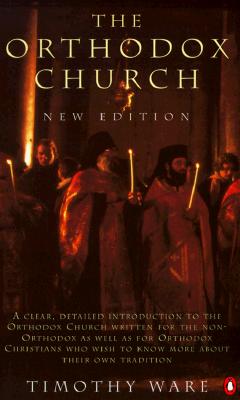
Orthodox Tradition
The Orthodox accept all ecumenical councils as “infallible” and desire to protect primitive beliefs and practices of the church. However, only the first seven major councils are considered truly “ecumenical.” Although Catholics went on to have more councils the Catholic Tradition would consider “ecumenical,” the Orthodox do not recognize them as ecumenical at all, and therefore do not recognize them as authoritative.
The Orthodox often consider the “apparent changelessness” of the Orthodox Church as one of its distinct characteristics: its “air of antiquity” and faithful continuation of the ancient practices of the church (195). According to Ware, this is also partly why some of the Orthodox fall into an “extreme conservatism” and fail to distinguish between Tradition and traditions (198). The “outward forms” that express the Orthodox Tradition include the Bible, the seven ecumenical councils (the Creed), later councils, The Fathers, the Liturgy, Canon Law, and Icons.
The Bible is honored and venerated as authoritative within the Orthodox Church, but not over the Orthodox Church. Within the Orthodox Church, Scripture is considered God’s supreme revelation (199). Therefore, its teaching has authority. However, “it is from the Church that the Bible ultimately derives its authority, for it was the Church which originally decided which books form a part of Holy Scripture” (199, italics added). Individual readers will inevitably interpret the Bible as they read it, but individual interpreters will always be “in danger of error” if they do not accept the authoritative guidance of the larger Orthodox Church. Unless an individual’s interpretation is accepted by the broader church, it is not authoritative. In this way, “it is the Church alone which can interpret Holy Scripture with authority” (199). Furthermore, the Orthodox Church does not dichotomize Scripture and Tradition, for they see Scripture as itself a part of Tradition.
It would be an understatement to say that Orthodox biblical interpretation is heavily influenced by the readings of the Septuagint: the Septuagint translation is considered “inspired of the Holy Spirit” and therefore constitutes God’s “continuing revelation” (200). This also means the ten additional books of the Septuagint are part of the Orthodox canon, although Ware concedes that many Orthodox scholars now consider the Deutero-Canonical Books of the Septuagint as “on a lower footing than the rest of the Old Testament” (200). Although Orthodox scholars have not enjoyed a prominent role in the critical-historical study of the Bible, Ware assures his readers that Orthodoxy “does not forbid” such study (201).
Even if all the doctrinal definitions of the seven ecumenical councils are “infallible,” the Nicene-Constantinopolitan Creed is the cornerstone of all the creeds, surpassing all subsequent creeds in its importance (202). Orthodox theology is also heavily influenced by subsequent definitions of certain local councils and letters or statements of faith written by certain influential bishops. Ware conveniently lists the most important of these, sometimes called the “Symbolical Books” (203).
While the theology of the Fathers produced the first seven ecumenical councils, “as with local councils, so with the Fathers, the judgment of the Church is selective” and “Patristic wheat needs to be distinguished from Patristic chaff” (204). The Orthodox do, however, see a consistency of mind in the Fathers. This they call the “Patristic mind” (204). Although there is a particular reverence for writers of the early church—especially the fourth century Fathers—“the Orthodox Church has never attempted to define exactly who the Fathers are,” so Ware is optimistic that unless God has “deserted the church,” more Fathers will come (204). The most recent “Father” mentioned by Ware, however, was the fourteenth century Saint: Mark of Ephesus (the one who refused to sign the Florentine Union document).
Ware claims that “other parts of Tradition do not have quite the same authority” as Scripture, the Creed and the Ecumenical Councils (197). When speaking of the Liturgy, however, he emphasizes that certain doctrines that the Orthodox express in their worship can be “just as binding as an explicit formulation,” even thought they have never been defined or proclaimed as dogma by Orthodoxy (197, 204). The maxim Lex orandi lex credendi [our faith is expressed in our prayer] is particularly applicable here. Orthodoxy has made very few dogmatic statements, for example, about “the Eucharist and the other Sacraments, about the next world, the Mother of God, the saints, and the faithful departed,” even though their services and the Liturgy reflect these beliefs (205).
Protestants often appreciate the theological definitions of the early councils, but Orthodox take the ecclesiastical declarations with a similar seriousness. Declarations of the ecumenical councils dealing with Church organization and governance are called canons. Certain writers compiled these canons, along with other local canons, and wrote explanations and commentaries. Today, the commentary of St. Nicodemus of the Holy Mountain (1800) known as the Pedalion [“Rudder”] is the standard Greek commentary on canon law. Although much of this ancient canon law is outdated and out of use, if and when a new general council of the Orthodox meets (which so many Orthodox despair will never happen), Ware hopes they will “revise” and “clarify” (read: update) Canon Law (205).
The Orthodox Church’s devotion to the veneration of two-dimensional icons is perhaps one of her most striking features. The Orthodox consider them as means to attain to “a vision of the spiritual world” (206). God can be revealed through art, yet because the Holy Icons are an expression of Tradition, “icon painters are not free to adapt or innovate as they please” but only within the limitations of “certain prescribed rules” (206). Their art cannot be a mere reflection of the artists ascetic sentiments but “must reflect the mind of the church” (206).
Audio Book Review: The Orthodox Church by Timothy Ware
Here is part 1 and 2 of the audio version of my book review of The Orthodox Church by Timothy Ware. You will find that on part 1 the audio volume fluctuates. This was because I accidently had my condenser microphone on a special auto setting. You can still listen and enjoy, but you may find yourself having to adjust the volume at different parts of the review.
Ware, Timothy (Bishop Kallistos of Diokleia). The Orthodox Church, 3rd Editition. New York, New York: Penguin Books, 1993. 359pp.
Part 1: Introduction and History of the Orthodox Church
Part 2: Orthodox Tradition and Theology; Criticism and Conclusion
Book Review: The Orthodox Church by Timothy Ware; Orthodox History
So many western Christians are ignorant about Eastern Christianity and The Orthodox Church. It’s not that we consciously snub our noses at Eastern Christianity; it’s that we virtually ignore them altogether. Our historical theology books almost pretend they don’t exist. We summarize the different theological views in Christianity by making reference to Protestants and Catholics, but rarely ever Eastern Orthodoxy. I might have guessed that after getting a Bachelors of Religion and a Masters of Divinity, I might know a bit about viewpoints of Eastern Christians. Instead, my own ignorance has led me to search it out. For the next several months, I will be posting almost exclusively about Eastern Orthodoxy, starting with a 4-part book summary/review of Timothy Ware’s introductory book on The Orthodox Church. I have also provided audio and PDF versions of this book summary/review for those interested in reading or listening through. My summary/review will cover Orthodox history, tradition, and theology, ending with my own criticism and conclusion on Ware’s book. Enjoy.
Book Review: The Orthodox Church by Timothy Ware (here is the whole review in PDF)
Ware, Timothy (Bishop Kallistos of Diokleia). The Orthodox Church, 3rd Edition. New York, New York: Penguin Books, 1993. 359 pp.
Born in England and converted from Anglicanism to the Orthodox faith at the age of 24, Timothy Ware became Kallistos Ware upon his entrance to the priesthood in 1966, the same year he began lecturing at Oxford on Eastern Orthodox Studies. Although Ware has become a well received historian in Orthodox studies, he is no mere academician. Since 1982, Kallistos has assisted the Ecumenical Patriarch himself, acting as metropolitan Kallistos over the archdiocese of Thyateira and Great Britan under the title Bishop of Diokleia. Furthermore, he has traveled throughout Greece and therefore is familiar with the monastic life of the East (e.g. Mt Athos and the monastery of St. John at Patmos).
Having been educated in the West, Ware’s historical and theological overview of Orthodoxy has become a widely used introduction to Orthodox Christianity in Western schools and is written with western sensitivities in mind. This makes his book an excellent starting point for the exploration of Orthodoxy for Christians in the West. The first part of Ware’s treatment covers the history of the Orthodox Church, while part two takes up various theological themes and also looks at the worship of the Orthodox Church. With unprecedented ecumenical interests in the West still active, Ware’s book is still an indispensible resource. Because Christians in the West are largely unfamiliar with Orthodoxy, rather than a mere book review, I have sought to make available a significant portion of the book’s content while giving only brief attention to criticism.
:: Orthodox History ::
Early Christianity
The history of the Orthodox Church starts at the same time and place that the history of the Catholic Church begins. Both Catholic and Orthodox tradition share in common many of the early figures of Christianity. For example, St. Ignatius, the Bishop of Antioch who wrote seven short letters on his way to Rome to be martyred, emphasized both a hierarchical and sacramental church, calling the Eucharist “the medicine of immortality” (13). Catholics and Orthodox alike have canonized St. Ignatius and have adopted many of his teachings. The same could be said of St. Cyprian of Carthage and his emphasis on the unity and salvific exclusivity of the church (14).
In Ware’s estimation, the reign of Constantine, his Christianization of Constantinople, and his instigation of the Council of Nicaea “mark the Church’s coming of age” (20). Nicaea, and the six Councils that followed, did not seek to explain the mystery of how God might become man, but simply sought to draw a fence around that mystery by excluding certain misunderstandings (20). These councils were not overly abstract and theoretical, Ware assures us, but were concerned with the message of human salvation (20). The reader is reminded by the author that the doctrine of theosis (deification)—a doctrine having centrality only in Orthodox soteriology—was taught by St. Athanasius, a champion of Trinitarian Orthodoxy during this critical period of doctrinal development in the church. It was Athanasius who proclaimed: “God became human that we might be made god” (21).
Protestants who tend to focus only on the theological declarations of the early Councils should notice Ware’s attention to the Council’s ecclesiastical declarations—all of which assumed a hierarchical structure of church government and singled out certain places for special honor in ecclesiastical affairs, i.e. the Pentarchy: Rome, Constantinople, Alexandria, Antioch, and Jerusalem (22-23, 26-28). From an Orthodox perspective, Rome’s mistake was to go beyond her place of pastoral primacy in the Pentarchy (“the first among equals”) and assume for herself supreme power and jurisdiction (27-28). It was also during the period Ware designates as “The Church of the Seven Councils” that Iconodulism was vindicated in what is now celebrated as “The Triumph of Orthodoxy” in 843 C.E. (31). Veneration of icons was not merely absolved from charges of idolatry or condoned as tolerable. Rather, the veneration of icons was (and still is) seen as a necessary safeguard for a full and proper doctrine of the incarnation (33). “The Iconoclast controversy,” Ware concludes, “is thus closely linked to the earlier disputes about Christ’s person. … about human salvation” (33).
Schisms and Attempts at Reunion
Rather than writing off the non-Chalcedonian Christians as mere heretics, Western historians will notice that Ware calls them “Oriental Orthodox Churches,” and he counts their alienation from Chalcedonian Christians as the first major historic division within Christendom, the second being The Great Schism of 1054 between East and West, and the third being the Protestant Schism of the sixteenth century (4). While Western historians have conveniently dated the Great Schism between East and West as beginning in 1054, Ware is quick to point out that starting in 1009 the Western popes were no longer included in the Diptychs (the Constantinopolitan Patriarch’s lists of other legitimate patriarchs). It does not appear coincidental that this is also the same year Pope Sergius IV is thought to have written a letter to the patriarch of Constantinople including the Filioque. Since this sort of omission of the Pope’s name from the Dyptychs is probably “tantamount to a declaration that one is not in communion with [the patriarch of Constantinople],” Ware considers this to be the real (or “technical”) date for the Great Schism (57).
Ware urges that this religious schism must also be seen in light of a larger context, for it takes place within a schism of Eastern and Western civilizations that unfortunately alienated Eastern and Western Christians (46). Although the schism was due to different developments in Eastern and Western theology and practice (e.g. different theological emphases, different styles of church government, different worship practices), Ware blames the instigation of the schism on a theologian of Charlemagne’s court who accused Eastern Christians of being “heretics” for not accepting the Filioque (51). The East had no choice but to respond. As if it was not enough that the Eastern Christians considered the Filioque heresy, tampering with the universal Creed without a universal council was considered a sin against the unity of the church. Even Pope Leo III himself, in his letter to Charlemagne, strongly objected to tampering with the Nicene-Constantinopolitan creed by adding the Filioque without an Ecumenical Council (51).
It was this tampering with the creed without ecumenical consultation, along with the papal claims of universal jurisdiction, that ultimately caused the irreconcilable differences that led to the incidents that culminated in the mutual anathemas of 1054. Exacerbating this formal schism, Crusaders began setting up Latin Patriarchs in the East. This localized the schism in new ways for ordinary Christians in the East previously unconcerned with the disputes between the pope and the patriarch of Constantinople (59). This brought the schism down to the popular level. The infamous forth crusade (1204) would further seal in blood the contentious divisions between Eastern and Western Christendom. Ware’s understanding of culpability for the schism, however, is not entirely one sided. He concedes that the East also shares responsibility for fueling the schism. For example, in the riot of 1182, “many Latin residents at Constantinople were massacred by the Byzantine populace” (61). Ware concludes that the schism was, for both sides, “a great tragedy” (61).
The first attempt at reunion with the West, The Council of Lyons in 1274, came during the restored Byzantine Empire under the auspices of Emperor Michael VIII (reigned 1259-82). But this attempt was—to a significant extent at least—motivated by political factors. Emperor Michael wanted the protection of the pope against the attacks of the Sicilian ruler Charles of Anjou, and ecclesial union was the best way to ensure this help (61-62).
The second attempt at reunion—the Florentine Union (meted out at the Council of Florence, 1438-39)—was accomplished in hopes of military support from the West and thus also largely motivated by political interests. Although its results were more impressive, this council ultimately suffered a similar fate as the Council of Lyons. In an official document, the Orthodox accepted the Papal claims, the Double Procession of the Holy Spirit, and the Roman teaching on purgatory (71). Only one member of the Orthodox party was unable to sign his name to the formula: Mark, Archbishop of Ephesus. Furthermore, both John VIII and Constantine XI (the last two emperors of Byzantium) held fast to the union.
The Union was proclaimed publicly at Constantinople in 1452, one year before the Turks began their sack of Constantinople. According to Ware, however, not only were the overwhelming majority of Orthodox clergy and people deeply against the Union, many signatories quickly recanted. The responses of the Orthodox faithful were unmistakable. When Isidore, for example, proclaimed the decrees of Florence to Moscow in 1441 he was thrown into prison by the Grand Duke (103). Orthodox people came to think that the Turkish success in their sack of Constantinople was God’s punishment for the heresy of the Florence Union where Byzantine leaders “betrayed the faith” (103-11). As for the Archbishop Mark, he was forever canonized as a saint by the Orthodox Church (71).
More recent attempts at unity have looked very different. Patriarch Athenagoras (in office 1948-72) made “the promotion of world-wide Christian unity” one of his main tasks, one for which he was “attacked by more conservative Orthodox in Greece and elsewhere” (129). His successor, Patriarch Dimitrios (in office 1972-91), however, continued to pursue to same agenda. Today, the Ecumenical Patriarch Bartholomew (elected 1991) “maintains close links with Western Christians” (129). It would seem, then, that a legacy of ecumenism now exists in the Eastern Orthodox tradition.
The Spread of Orthodoxy
Although The Orthodox Church is often accused of not being missionary minded, Ware is concerned to show that Orthodoxy has a strong tradition of missionary outreach. In his chapter entitled “The Conversion of the Slavs,” he explores the explosive missionary activity of the ninth century. The missionary work to the Slavs began to take place on a large scale with Patriarch Photius who sent two Greek brothers among the Slavs (Constantine/Cyril and Methodius) who became known as “The Apostles to the Slavs” (73). Ware unfavorably compares Rome’s insistence on a Latin mass to the missionary practice of the East. “The Orthodox Church,” Ware exclaims, “has never been rigid in the matter of languages; its normal policy is to hold services in the language of the people” (74). Although the work of these apostles seemed at first to have ended in failure, Ware considers the conversion of Bulgaria, Serbia, and Russia, to be the result of their missionary labors (75).
Eastern Orthodoxy especially flourished in Russia, initially in Keiv (before the Mongol invasions brought Kievan Russia to a “sudden and violent end”) but centering eventually in Muscovy. When Ivan III “The Great” (reigned 1462-1505) married the niece of the last Byzantine Emperor (Constantine XI), he established a link with Byzantium and began assuming the titles of “autocrat” and “Tsar” (an Eastern adaption of the Roman “Caesar”). The period from 1350 to 1550 Ware considers to be “the golden age in Russian spirituality” and religious art (86). People began to think of Moscow as “the third Rome,” the new center of Orthodox Christendom.
Ware warns, however, that some depictions and impressions of “Holy Russia” from this period place “too much emphasis on externals” (110). Nikon the Reformer (1605-81) would later aim to conform Russian Orthodoxy to ancient Greek practices of worship. He not only persecuted all opposition to his reforms, but also tried to make the Church supreme over the State (113). This went beyond the Byzantium notion of dyarchy (or symphony) between the sacerdotium and imperium, each supreme in its own sphere, and placed the Patriarch’s authority over the authority of the Tsar. Because the church had come to be controlled more and more by the state, Nikon wanted to reverse the situation and intervene in civil affairs—even taking on the title “Great Lord” (previously reserved only for the Tsar).
A Council held at Moscow (1666-67) decided in favor of Nikon’s worship reforms but against his political reform, reasserting the Byzantine doctrine of dyarchy (113). Ware believes this attempt at political supremacy ultimately caused future Tsars to suppress the office of Patriarch, for soon Peter the Great (1682-1725) would issue the Spiritual Regulation of 1721. This Regulation abolished the office of Patriarch altogether and replaced it with “The Spiritual College” or “The Holy Synod” (114). Even then, however, the church was not allowed to choose the members of this Holy Synod. This authority now belonged to the Tsar alone, along with the title “Supreme Judge of the Spiritual College” (114). There are many interesting parallels here with the history of the papacy in the West with its long chronicles of tug-of-war between ecclesiastical and secular politics.
Orthodoxy Under Persecution
Because the Orthodox are so unified in their doctrinal commitments, rather than dividing Eastern Orthodoxy according to various strands of theological camps, Ware helpfully divides the Orthodox according to social location: 1) those living in a dominantly Muslim culture, 2) those still living in the Church-State alliance of the Byzantine type, 3) those who were (until “recently”) living under Communist rule, 4) those living in the West that comprise what Ware calls “the diaspora,” made up of immigrants and converts (a significant portion of which dwell in North America), and 5) those in various missionary movements in places like East Africa, Japan, China, and Korea. Category three (those recovering from Communist control) are “by far the largest of the five groups, comprising as it does the Churches of Russia, Serbia, Romania, Bulgaria, Georgia, Poland, Albania and Czechoslovakia, and amounting to over 85 per cent of the total membership of the Orthodox Church today” (126).
Persecution is a common theme in Orthodox history. Since the expansion of Islam, Orthodoxy was not allowed to flourish freely under Muslim rule. This is still true today. For example, in the “anti-Greek” and “anti-Christian” riot of 1955, “sixty out of the eighty Orthodox churches in the city [Istanbul] were sacked or gutted and incalculable damage was done to Christian property, with widespread raping and loss of life” (128). The Patriarchate’s printing press was shut down in the 1960s by Turkish authorities. The theological school of Halki near Istanbul was forced to shut down in 1971. “By the early 1990s the Greek community had dwindled to a mere three or four thousand, mostly elderly and poor” (128).
The history of Orthodoxy under Communist rule is also grim. The beacon of Orthodoxy—Russia—experienced intense persecution during the 20th century. The basic attitude of Communist authorities during this century was hostile to Christianity (along with any other religious belief). This is because, as Ware explains the state of affairs, “Soviet Communism was committed by its fundamental principles to an aggressive and militant atheism” (145). After the Bolsheviks came to power, in Ware’s words, “The Church ceased to possess any rights; quite simply, it was not a legal entity” (146). For example, the Church was excluded from all participation in the education system. Ware gives a shocking example of an injunction given to teachers during this period:
A Soviet teacher must be guided by the principle of the Party spirit of science; he is obliged not only to be an unbeliever himself, but also to be an active propagandist of godlessness among others, to be the bearer of the ideas of militant proletarian atheism. Skilfully [sic] and calmly, tactfully and persistently, the Soviet teacher must expose and overcome religious prejudices in the course of his activity in school and out of school, day in and day out. (147)
Article 13 of the “Law on Religious Associations” (enacted in 1929) granted only “freedom of religious belief and of anti-religious propaganda” (146). “The totalitarian Communist State employed to the full all forms of anti-religious propaganda, while denying the Church any right of reply” (147). Furthermore, after 1943, bishops and clergy were not allowed to engage in charitable or social work. Even “sick visiting was severely restricted” (146). “Not only,” writes Ware, “were churches closed on a massive scale in the 1920s and 1930s, but huge numbers of bishops and clergy, monks, nuns and laity were sent to prison and to concentration camps. How many were executed or died from ill-treatment we simply cannot calculate” (148, italics added).
Tikhon, the Patriarch of Moscow, anathematized the “the godless rulers of the darkness of our time,” but was thrown into prison by the Communist regime for his outspoken resistance. “What pressures St. Tikhon underwent in custody we do not know,” but by the time of his release his antagonist tone had become more conciliatory. He died later under “mysterious circumstances” (151). Patriarch Sergius—head of the Russian Orthodox Church under the title locum tenens from 1925 to 1943 and Patriarch from 1943 until his death in 1944—would later attempt to segregate political loyalty from ecclesiastical loyalty, arguing that one could be both a Christian and a supporter of the State and demanding a “written promise of complete loyalty to the Soviet government” (152). The “exiled Synod,” however, labeled this “Sergianism” and condemned it as “capitulation of the Church to the atheist government” (153). Others, however, supported the policy of Sergius and “felt that he was sincerely seeking to protect the Church” and taking upon himself the “martyrdom of lying” to save the Church from destruction (154). “Members of the Russian Orthodox Church remain to this day deeply divided in their estimate of Sergius’ conduct” (154).
Over time, political leaders—such as Stalin—eventually realized it was in their best interest to make concessions to the church in order to have the full support of the people for war (155). In 1943, Stalin summoned Sergius and two other metropolitans into his presence and allowed them to elect a new Patriarch. After the war, Stalin also permitted a major reconstruction of the Church. Ware warns the reader, however, not to jump to the conclusion that this was a vindication of Sergius’s policy. According to Ware, this change in the churches fortunes was “a historical accident – the war” (156). Furthermore, Stalin’s toleration was limited; the State still combated the church through propaganda, disallowing a response; the State still forbade the Church to do charitable social work or youth work; the State still forbade the “religious” education of children, etc.
Perhaps most importantly, the State expected the church leaders to be loyal to the State and squelch the Orthodox dissidents who openly protested against the State’s intervention with church affairs. The Open Letter written in 1965 by two Moscow priests from this movement (Fr Nicolas Eshliman and Fr Gleb Yakunin) addressed to Patriarch Alexis “mentioned in detail the repressive measures taken against the Church by the Communist authorities and the lack of resistance, even the apparent co-operation, of the Church authorities,” and urgently called the Patriarch to act (158). “Sadly, yet perhaps predictably, the Patriarch’s only response was to suspend the two priests from their ministry” (158). Other dissidents were “sent to labour camps and exile” and the KGB discredited many of them in various ways (159). “By 1980 most of the leading Orthodox members had been silenced” (159). The Bolshevik Revolution was the single most important historical event that was a catalyst for the spread of Orthodoxy in the Western world, for it “drove into exile more than a million Russians, including the cultural and intellectual élite of the nation” (173). A significant portion of the Orthodox faithful are now North America, consisting not only of immigrants, but converts. The Orthodox Church in America (OCA), according to the more generous estimates, has over one million members.
When the Communist regime fell in 1992 and the Church in Russia began her slow liberation, she faced shocking costs of repairs, a gaping need for the supply of religious literature, lack of training in social work or religious teaching. They had to “start from nothing” (163). Furthermore, the Church now faced a pluralistic society—there was now true separation between Church and state. Athiesm was no longer the State’s “religion,” but neither was Orthodoxy. Protestant and Catholic missionaries are now free to carry out missionary work in Russia and the Orthodox Church has no power to stop it (163). “Russian Orthodoxy under Communism was in a paradoxical way still to some extent a ‘State Church’, protected by the authorities as well as persecuted. Now this is no longer so.” (163). The power of the state can no longer be used to suppress heretical movements of pretenders to Orthodoxy. There has also been a fragmentation of ecclesial structures in Orthodoxy (174). Perhaps the most crippling impairment, however, to the Orthodox Church in Russia in the post-Communist era, is her tarnished moral authority (163). “With the opening up of the KGB files in 1992, many of the laity have been scandalized to discover the extent of the collaboration under Communism between certain bishops and the secret police” (164).
7 Most Viewed__T h e o • p h i l o g u e__Posts
Of all the things I post about on my blog, it always surprises me which posts get the most hits. Here are my 7 most popular posts to date:
1. Ancient Persian Imperial History :: pt. 2 :: The Empires Peak — This was just part 2 (of 4) in a series I did on the ancient Persian Empire. I was shocked when I began to realize that more people were interested in my concise summary of this history than any of my other posts.
2. Psychology is the Devil: A Critique of Jay Adams’ Counseling Paradigm — My very brief criticism and critique of Jay Adams’ book Competent to Counsel, along with a bit of criticism about the Biblical Counseling Movement he influenced. I don’t know why this post became such a popular post either.
3. The Sacrament of Baptism in Roman Catholic Theology — Here I simply summarized the Catholic view of Baptism using the Catholic Catechism and offered my friendly Protestant critique.
4. Charlemagne & the Carolingian Renaissance — The entire history of Charlemagne and his legacy in four short paragraphs.
5. What Martin Luther Really Said — In this post, I correct a certain misunderstanding of Luther’s doctrine of justification by offering quotations from Luther that show that Luther’s doctrine of sola fide is not what most Protestants think it is.
6. Extra-biblical Evidence for King David — I read a book written by a secular historian who thinks King David was a brutal tyrant. Yet his introductory chapter deals with evidence for King David, and the author thinks many historians are being unreasonable in their skepticism about the existence of the Davidic Kingdom. I couldn’t believe what I read.
7. Book Review: Jesus of Nazareth by Pope Benedict XVI — My review of the current Pope’s book about Jesus. This review is not easy reading, for I critically analyze Pope Ratzinger’s theological methodology, not the substance of the book as a whole. I use the Pope’s own explanation of an ideal methodology (taken from an article written long before he was pope) to judge whether or not the Pope is faithful to his own methodological proposal.
 T h e o • p h i l o g u e