
Home » Articles posted by T h e o • p h i l o g u e (Page 2)
Author Archives: T h e o • p h i l o g u e
Atheist Ethics :: Book Review of Julian Baggini’s book Atheism: A Very Short Introduction
We have looked at how to better define atheism and the rational case for atheism. In this post I will summarize Julian Baggini’s own summary of atheist ethics, presented in chapter 3 of his book Atheism: A Very Short Introduction (Oxford University Press, 2003), 119 pp. Where does morality come from? How can people who don’t believe in God believe there are moral codes everyone should obey? Does morality automatically make perfect sense in a theistic framework? He answers these types of questions in this chapter.
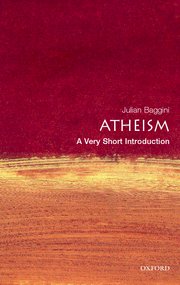
Chapter 3: Atheist Ethics
Many people believe that in order for morality to be possible, one must have a lawgiver and a judge who either punishes or rewards, but Baggini says this confuses law and morality—laws can be either moral or immoral. The big question is this: Where does morality come from? The author makes his case against the theist view of morality by breathing fresh air into the Euthypryo dilemma from the Socratic dialogues: Does God (or the gods) choose what is good because it is good, or is the good good because God (or the gods) choose it? If we answer this question by arguing that God just is goodness (God and good are the same thing), the Euthypryo dilemma only needs to be restated differently:
Is God good because to be good just is to be whatever God is; or is God good because God has all the properties of goodness? If we choose the former answer we again find that goodness is arbitrary, since it would be whatever God happened to be, even if God were a sadist. So we must choose the second option … this means the properties of goodness can be specified independently of God and so the idea of goodness does not in any way depend upon the existence of God. (39)
In other words, “God cannot be the source of morality without morality becoming something arbitrary” (39). Furthermore, being moral due to fear of punishment or self-interest in reward only taints (if not ruins) the concept of morality, giving the atheist “more moral merit” than the theist (40). But doesn’t this leave us all with our own “privatized moralities”? Yes, answers Baggini, but to ask the question this way (as an objection) misses the point that we all inevitably have our own privatized moralities anyway because “individual choice is an inescapable part of morality whether one believes in God or not” (41). There is no way to avoid making private decisions about what is morally right or wrong even in the theistic framework for morality, for two reasons: 1) one must make the privatized decision in the first place to follow the moral law of a religion—a decision which could later be changed or abandoned, 2) even while one has adopted a moral code of a particular religion, one still is forced to either accept these laws or reject them. More to the point: since “listening to the advice of their holy men (it is usually men)” religious persons have been led to “suicide bombing, bigotry, and other moral wrongs, it should be obvious that” adopting a religious morality “does not absolve one of moral responsibility” (43). In the end, we must all “in some sense ‘create’ values for ourselves” even if we are religious and have decided to follow the moral path laid out by that religion (46).
No Easy Answers for Grounding Morality
Baggini finds the whole question “Why should I be moral?” strange. There are no easy answers. A non-moral answer to the question only undermines morality—for example, that we should be moral because we will be happier if we do or punished if we don’t. Again, if we act moral out of self-interest, Baggini thinks we undermine morality because “morality is about acting in the best interest of others and oneself” (44). If we give a moral answer “because we ought to do what is right” our reason becomes circular. We shouldn’t expect an easy answer or source for morality that every rational person should recognize because no such answer exists.
At the root of morality is empathy and concern for the welfare of others that is, for most, a part of human instinct. It’s not a logical impulse that leads us to morality, but a psychological one. Yet if we accept it, we have a foundation for morality and the richness of Western philosophy provides a diversity of approaches for working this out.
Building a Godless Ethic
Aristotelian ethics helps us think about morality in terms of our desire for happiness and helps us see strategies for instilling virtues (although Baggini criticizes this model because he thinks any morality based on self-interest is problematic). Nevertheless when we simply think of what we need in order for life to go well, morality comes into play. Living well, however, and self-interest do not always coincide, so we need to draw from other sources of philosophy.
Utilitarianism can be another source: we think in terms of what causes pleasure and pain, then we evaluate our actions based on their consequences (both for ourselves and others). So long as we agree that pain is bad, morality comes into play. “Bad consequences thus provide reasons not to do certain actions and good consequences provide reasons to do others” (52). This adds another “pillar upon which to build a godless morality” (52).
Another pillar is Kant’s categorical imperative: asking “what would happen if everyone behaved that way?” This helps us think about the moral merit of an action apart from self-interest, which helps us avoid being hypocritical. It’s obvious that Baggini favors this pillar above the others, for he already has shown his hand that he believes it is essential to morality to avoid self-interest. “Some form of universalizability is both an essential feature of moral rules and a natural part of moral reasoning” (54). What is good or bad for us should be considered good or bad also for all others in similar circumstances.
In the end, Baggini admits he has not provided any sort of logical proof that atheists ought to behave morally, but he is not bothered by this because he thinks theists have no such logical proof either. It’s a myth, he argues, that morality just comes along with the package if you are a theist. “Being good is a challenge for everyone, atheist or non-atheist” (56).
Can an Atheist Believe in Meaning or Purpose?
In our next post, we will explore meaning and purpose within an atheist worldview. Once I have summarized all of the major points in each chapter, I will offer my own personal assessment of Julian Baggini’s account of atheism.
The Case for Atheism :: Book Review of Julian Baggini’s book Atheism: A Very Short Introduction
In this post I will summarize Julian Baggini’s own summary of the case for atheism, presented in chapter 2 of his book Atheism: A Very Short Introduction (Oxford University Press, 2003), 119 pp.
Chapter 2: The Case for Atheism
To make a case for anything, argues Baggini, one must use a combination of argument/logic, facts/evidence, and rhetoric. Rhetoric is the odd ball here, since it can neither make a case good or bad, but only makes good or bad cases more or less persuasive. The structure of Baggini’s overall argument is this: strong evidence counts in favor of atheism, and only weak evidence counts against it. What makes evidence stronger is its experimental verification—that is, “evidence is stronger if it is available to inspection by more people on repeated occasions” (13). Likewise evidence is weaker if “it is confined to the testimony of a small number of people on limited occasions” (13).
Evidence
There is a continuum here, with extremes on each side. On the extreme side of strong evidence we have things like “in countless repeatable tests countless scientists have verified that water freezes at zero degrees centigrade,” and on the extreme side of weak evidence we have anecdotal evidence such as “my dog spontaneously combusted right before my eyes yesterday at 2:00pm while I was at home all alone.” In the former case, we have countless witnesses and can repeatably test the claim. In the latter case, we have a claim that relies on the testimony of a single person relating one incident. It’s not that the latter is not evidence at all, it’s just that it is weak when compared to “all the other evidence” that suggests dogs do not spontaneously combust (14).
Secondly, it’s not strong evidence because “human beings are not very good at interpreting their experiences especially unusual ones” (14). This does not mean such testimony should reflect poorly on the character of the one testifying to some anomaly—they could be the victim of a clever trickster or just be mistaken about the interpretation of their experience. The strength of evidence grows in proportion, then, to an occurrence’s repetition under close scrutiny. The close scrutiny part is important too, since magicians (for example) can make it seem that rabbits can be instantaneously transported into previously empty hats quite regularly, but such an occurrence (though there might be thousands of witnesses) does not hold up under close scrutiny.
Baggini insists that the argument for atheism does not follow the “absence of evidence is evidence of absence” fallacy, for he is not concluding that absence of evidence for God’s existence necessarily means God does not exist, only that the strongest evidence favors naturalism, and only weak evidence seems to favor Theism (or anything supernatural). Thus, the conclusion of his argument is not “God does not exist,” but rather: we have no good reason to suppose God exists, for nature is found to lack any good reason for such a hypothesis.
If we look inside the fridge, thoroughly examine it, and don’t find any butter, then we have an absence of evidence which really does add up to evidence of absence. Indeed, it is hard to see what other evidence there could be for something not being there other than the failure to find any evidence that it is there. Something which does not exist leaves no mark, so it can only be an absence of marks of its existence that can provide evidence for its non-existence. … So the evidence for atheism is to be found in the fact that there is a plethora of evidence for the truth of naturalism and an absence of evidence for anything else. (17)
It’s unfortunate that many people see atheism as simply an attack on the existence of God rather than the affirmation of naturalism, which rules out “goblins, hobbits, truly everlasting gobstoppers,” etc., and God just happens to be another one of those postulates that lacks any strong evidence. Owing to historical circumstances, however, atheism is the name branded to naturalists, which perpetuates the stereotype of atheism as something fundamentally negative.
Although atheist humanism tends to affirm “human exceptionalism” (the belief that humans are essentially different from other animals) it does not go as far as to claim that human beings survive death after the grave because they have an immaterial soul. All the strong evidence suggests that human consciousness is the product of brain activity “and that with no brain, there is no consciousness” (18).
The data of neurology show that all the diverse experiences which we associate with consciousness correlate with particular patterns of brain activity. The key word here, of course, is ‘correlate.’ To say brain events are conscious experiences correlate is only to say one always accompanies the other. This is not to say one causes the other. … But while it is true that a correlation does not necessarily indicate a cause, in the case of brains and consciousness the link is at least one of dependency. … If any one thing distinguishes us as individual persons then that must be our capacity for consciousness and rational thought. And if this capacity is entirely dependent on our organic brains, as the strong evidence suggests, then the atheist view that we are mortal, biological organisms is well supported. (18)
Counter-evidence is of the weak variety—from the testimony of mediums, supposed appearances of ghosts, near death experiences, and so on. Demanding a case-by-case rebuttal from atheists on any claim of life after death, as many do, places an unfair burden on the atheist. It’s enough that atheism can appeal to general principles and strong evidence. The burden of proof should be on the non-atheist. And in any case, “none of these so-called cases … have left us with anything approaching the kind of generally observable, verifiable data that is characteristic of strong evidence. So the question for the non-atheist must be, why do they think that a few pieces of such weak evidence for life after death will suffice to outweigh the mountain of strong evidence for the mortality of human consciousness?” (21).
Baggini admits that his arguments will not be persuasively conclusive for those bent on believing, since for many it only takes the mere logical possibility that there is life after death to justify either believing in it or withholding judgment. He reminds us that logical possibilities like this exist for so many beliefs. For example:
Tomorrow it will be revealed that you have lived all your life in a virtual reality machine; that aliens have been preparing for an invasion of Earth for the last hundred years; that the Pope is a robot; that the Apollo mission never made it to the moon and the whole landing was filmed in a studio; that the evangelical Christians were right all along and Judgment Day has arrived. But the mere possibility that such things might be true is no reason to believe them. Indeed, the fact that the evidence to date suggests strongly they are not true is good reason to disbelieve them. (22).
Is Atheism Dogmatic?
The author is concerned to emphasize that his position is not dogmatic, for he still believes in the defeasibility of his views—namely, that the possibility remains that he could be wrong. After defining dogmatism as the belief that one’s position is indefeasible, and his own view as “firmly held belief” rather than dogmatism, he goes further to suggest that one must go beyond merely gesturing that one might be wrong, but must sincerely acknowledge this possibility. This sincerity allows for a distinction between dogmatic atheism and un-dogmatic atheism. Neither the theist position nor the atheist position can be proven, and thus absolute certainty is not a possibility.
Although absolute certainty is not possible for theism or atheism, for some reason (perhaps Plato he suggest) too many people think in black and white, all or nothing terms. He bemoans the fact that people often think we are not justified in believing something unless we can be sure—if followed through to its logical conclusion, he argues, this would lead us to doubt everything we think we know. All we need are good reasons to believe something.
I am as opposed to dogmatic atheism as anyone, and I am also opposed to dogmatic theism. Indeed, it is my personal view that dogmatic views of any kind are in general more dangerous than the views themselves. Intelligent atheists often have much more in common with undogmatic theists than one might suppose. (24 – 25)
Baggini makes explicit his reliance on inductive reasoning, a type of reasoning that doesn’t lead to absolute certainty, but generalizes from specific evidence. He argues that everyone uses this type of reasoning every day so its legitimacy cannot be denied. For example, we always rely on the principle of uniformity—that natural laws will continue to operate tomorrow the way they did the day before so that gravity, for example, will not suddenly stop holding you to the earth. We don’t believe in this principle because it logically follows or is somehow logically necessary, yet we still strongly believe it because of our inductive reasoning.
We live in a world where everything is governed by natural laws and everything is explainable in terms of natural phenomenon. Many things remain unexplained, but as the past has shown, as our knowledge increases about natural phenomenon naturalistic explanations continue to fill in the gaps—gaps that in many cases were previously filled with supernatural explanations. It’s reasonable, then, to expect that supernatural explanations feed off of ignorance. As Baggini puts it: “The class of unexplained phenomena therefore is unlikely to contain anything that will come to be explained by anything supernatural” (27).
Arguments from “Best Explanation”
In addition to the evidence of experience, Baggini adds a second argument he labels “abduction” or “argument to the best explanation” (27). He admits that the criterion for judging whether one explanation of a phenomenon is “better” than another is not like a math problem because “there is no magic formula” for adjudicating between two explanatory hypothesis (28). Nevertheless, he argues that “in general better explanations are simpler, more coherent … more comprehensive” and more testable than the alternatives (28).
Atheism is simpler because it posits only the natural world, not a natural and supernatural world where the supernatural world is by definition unobservable. This extra dimension of the supernatural is thus less testable. A naturalistic worldview is also more coherent for several reasons. First, it fits the whole universe into one scheme of being rather than two, and when you have two it requires an explanation of how the natural and supernatural interact and co-exist. Second, it better explains the phenomenon of world religions all contradicting each other. The alternative would be to hold that only one (or a few maybe) are really true.
It’s no good saying that all religions are different paths to the same truth: the fact has to be accepted that religions flatly contradict one another, and if one were to focus simply on what all religions agree upon one would be left with very little indeed. (29)
Third, atheism better explains the existence of evil in the world—the religious explanation “requires rather a lot of sophistical reasoning” for explaining how a loving God would allow such terrible suffering and injustice. Fourth, what best explains the dependency of consciousness of brain activity? This makes perfect sense for a naturalist who doesn’t posit a non-material thinking soul that exists (somehow mysteriously) alongside brains and interacts with them—and further that “the dependencey of consciousness on brain activity miraculously disappears at death, when the soul lives on without the body” (30).
These are just a few examples, but in the big picture Baggini thinks naturalistic explanations are less problematic.
Is Atheism a Faith Position?
It’s often claimed that because atheism cannot “prove” their case to be true with absolute certainty on the basis of logic or science, atheism is just as much a “faith position” as theism. But Baggini dispels this myth by showing that we must make a distinction between believing something because one thinks they have sufficient and strong evidence for believing it (even if it’s not conclusive), and accepting a belief without such evidence merely on the basis of faith. Most of our beliefs we don’t have absolute proof for anyway, so to call all beliefs “faith positions” that cannot be proven absolutely (even if there is strong evidence for them) is very misleading.
The popular notion of religious faith includes the opposite element: believing in something on mere trust without first requiring evidence or logical argument. For example, the Christian scripture teaches “blessed are those who have not seen and yet have believed” (John 20:29). Naturalism, according to Baggini, does not require one to believe anything that goes against available evidence, experience, or logic. It only requires one to believe what there is strong evidence for believing. Religious faith is “what supports beliefs that lack the ordinary support of evidence or argument” (33). This is very different from atheist “faith,” and to call beliefs that are rationally justified based on strong available evidence “faith” is to rob the word of its meaning.
In my next post I will attempt to summarize the rest of his book before my final post, where I will offer my appraisal of his book and arguments.
What is Atheism? :: A Book Review of Julian Baggini’s “Atheism: A Very Short Introduction”
In the next few posts I will be both summarizing and reviewing a book designed to explain and defend Atheism. The book is not written for academicians but intended for the broadest possible audience.
Julian Baggini, Atheism: A Very Short Introduction (Oxford University Press, 2003), 119 pp.
In this short book, Baggini has defined for us what it means to be an atheist, summarized the case for atheism, addressed some of the main objections to atheism, and clarified some of the misconceptions of atheism along the way. In defining atheism, the author is concerned to correct what he sees as a misunderstanding that atheism is fundamentally negative. As he puts it “there is no a priori link between being an atheist and having a positive or negative outlook” (11). Furthermore, for Baggini, atheism is actually a positive worldview “that includes numerous beliefs about the world and what is in it” (8-9). Atheism, as he sees it, is not parasitic on religion, but would exist whether religious belief in God or gods existed or not (9).
Chapter 1: What is Atheism?
Defining atheism simply in terms of its negative aspects—the lack of belief in God or gods—is an unfortunate accident of historical circumstance. That is, if we define atheism negatively we commit the etymological fallacy, which Baggini summarizes as “the mistake of thinking that one can best understand what a word means by understanding its origin” (7). The linguistic construction of the word “atheism” may be fundamentally negative (a + theism = no theism), but (warns Baggini) to assume therefore that atheism itself is fundamentally negative is a logical fallacy.
He is also concerned to avoid the pitfall of allowing his discourse about the nature of atheism not to degenerate into a negative bashing of religious belief (7). As we will see in chapter 2, he also does not want to come across as dogmatic in his belief, and admits that even though he has no good reason to think so, he may be wrong. In many ways Baggini is attempting to leave the reader with a more positive impression of atheism, not just convince them that atheism is reasonable.
One of his illustrations will prove helpful here. Before people started believing in the Loch Ness Monster, people who did not believe in this monster were not called “anessies” or defined in fundamentally negative categories. The rise in popularity of belief in the monster Nessie, however, as a matter of historical circumstance, caused people who had an otherwise positive worldview to be defined in exclusively negative terms by being branded as “anessies.” Likewise, argues Baggini, the same historical misfortune has befallen atheists, and this book seeks to redress this situation.
Baggini defines atheism as “the belief that there is no God or gods,” but stresses that many people assume this means atheists do not believe in morality or meaning to life (3). “Atheism is only intrinsically negative when it comes to belief about God,” says Baggini, “it is as capable of a positive view of other aspects of life as any other belief” (3). He does admit, however, that atheism tends to go hand in hand with something called naturalism, which he distinguishes from something else he calls crude physicalism. While naturalism is “a belief that there is only the natural world and not any supernatural one,” crude physicalism is the belief that “the only things that exist are material objects” (4).
What’s the difference? A subtle distinction Baggini believes is worth pointing out: so much of the natural world includes forces of physics that “don’t seem to be ‘material objects’ in the everyday sense of the word” (e.g., gravity, magnetism, human ideas and affections). Therefore Baggini thinks it may be misleading to call naturalists “physicalists” because it might seem to imply that they don’t believe in forces of physics that may not be considered “material objects” in the common use of language. Those who rule out the existence of such “forces of physics” he calls eliminative materialists. Eliminative materialists believe that everything that exists is physical “stuff” in the normal use of the word that excludes forces of physics (5).
Although Baggini is a naturalist, he wants to distinguish himself with something he calls philosophical Naturalism, which he believes “may make stronger and more specific claims” (5). He puts it another way: atheists are usually naturalists with a lower-case “n,” not necessarily an upper case “N.” Also, rather than “crude physicalism” or “eliminative materialism” the author is willing to believe in a generic form of physicalism so long as it’s defined the same as naturalism, so that it includes forces of physics in addition to “physical stuff.” SIDE NOTE: I’m not sure what philosophical group Baggini has in mind here, since I’ve never personally heard of any such group of naturalists who are in denial that forces of physics are contained within and caused by nature. It seems to only make his presentation more muddled (but more about that in my final post).
In case you are a bit turned off by all these heavy labels (naturalism vs. Naturalism, eliminative materialism, crude physicalism), we should simply note that Baggini believes that everything that exists is contained within what we call “nature” (even if it’s not physical “stuff” in the normal sense of the word “physical”—like human ideas or affections) and nothing exists outside of nature that would therefore be considered as somehow supernatural. Although it’s admittedly possible for atheists to believe in the supernatural even if they don’t believe in God or gods, the author argues that atheism tends to be more of a by-product of naturalism and thus (with perhaps a few exceptions) goes hand-in-hand with it. In this I’m sure Baggini will be glad to find himself in agreement with most theists who also are keen to point out this philosophical link.
In my next post I will discuss his second chapter, where he makes a summary of “the case for atheism.” My critical and laudatory remarks will be reserved until the very end once I have summarized each chapter, at which time I will post a link to the full book review in PDF format for those who wish to read it all the way through as opposed to a series of posts.
Bradley R. Cochran
John Chrysostom’s Interpretation of Romans 1:1-7 :: The Fathers of the Church
I have summarized highlights of John Chrysostom’s interpretation of the introduction to the book of Romans. I believe they foreshadow much of his interpretation of the rest of the book. Wanting my citations to be easily traceable but using an online version of the text (which does not supply the page numbers of the original), I have cited his homilies on Romans this way: § 1.1:1 = Chrysostom, “Homilies on Romans,” Homily 1, comments on Romans chapter 1, verse 1. Where no citations appear after quotations, you can see from the biblical text where I am pulling the commentary from Chrysostom: I have used the RSV in my English translation.
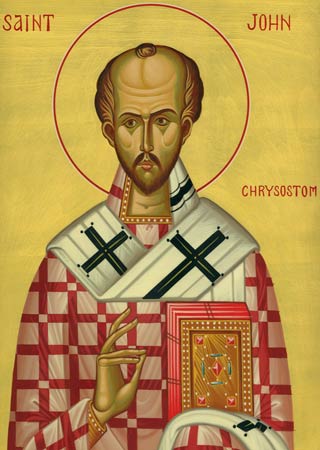
John Chrysostom, “Homilies on Romans,” in Nicene and Post-Nicene Fathers,First Series, Vol. 11, translated by J. Walker, J. Sheppard and H. Browne, and revised by George B. Stevens; edited by Philip Schaff (Buffalo, NY: Christian Literature Publishing Co., 1889); revised and edited for New Advent by Kevin Knight, http://www.newadvent.org/fathers/210203.htm (accessed 11.10.12).
Romans 1:1-7
(1) Paul, a servant of Jesus Christ, called to be an apostle, set apart for the gospel of God
The fact that Paul (unlike Matthew, John, Mark, and Luke) attaches his own name to his letters becomes a textual irritant that requires explanation—a twofold irritant, since Hebrews was thought at that time to have been written by Paul but did not bear his name as in his other letters (§ 1.1:1). Chrysostom argues that it would’ve been superfluous for Moses or the gospel writers to attach their names to their writings because they were writing for people “who were present” and therefore already knew the author, whereas Paul was writing for people far away. As for Hebrews, Paul left off his name because he didn’t want to prejudice his hearers, since some of the target audience was “prejudiced against him,” thus leaving the work anonymous “subtly won their attention by concealing the name.”
God changed Saul’s name to Paul’s so that he could acquire the same preeminence of the other apostles.
Paul calls his message “gospel” because unlike the prophets who bore messages primarily of judgment, Paul’s message is primarily of the “countless treasures.”
(2) which he promised beforehand through his prophets in the holy scriptures,
Paul emphasizes that his message has been prophesied “expressly” and in “temper” already in the Old Testament because some have accused him of novelty (§ 1.1:2). God announces beforehand his great deeds “to practise [sic] men’s hearing for the reception of them when they come.”
(3) the gospel concerning his Son, who was descended from David according to the flesh
Paul mentions that Jesus was born “according to the flesh” before referring to his divine origin “according to the Spirit” because “he who would lead men by the hand to Heaven, must needs lead them upwards from below”—which is the same reason Jesus was first revealed as a man, then later as God; for the same reason also Matthew, Luke, and Mark began from “below” as well with their genealogies in their gospel accounts.
(4) and designated Son of God in power according to the Spirit of holiness by his resurrection from the dead, Jesus Christ our Lord,
This passage is “made obscure by the close-folding of the words” (§ 1.1:4).
It is made plain that the person of Jesus was also the Son of God by way of his generation: 1) the testimony of the prophets, 2) the way of his generation (“he broke the rule of nature” [in being born of a virgin?]), 3) by his miracles which revealed power, 4) “from the Spirit which He gave to them that believe upon Him, and through which He made them all holy, wherefore he says, ‘according to the Spirit of holiness.’ For it was of God only to grant such gifts,” 5) from the resurrection.
Chrysostom appears to take the Greek word horízô in the sense of “declared” (cf. KJV, NRS, NASB, NIV, ESV) rather than in the sense of “designated” (cf. RSV, CEB).
(5) through whom we have received grace and apostleship to bring about the obedience of faith for the sake of his name among all the nations,
Paul “calls the things of the Spirit, the Son’s, and the things of the Son, the Spirit’s” (§ 1.1:5).
That grace is what causes the apostleship that brings about faith shows
… it was not the Apostles that achieved it, but grace that paved the way before them. As also Luke says, that “He open their heart” Acts 16:14; and again, To whom it was given to hear the word of God. “To obedience” he says not, to questioning and parade of argument but “to obedience.” For we were not sent, he means, to argue, but to give those things which we had trusted to our hands. (§ 1.1:5)
Here Chrysostom emphasizes that the word of God is only to be received by the apostles as opposed to handled “curiously” by adding to it or making an “argument” for it. The apostles were sent out to preach so that “we for our part should believe.”
Not that we should be curious about the essence, but that we should believe in the Name; for this it was which also wrought the miracles. … And this too requires faith, neither can one grasp anything of these things by reasoning…(§ 1.1:5)
Here we can see Chrysostom developing a dichotomization between argument, reason and novelty on the one hand, and what the role of the apostles were on the other: they were only to receive the revelation and then deliver it. Likewise, those who receive the revelation in faith are not to be “curious about the essence” because it cannot be grasped by human reason.
Chrysostom takes Paul’s claim to have received apostleship “among all nations” as an irritant that requires explanation since Paul did not literally travel and preach to all nations.
What? Did Paul preach then to all the nations? Now that he ran through the whole space from Jerusalem to Illyricum, and from thence again went forth to the very ends of the earth, is plain from what he writes to the Romans; but even if he did not come to all, yet still what he says is not false, for he speaks not of himself alone, but of the twelve Apostles, and all who declared the word after them. And in another sense, one would not see any fault to find with the phrase, if about himself, when one considers his ready mind, and how that after death he ceases not to preach in all parts of the world. (§ 1.1:5).
Paul “attaches no more to [the Romans] than to the other nations” even though they were at the top of the world so to speak, but numbers them among the Scythians and Thracians “and this he does to take down their high spirit and to prostrate the swelling vanity of their minds, and to teach them to honor others alike to themselves.”
(6) including yourselves who are called to belong to Jesus Christ;
Paul continues to humble the Romans with the use of the word “called” here which emphasizes: “you did not come over of yourselves” (§ 1.1:6).
(7) To all God’s beloved in Rome, who are called to be saints: Grace to you and peace from God our Father and the Lord Jesus Christ.
Paul continually uses the word “called” to humble the Romans since it was likely that among them were high ranking people alongside common and poor people. Thus, Paul is “casting aside the inequality of ranks” by writing to them “under one appellation” (§ 1.1:7). In verses 5-7 of Paul’s introduction, then, Chrysostom already sees the development of a Pauline tact to humble certain Roman Christians, which implies that Chrysostom thought that at least part of Paul’s motivation in writing the letter was his pastoral concern to humble certain high-minded Roman believers.
Chrysostom interpreted the close arrangement of these two thoughts of being both beloved and called as a sign that the one flows from the other; hence “love presented us with grace.” That those who are called in Rome are beloved “shows whence the sanctification was. Whence then was the sanctification? From Love. For after saying, ‘beloved,’ then he proceeds, ‘called to be saints,’ showing that it is from this that the found of all blessings is. But saints he calls all the faithful. ‘Grace unto you and peace’.”
Chrysostom takes the chain of causation further and argues that love causes grace and grace causes peace. Peace he understands in terms of happiness, joy, pleasure, and delight—and all of which he understands to come in this life (not exclusively reserved for the life to come). His rational for understanding grace as causing peace shows that his primary understanding of grace is not forensic, but transformative. He argues that peace only comes when we keep “an exact watch” on our holiness so as to have “spiritual success and a good conscience.” The implication is that grace is what causes us to persevere and grow in holiness.
For he that holds on in the adoption, and keeps an exact watch upon his holiness, is much brighter and more happy even than he that is arrayed with the diadem itself, and has the purple; and has the delight of abundant peace in the present life and is nurtured up with goodly hopes, and has no ground for worry and disturbance, but enjoys constant pleasure; for as for good spirits and joy, it is not greatness of power, not abundance of wealth, not pomp of authority, not strength of body, not sumptuousness of the table, not adorning of dresses, nor any other of the things in man’s reach that ordinarily produces them, but spiritual success, and a good conscience alone. … If then we wish to enjoy pleasure, above all things else let us shun wickedness, and follow after virtue; since it is not in the nature of things for one to have a share thereof on any other terms, even if we were mounted upon the king’s throne itself (§ 1.1:7)
The key link in grace leading to peace is holiness. Grace leads to peace through holiness, which produces spiritual success and a good conscience. This common apostolic greeting “grace and peace” is thus interpreted in a way that centralizes holiness as the product of grace and the necessary condition of peace and happiness. He also interprets Paul’s “fruits of the Spirit” in these terms, citing Galatians 5:22 which includes among them love, joy, and peace as the first three. He closes his first homily by encouraging his hearers to grow in this fruit “that we may be in the fruition of joy here, and may obtain the kingdom to come, by the grace and love toward man of our Lord Jesus Christ, through Whom and with Whom, be glory to the Father, and to the Holy Spirit, now and always, even unto all ages. Amen.”
A Criticism of Scholastic Theology from an Eastern Orthodox Believer
Remember Francis Shaeffer? The great evangelical apologist who, for example, helped galvanize evangelicals over the issue of abortion? I ran across an old video of Francis Shaeffer’s son (much less known to evangelicals): Frank Shaeffer. He turned out to be an author, screenwriter and film director. He was a very adamant believer from a young age, but he converted to Eastern Orthodoxy and wrote a book Dancing Alone about his reasons for this development in his spiritual life.
I found an old video where he talks about this conversion and his reasons for it with a Reformed Evangelical host on the Calvin Forum. It was a very interesting interview, and I would recommend evangelicals especially listen to his story to try to grasp why conversions like this take place. (Note: Catholics will likely take issue with his comment that the pope had no special role in church government from earliest times). However, the most interesting part of the interview (for me) begins at 39:00 where he raises the question I’ve been struggling with for some time now about Protestantism: the problem of fragmentation. It’s something most Protestants simply take for granted and admit is a shame, but accept it as an unfortunate reality of sola scriptura (letting people interpret the Bible for themselves without being told how they should be interpreting it). Frank raises the question “Is this what Martin Luther or John Calvin had in mind?” with great eloquence and sincerity, and I think it’s worth a listen.
One of the reasons I’ve never been all that attracted to Orthodoxy is because it seems to shave off so much interesting doctrinal development that has taken place since the ecumenical councils. I find scholastic theology incredibly interesting, but he blames the Western schisms in the church (especially in Protestantism) on scholastic methodology and offers an acceptance of mystery as the solution. I think his critique may have more merit than I would like to admit.
The Unitarian Universalist Church: A Personal Encounter

Who Are the Unitarian Universalists?
It was a customary scene I have been familiar with since my own childhood: first-time visitor parking, greeters at the door with smiles and a word of welcome, double-doors leading into a Sanctuary where the morning bulletin is handed to me. People are talking to their kids, young and old alike share warm greetings, others are sitting down drinking coffee, but the room is filled with people who are rustling like leaves in the Fall wind, filling the room with the sounds of life. I take a seat in the very back trying not to be noticed, but already my new face has caught the eyes of those more familiar with the regular congregants. Hymnals are placed under every chair, a classy black piano sits in the front where choir members are taking their seats. At the sound of a chime a holy silence seems to fall over the room as the worshipers face the front and a young man begins to eloquently strike the keys. In due time the music stops, and a man stands up at the pulpit and welcomes everyone before making his announcements. A time of greeting gives me a chance to talk to the woman next to me—Barbara—a tall thin middle-aged woman with short dark hair, a warm smile and welcoming spirit. When the time of greeting is over, my eyes are fixed toward the front of the room as the pastor lights a large chalice-shaped candle. The room needs no electric lights, for the transparent windows above our heads outline the room while light floods the corporate space through a transparent spherical globe-like window that dominates the aesthetic of the room. Through it I can see the trees and the grass that compliment the paper-bag colored walls and forest green carpet inside. The transparent windows outlining the room are sprinkled with leaf-art giving the entire room the feel of nature.
Even the sermon topic was an exhortation hardly unusual to my church going ears. The pastor urges the congregation to consider the scary statistics of traditional-styled churches becoming churches of the past faced with the reality of sharp decline and the threat of extinction. He urges the congregants to be open to change even as the service (unknown to me) is uniquely sequenced to gently throw the regular attendees for a liturgical loop. As the minister is waxing eloquent, I cannot help but notice the unusually robust wooden pulpit from which his oration emanates, and his humble position in the back corner rather than front-and-center. Nor could I help from staring at the multicolored cloth draped down the middle of the massive pulpit. As I take it all in, I hear the pastor himself begin his scrutiny of the room as he lamented the stark and “Quaker-like” worship space of the churches typical of his denomination. He attempts to help his people untangle the stigma of contemporary worship music from the musical style itself. “We tend to associate contemporary worship with those churches we don’t want to be like,” he suggests, “But if you think about it … objectively … what we don’t want to be like is not a music style, but a certain theology.” He even mentions the technological revolution unfolding at the beginning of the 21st century, and how it has swiftly changed the landscape of communications.
Reverend Bill Gupton did not pick his topic capriciously, but his prophetic plea was a timely execution as the church continues to have “building conversation meetings” open to everyone. As the service progresses, a time of testimony and candle lighting finally breaks my own acquaintance with the service dynamics and my eyes behold a scene hard to forget. Before I even realized it, each side of the room was lined with congregants. I looked around to estimate how few of us were still in our seats. One by one, the congregants take their turn coming up to the microphone, offering spontaneous words of praise, mourning, humor, remembrance, joy, and gratitude, lighting a small but symbolic candle for each spoken gesture and placing it around the larger chalice-candle in the center of a table at the front of the sanctuary between the pulpit and the choir. It was then that I was reminded of just what kind of church I had walked into that morning, and how different it was from anything I knew, for as the people spoke their words and lit their candles around the chalice, I noticed a certain linguistic discipline. Those with concern either for themselves or others, rather than asking for prayer, were beseeching their fellow religionists to send “positive [or good] thoughts [or energy]” to the person of concern.
Toward the end of the service, we all stood for the recital of what I would otherwise identify as a creed had I not later learned the church strives to be non-creedal. Although they call it a church covenant rather than a creed, the way the congregation recited it reminded me of how the Apostles Creed was routinely recited aloud at the United Methodist Church my parents often brought me to as a child. Their covenant, though not a creed, is read just as powerfully as any church’s creed nonetheless:
Love is the spirit of this church, the quest for truth is its sacrament, and service is its prayer. To dwell together in peace, to seek knowledge in freedom, to serve humankind in fellowship—to the end that all souls shall grow into harmony with the Divine—Thus do we covenant with each other, and with God.[1]
Heritage Universalist Unitarian Church, although initially established in downtown Cincinnati in 1827 as a Universalist Society, merged with the Unitarians (as did all Universalist Churches in 1961) and later relocated to the eastside of the city in 1985.[2] A rainbow flag hangs in the entry room; bold colors send a bold message of tolerance. The UU Church has come to be an advocate of and supporter of social outcast groups such as the LGBT (Lesbian, Gay, Bisexual, and Transgender people). For Hollie Johnson, the Director of Religious Education at Heritage UU, the UU Church is primarily a “safe place” where people on diverse spiritual paths can pursue their spiritual journey unhindered with exposure and knowledge to a range of religions and religious beliefs. Here people do not have to worry or fear what someone else might think of their beliefs or worry about being excluded for “unorthodox” views. In this pluralistic community of tolerance, unconditional love takes on new meaning.
For congregants like Barbara Rohrer, Heritage UU has become like a family she wound up with when her own spiritual journey became at last honest. She could no longer bear the boredom of Catholic Mass, the continual anthropological pessimism that seemed to reduce the value of her spiritual status down to that of a “sinner,” and the teaching that Jesus had to die a cruel death because of her sins. “No, I reject that,” she said finally with her actions when she, in a dramatic turning point in her own spiritual journey, simply and literally walked out of the Catholic Church.[3] For Barbara, the Universalist faith has mainly to do with a rejection of the doctrine of hell—a refusal to believe that God is a vindictive deity who would torture some sector of damned humanity forever. After church shopping in her 20’s she finally landed at Heritage UU. “What I really like about Heritage is the fact that we all have so many different beliefs,” she told me over coffee in the Anderson Town Center close to the church. “I see my church as trying to live out on a micro-level what I think the world needs to live out on a macro-level.” Barbara emphasized tolerance and acceptance in a society of religious pluralism, but put more broadly this simply means “accepting other people’s differences.”[4] Here in Barbara’s words I found the simple link between theological pluralism and advocacy of the LGBT. If the UU Church is going to accept people’s varied religious beliefs, no matter how distant or contrary they are from their own, why should they hold a double standard with people’s sexual orientations, which may fit perfectly with religious intuitions about human flourishing?
Finding out that Barbara used anything but the language of material naturalism, and listening to her oft repeated refrain—“I am a Universalist. I believe we all came from God, and we all will return to God,”—my theological mind began to race over just what salvation might mean if it applies to everybody.[5] She acknowledged that she did not believe salvation was to be understood as something applying to an afterlife per se (if there even is such a thing), but had to do with basic human needs being met: food, clothing, shelter, affection, etc. I tried to conjure up a mental picture for Barbara of the injustices and hardships some orphaned children in the world are born into before they die of malnutrition or hunger, and asked how she could see salvation as applying to these most unfortunate people. If even they are saved, my mind is at a loss to comprehend what this salvation would consist in if not an afterlife.
But Barbara relentlessly brought the focus back to what ought to be rather than what actually is—that is, her response emphasized human culpability: “I think it’s up to us to make changes,” she said with a tone of urgency.[6] She believes a great deal of the suffering and injustice in the world is owing to human agency, and it is up to human agency to set it right. But when I pressed the question persistently she articulated a view of salvation as “in the here and now” and as a gift of “grace” if we choose to accept the “spiritual path,” which for Barbara is exemplified in the life of Jesus.[7] Eventually I concluded that although Barbara says she has a belief in universal salvation (that everyone is or is going to be saved), her embrace of this had more to do with an embrace of universal human dignity and human responsibility than with any traditional notion of salvation for which I had ready-made categories. Barbara’s well articulated and passionately spoken views on injustice, human culpability, and the practice of compassion, along with her contrasting hesitancy, puzzlement, and inconclusive answers to my theological quandary spoke volumes of what was central to her own spiritual journey. Listening to Barbara, I got the feeling that for her, formulating exacting creeds about how to define salvation will do virtually nothing for those in need of it, nor necessarily give the creedal adherent any major salvific advantage. Her insistence on social action and ethical concerns, coupled with her uncertainties about doctrinal definition (such as figuring out how to articulate a theology of universal salvation) make her an instructive example of why many UU folks are proud to be part of a non-creedal religion. The virtue of good deeds outweighs the virtue of formal creeds.
While Heritage offers a “Build Your Own Theology Class” where congregants are given the tools for doing theology and encouraged to discover their theology for themselves, what is most important here is the method rather than its results—people are not indoctrinated, but empowered to think for themselves. Hollie Johnson’s educational ministry at Heritage UU, according to congregant Jenny Hamerstadt who gave me a tour of the building, is bringing more and more young families to the church along with their small children. “The Children’s education has grown tremendously!” she exclaimed in an appreciative tone.[8] It was Jenny that explained to me why the atheists at their church are not offended by God-talk: they have come to an understanding that “God means very different things to different people.”[9] The tolerance practiced by UU atheists make militant atheists like Richard Dawkins look like arrogant, narrow-minded fundamentalists.
Hollie remembers being told by a Catholic priest when she was very young that she would probably not get as good of a job if she went to a secular school instead of a Catholic one. Knowing this was not true, her young mind quickly learned to question religious authority. In her late 20s as she searched for the truth on her spiritual path, Hollie began to identify with paganism and felt drawn to pay attention to the seasons, but she had to learn to overcome her fear of what her parents or others might think of this. “What we do [at UU] is support your path,” she explains, “so everybody might come to a different creed or belief.”[10] I wondered, however, if a UU fundamentalist might be an oxy-moron, so I asked whether fundamentalist evangelicals or Islamic extremists would be welcomed also and treated as equal at Heritage UU. Hollie answered slowly only after a long pause, talking as if her words were coming out before she were sure of them: “I believe that everyone will be accepted at our church, but people who want to come to our church are going to believe what we believe in.”[11]
Given the UU Church’s pride in such a non-creedal identity, I asked Reverend Bill Gupton why the pamphlet I swiped from the table peppered with free UU summation literature in the open church foyer read so much like a creed, as it proclaimed:
We believe that personal experience, conscience, and reason should be the final authorities in religion. In the end religious authority lies not in a book, person, or institution, but in ourselves. … We believe that religious wisdom is ever changing. … Revelation is continuous. We affirm the worth of all women and men.[12]
His answer was representative of what the members also told me. “Well you don’t have to agree with everything … in order to be a member of this church. You don’t have to stand up and affirm those things.”[13] He also made the point that even the seven principles of UU—which were adopted by democratic vote at a UU Convention in 1985—could be amended at any time and may not represent all UU churches. He would prefer the pamphlet used language that better reflected the state of affairs by reading “’We tend to believe…’ or ‘Most of us believe…’.”[14] As I laughed and told him how ironic it was to pick up a pamphlet that read “We believe … we believe … we believe,” when one of these statements says “We will not be bound by a statement of belief,”[15] he began to talk about his handout on “creedless creed-making.”[16] “Groups feel the need to define themselves,” Gupton replied after laughing along, “and when defining themselves to outsiders, they tend to speak in generalizations” that can sound “creed-like.”[17]
Gupton himself was attracted to the UU from a non-religious position when he discovered UU churches did not preach or teach things he could not “rationally believe in,” and emphasized in no uncertain terms the role Enlightenment thinking played in shaping these two denominations that now form the UU.
We would not exist without the Enlightenment. Every important figure in early Universalism and Unitarianism in North America was an intellectual product of the Enlightenment. The Enlightenment totally goes hand-in-hand with Unitarian Universalism. … We were a group of people who embraced the Enlightenment and all its implications early on.[18]
Given that western religion has been so caught up with belief in the supernatural—especially a supernatural deity who intervenes in history and in people’s lives—I asked Reverend Bill why he should not just give up the religious identity and become a lecture society instead. His response was unhesitatingly sanguine. “Not being interested particularly in the supernatural does not necessarily mean that you are not very interested in something greater than yourself; something greater than we can touch and see and taste.”[19] One of Reverend Bill’s recent sermon’s was focused entirely on newly developing science, for example, about electromagneticism, quantum consciousness and quantum entanglement. The point of course, was that the scientists are now arguing for counter-intuitive ways of understanding reality and are saying that maybe the universe is one giant quantum entanglement—which is to say, it is all somehow interconnected in ways we never before thought possible. I already knew the UU faith was more open-minded than conservative churches, but Gupton helped me to see how it represents a spirituality that is also “open ended.”[20]
Although UU has minority leaders currently working to help UU become more diverse, UU churches have a tendency to be on the higher end of the socio-economic latter. In general American churches tend to minister to a certain niche of society rather than a wide range of people from various socio-economic, ethnic, and racial identities. Gupton knows other UU churches in Cincinnati more racially diverse than his own, for example, and admits his congregation is mostly a representation of the immediate surrounding community of a highly educated white middleclass; it does not represent the broader community in the city as a whole. Educated or not, Gupton had no problem using excessive redundancy to make a point when conveying his own disappointments of the failed efforts to create more diversity in the UU, which efforts have been “at best ever so moderately tiny slightly successful.”[21] Thus while diversity of thought is achieved in most UU churches, social diversity is not necessarily characteristic of their churches. This high level of education results in the danger of a dry intellectualism, and thus the UU movement has had its own tradition of charismatic prophets, as it were (men like Ralf Waldo Emerson), rise up to pull the denomination in a more spiritual direction.
The Flaming Chalice
If Rev. Bill Gupton was attracted to the UU by his pleasant surprise at its full accommodation to modernity and the Enlightenment critique, and Barbara Rohrer was drawn largely through a rejection of Catholic doctrines of sin, atonement and hell, the UU church in Hollie’s words seems to pull all these stories together and highlight a common theme—as Hollie says, in the most simple terms the UU Church is a “safe place” where one will be unconditionally accepted regardless of their beliefs, race, religious background, sexual orientation, or social status. When I asked her to also interpret the UU emblem for me—a flaming chalice—she resorted to this same language: it symbolizes for her the safe place in which each person can follow his or her own path without trepidation of creedal restraint, exclusion from fellowship, unequal treatment, suppressed inquiry, or anything other than encouragement.
The Flaming Chalice, although depicted in a range of branding styles, is the official religious symbol of the UU church. It was originally created for the Unitarian Service Committee (USC) in Portugal by an Austrian musician and artist Hans Deutsch in 1941. Deutsch was a refugee from Paris who, having contributed political satire against the Nazi regime by drawing critical cartoons, was forced to flee Paris and eventually landed in Portugal and ended up being so impressed by the work of USC for refugees, wound up joining the movement and working for USC. Although depicted in many forms, this symbol was “made into a seal for papers and a badge for agents moving refugees to freedom” and the burning oil was meant to stand for helpfulness and sacrifice—“a lifetime of service.”[22] The interpretation of the symbol since its creation typifies the UU approach to religion: “no one meaning or interpretation is official. The flaming chalice, like our faith, stands open to receive new truths that pass the tests of reason, justice, and compassion.”[23] The interpretations suggested by Hotchkiss for the chalice related it to Jan Hus’s proposal that the communion chalice used in worship be shared with the laity. Charles Joy (executive director of the USC at the time of Deutsch’s service and knew Deutsch personally) was nevertheless quick to emphasize something of great importance: “the fact, however, that it remotely suggests a cross was not in the mind of the artist, but to me this also has its merit.”[24] Deutsch actually did not believe in anything he considered characteristically religious, but found himself an enthusiastic supporter of UU as he understood it to demystify religion into a confession of “practical philosophy” and “useful social work.”[25]
Context and Evaluation
The UU church is honest about its Christian roots but more proud of its liberal identity. The Universalist Unitarian Church (UUC) is the result of a merger between two liberal branches of Protestant Christianity—the Universalists and the Unitarians—who, although having started off taking the authority of the Bible for granted and basing their arguments rigidly therein, came to rely more on reason and intuition along a very similar trajectory as the American experiment itself as it progressed to increasingly tolerant laws concerning religion and social mores. Although the Universalists and Unitarians started off from different places with different theological emphases historically, their liberal identity has at last brought them together and relativized any historical or theological differences. As mentioned above, Heritage UU was founded in 1827 in America as a Universalist Church initially, so it has kept its Universalism first in the Church’s name even though this causes confusion because the denomination has these names the other way around—the UU denomination is the Unitarian Universalist Church, but Heritage is a Universalist Unitarian church.
Alister McGrath’s focus on the authority question in Christianity’s Dangerous Idea: The Protestant Revolution (New York: HarperOne, 2007) helps us to see that the variety of beliefs within a given UU church (including atheism) are a natural outworking of the movement’s multiple sources of “final authority”—personal experience, conscience, and reason.[26] In addition to the seven principles, this church also appears to have many other doctrinal beliefs: certain views on ultimate religious authority, ecclesial agency, and social justice. For example, that revelation is continuous and religious wisdom is “ever changing,” that the church should act as a “moral force” in the world, that “ethical living” is the “supreme witness of religion,” that each “church” (read: local congregation) should be free and autonomously governed, etc.[27] The UU brand of “social justice” includes acceptance and public advocacy for LGBT (Lesbian, Gay, Bisexual, and Transgender people).
If one thing is blaringly obvious from my own experience and analysis it is this—the non-creedal identity of the UU church has more to do with its insistence against traditional Christian dogma and its creedal tolerance and flexibility than anything else. They may be self-branded as non-creedal, but they most certainly have a creed that creates the climate and boundaries in which free inquiry and theological pluralism is practiced. Their routine recital of the “covenant,” the famous “seven principles” adopted by the denomination,[28] the parts of their pamphlet literature that read like a creed and the particular theological and ethical stances taken therein, Hollie’s comment about those who “believe what we believe,” Reverend Gupton’s comments about their embracing of the Enlightenment “and all its implications,” all indicate strongly that the non-creedal identity can be very misleading. Perhaps, as Gupton pointed out, the official statements can be revised at any time, but so can the Southern Baptist Message and Faith. Whether it is likely is another question.
My rich experience and conversations have left several additional impressions on me concerning the UU Church. First, Heritage’s strong Universalist history means there are many congregants like Barbara who still use God-talk and even quote Scripture, borrow traditional Christian language (like “grace” and “salvation”) and talk about Jesus. Christians are a minority in UU churches, so Heritage is unique in its strong representation of Christian linguistic residuals. Yet when asked if Christians were persecuted in any way as the UU attempts to rid itself of the baggage of Christian particulars, he laughed. “To use the word persecution, he said, would be a distortion of terms if ever there was one. Now feeling persecuted—that’s a different story.”[29] Second, the church’s move to a better part of town in 1985 also localizes the continuing trend away from non-theological diversities. Finally, with the decline in numbers abroad and locally, along with Rev. Bill’s prophetic “change or die” sermon, I have reason to be skeptical of whether the UU denomination has the potential to continue to thrive the American jungle, stomping grounds of the 900 pound Gorilla in U.S. religion.
I am alluding, of course, to the explosive Protestant evangelicalism that has recently exploded yet again in the U.S. in the form of Pentecostalism in recent history expanding its reach of influence into the global South. As long as this massive Gorilla keeps a tight grip on the popular level of American religion across class, race, political, and denominational divides, the UU church will be swimming upstream against a constant smear campaign in which UU churches are seen as ecclesial duds, lacking any firm theological basis for aggressive expansion. It certainly appears that all King Kong has to do is say the word “liberal” and all the stigma of a unbelieving, scripture twisting, relativist with no objective standard of ethics is immediately foisted upon the perceptions of Americas religious majority. So long as America continues to be a land of openly competing ideologies, the religious landscape will be determined by who has the competitive edge, and minority groups like the UU might do well to come full circle and seek to learn a little something about evangelical fervor, the strength of easy-to-grab ready-made commitment demanding doctrines that provide a totalizing worldview capable of pervading the religious adherents entire way of life, missions mobilization, traditions of apologetics for intellectual engagement, and the list could perhaps go on, but you get the point. Whatever else the UU might say about evangelicals, they have a history of explosive expansion and institutional strength.
[1] Church bulletin for December 4, 2011 at Heritage Universalist Unitarian Church.
[2] Unitarian Universalism and Heritage Universalist Unitarian Church (founded 1827), anonymously printed pamphlet. For a brief historical overview of both denominations, see “Appendix 1.”
[3] Interview with Barbara Rohrer, congregant at Heritage Universal Unitarian Church in Cincinnati, Ohio: 2011.
[4] Ibid.
[5] Ibid.
[6] Ibid.
[7] Ibid.
[8] Interview with Jenny Hamerstadt, congregant at Heritage Universalist Unitarian Church in Cincinnati, Ohio: 2011.
[9] Ibid.
[10] Interview with Hollie Johnson, Director of Religious Education at Heritage Universalist Unitarian Church in Cincinnati, Ohio: 2011.
[11] Ibid.
[12] Marta Flanagan, We Are Unitarian Universalists (UUA Pamphlet Commission Publication, 1999).
[13] Interview with Bill Gupton, minister of Heritage Universalist Unitarian Church in Cincinnati, Ohio: 2011.
[14] Ibid.
[15] Marta Flanagan, We Are Unitarian Universalists.
[16] Interview with Bill Gupton.
[17] Ibid.
[18] Ibid.
[19] Ibid.
[20] Ibid.
[21] Ibid.
[22] Dan Hotchkiss, The Flaming Chalice (Boston, MA: UUA Pamphlet Commission Publication, 1993).
[23] Hotchkiss, The Flaming Chalice.
[24] Ibid.
[25] Ibid.
[26] Marta Flanagan, We Are Unitarian Universalists (Boston, MA: UUA Pamphlet Commission Publication, 1999).
[27] Ibid..
[28] “We affirm: The inherent worth and dignity of every person. Justice, equity and compassion in human relations. Acceptance of one another and encouragement to spiritual growth in our congregations. A free and responsible search for truth and meaning. A free and responsible search for truth and meaning. The right of conscience and the use of the democratic process within our congregations and in society at large. The goal of world community with peace, liberty, and justice for all. Respect for the interdependent web of existence, of which we are a part.” Unitarian Universalism and Heritage Universalist Unitarian Church (founded 1827).
[29] Interview with Bill Gupton.
A u d i o p o s t :: A Wake Up Call :: The Continuation of Human Slavery
For those of us who tend to think of slavery as merely a historical evil (that is, an evil only to be studied from our past) abolished years ago with the abolitionist movement: it’s time for a wake up call. Human Trafficking is arguably the fastest growing and most profitable organized criminal activity (expected to surpass even drug smuggling profits within the next decade).
 The following is an excerpt from the introduction of Kevin Bales’ book Ending Slavery: How We Free Today’s Slaves (Berkley, California: University of California Press, 2007), 1-2.
A u d i o p o s t :: The Great Questions
The following audio is a book reading about “The Great Questions” from William Portier’s Tradition and Incarnation: Foundations of Christian Theology (Mahwah, New Jersey: Paulist Press 1994), 9-16.
[audio https://theophilogue.com/wp-content/uploads/2012/05/reading_portier_incarnationtradition.mp3]Do Catholics Practice Open Communion? :: The Case of Frère Roger
Do Catholics practice open communion? In the past, I would’ve answered this with a simple: No. And perhaps on the local level for many Protestants this is the case. However, John Armstrong of ACT3 (author of Your Church is Too Small who also recently had an unprecedented ecumenical dialogue with the Archbishop of Chicago which can now be viewed here) has recently written two posts that make the picture more complicated. 
He points to the example of Frère Roger of the Taizé Community, a Protestant until the day of his death who was nevertheless communed by the highest authorities in the Catholic Church for a long time. I have taken a few excerpts from these posts to give a summary. The first excerpt comes from his post entitled: “Chicago Taizé: An Event You Should Know About.”
The Taizé Community was begun after World War II by a young Reformed minister by the name of Frère Roger, or Brother Roger as we know his name in English. Roger Louis Schütz-Marsauche (1915-2005) was the ninth and youngest child of Karl Ulrich Schütz, a Reformed pastor from Bachs in the Swiss Lowlands. His mother was Amélie Henriette, a French Protestant from Burgundy (France).
From 1937 to 1940, Roger studied Reformed theology in Strasbourg and Lausanne. He was a leader in the Swiss Student Christian Movement, part of the World Student Christian Federation.
… Today the community has become one of the world’s most important sites of Christian pilgrimage. Over 100,000 young people from around the world make pilgrimages to Taizé each year for prayer, Bible study, sharing, and communal work. Through the community’s ecumenical outlook, they are encouraged to live in the spirit of kindness, simplicity and reconciliation. Some of you know about Taizé because of hymns and simple songs that you use in worship or you have attended a unique Taizé service.
In his following post, “The Life and Witness of Brother Roger: An Icon of Love and Unity,” Armstrong points out something that both surprised and delighted me when I first discovered it.
I wrote in my book, Your Church Is Too Small, of Cardinal Ratzinger serving the Eucharist to Brother Roger at the funeral Mass of John Paul II. I have had a number of responses to this statement, many claiming that Cardinal Ratzinger was “caught off guard” when Brother Roger was wheeled forward to the altar areaafter the service had already begun. With him very near the bishops there was a sense that they had to serve him the Eucharist rather than create offense. I have asked members of the Taizé community about the facts of this case and I am persuaded that I now know the truth.
The answer as follows. Brother Roger went to Rome for the funeral but did not plan to go when the day of the service came because he had arisen that morning so weak and tired. He was even late in arriving. Because he was so widely known and loved he was wheeled forward to a place where the cardinals were near to the altar. When the time came to distribute the sacred meal it is true that there was little choice but to serve Brother Roger. But what those who insist that a Protestant minister could not be communed fail to realize is that this was gladly done because it had been done for many yearsbefore this Mass seen by millions of viewers the world over. Brother Roger did not force anyone’s hand in the matter. He did not create a problem. He was placed there, by Catholic leaders, out of love. He would not have been there in the first place had others not have taken him there. But the simple fact is that he acknowledged the real presence of Christ in the Eucharist, remained a Protestant minister his entire life and was routinely communed by Catholic priests, including the last two Popes.
In an unusual way Brother Roger was an icon and Taizé remains an iconic community of love and unity. This is one of the many reasons I encourage you to learn more about this remarkable mission. It is also why I encourage you, if you are between 18-35 years of age, to attend the Memorial Day Taizé conference at DePaul University.
 T h e o • p h i l o g u e