
Home » 2009 (Page 4)
Yearly Archives: 2009
THoR = The History of Rome :: Mike Duncan
Mike has put together an amazingly entertaining History of Rome podcast series with all the historical detail you could want. I’ve listened to over half the episodes already each morning as I get dressed, each night as I am going to bed, and in my car on the road. It’s very addictive.
Although this video link below is not a trailer for the podcast, it can wet your appetite.
::::::::::::: HT: The History of Rome
Book Review: Seeing With New Eyes by David Powlison
Since I posted a book review on Jay Adams’ book Competent to Counsel entitled Psychology is the Devil: A Critique of Jay Adams’ Counseling Paradigm, it has been the most viewed post here at T h e o • p h i l g u e. On the one hand, I think the Biblical Counseling Movement has great potential and certainly beats compromised approaches to counseling that do not take the Christian Worldview seriously enough. On the other hand, I also think that many who associate themselves with the BCM are plagued with a spirit of anti-science, and that sometimes those who are not a part of their movement interpret and apply the Bible in a way that is more biblically informed and scientifically aware. Although not associated closely with BCM or the integrationist approach, Eric Johnson has presented by far the most balanced and sophisticated approach that anchors itself in a biblical worldview without bashing science and psychology. I have learned, however, after reading more literature from the BCM, that not everybody thinks as dogmatically as Jay Adams (who endorses very negative and unfair critiques of Eric Johnson’s work). Case in point: David Powlison and Paul David Tripp. Although closely associated with the Biblical Counseling Movement, these authors are much more helpful in their application of biblical truth and much less polemic in their tone. Below is a book review of David Powlison’s book Seeing With New Eyes. I offer praise as well as critique.
Powlison, David. Seeing with New Eyes: Counseling and the Human Condition Through the Lens of Scripture. Phillipsburg, New Jersey: P&R Publishing Company, 2003. 274 pp. $10.49.
Positive Summary
One of Powlison’s greatest advantages in his approach to biblical counseling is his desire to be somewhat systematic and comprehensive as opposed to merely pragmatic (3). This project includes presuppositional candor and consistency. He rightly perceives all counseling models as virtual pastoral care that ultimately seeks to diagnose and cure (3). Because of this paradigmatic sensitivity and cultural familiarity, our author cleverly understands that although secular counseling models may have great insights into human nature and provide half decent advice, ultimately, because they fail to put God in the equation at all (much less at the center) they are paradigmatically hostile to the Christian worldview (4). Such epistemic alertness has been the strength of the biblical counseling movement and is the foundational insight of this book.
More important than systematic attempts to understand accurately is the author’s more ultimate goal of feeling appropriately. Powlison is jealous not to sound “overly cognitive,” but emphasizes that the end goal is to “feel God’s feelings, love God’s loves, hate God’s hates, desire God’s desires” (10). It is made very clear that our author’s rigorous method for dealing with the concepts of counseling is rigorous only because “seeing clearly, we can love well” (12). The principle of getting “personal” in the application of biblical truth is part of the very fabric of every chapter (11, 37).
Powlison’s motivational theory influences how he addresses every problem in counseling scenarios. This applies not only to his belief that “we can be fundamentally rewired” but also his supreme insight into the biblical picture of human nature (147). We all worship something because God designed us for worship; thus, every ethical problem is rooted somehow in our failure to have God-centered desires (147, 149). The author also operates under the assumption that desires for good things such as family, friends and human love become sinful snares of idolatry when they are not subordinate to our desire to please God (151).
Negative Critique
Our author has a “Christifying” modus operandi hermeneutical scheme worth noting, which scheme I am inclined to be skeptical about (26, 28). He believes that the New Testament “alters” the Old Testament for pragmatic purposes (23, 25). Paul uses the Old Testament pragmatically, not exegetically. Even passages which do not originally have messianic overtones should now be understood primarily in terms of what they say about Christ (23-24). I am skeptical concerning this hermeneutical approach because it seems to violate the theory of authorial intent, and so far, I have not seen a more comprehensive and sophisticated theory of inspiration than the Chicago Statement which works through the implications of authorial intent for the doctrine of inspiration. I am afraid that Powlison, as something of a neo-Adams, has not developed a robust and clear hermeneutic for the BCM that does justice to the issues that inevitably arise in a uniquely Christian discipline of practical theology. If Scripture is the foundation for counseling, consistency in hermeneutical precision is indispensible, yet Powlison’s theory of hermeneutics seems to betray the Chicago Statement on Inerrancy at the point of authorial intent.
Another question Powlison’s admonitions raise is this: “Is the style of Scripture inspired as well as the meaning which the style embodies?” This question should be raised since Powlison asserts that not only “may” we communicate biblical truth in the way Paul did, but we “must do so” (29). I would agree that we might take some cues from some of the various styles of communication found in the biblical authors, but Powlison seems to define fidelity to the meaning of the biblical text with fidelity the genre or style of the biblical authors. Although Powlison attempts to state his understanding more modestly in his disclaiming section, his more modest summary of the argument does not live up to the bold claims which precede it (30).
Furthermore, a similar mistake seems to be made when Powlison admonishes his readers to reinterpret their experiences in biblical categories. In context, he really has in mind that we should think and speak of the human experience primarily in biblical language (152), yet he seems to violate his own principle by calling desires for things which are inherently good “lusts” (151). We might ask, “When Paul uses the phrase ‘lusts of the flesh,’ does he have in mind things which are inherently good?” Perhaps such a case could be made, but Powlison makes no such case. Rather, he seems to be unconsciously taking the liberty to bend the language of the biblical text to better communicate a mature biblical category of idolatry (150). Does fidelity to biblical meaning and truth necessarily entail using the exact biblical language, or is the meaning capable of being spoken in different words than those in our English Bible translations? Since Powlison’s call to think in biblical categories winds up including the use of biblical language, although inconsistently, he seems confused about the nature of this distinction, which is an important one for defining “fidelity” to the Christian worldview. How one understands the answer to these questions will have a major effect on whether one’s counseling model seeks to synthesize the insights of secular sciences with the lenses of biblical categories of meaning or reject these insights as “unbiblical” just because they do not go by the biblical labels.
Conclusion
I was challenged to appreciate the BCM more through reading Powlison’s views. His views are more mature than those of Jay Adams. Therefore, my sympathy with the movement has grown as a result of reading this book. Although, in the footsteps of Adams, Powlison multiplies false dichotomy upon false dichotomy, his false dichotomies are less frequent and less dramatic. Moreover, they are attended with a deeper level of insight that is more faithful to the biblical teachings than Adams’ analysis.
::: Scenario Experiment for Baptists: Infant Baptism and Church Membership :::
A Question For Baptists :: How would you counsel a young married couple who 1) want to join your church but have only been baptized as infants in a Presbyterian church and who 2) do not think they need to be baptized at your church since they were baptized as infants in the Presbyterian church?
:: One Possible Distinctly Baptist Approach to this Scenario ::
First, as a preliminary point, I would make sure this couple—let’s call them the Robertson’s—understood why the church practices baptism in the first place: because Christ commanded it (Mt 28:19-20). After this, the first thing I would want to establish at length is the meaning of baptism. The reason I would start here is because unless one first understands the meaning of baptism, it is harder to discern the importance of doing it one way or the other or administering it to only certain people and excluding others. In other words, the answer to the question of the proper subjects of baptism (and also mode) flows logically and naturally from a discussion of the meaning of baptism itself. My chief text in this endeavor would be Romans 6:1-11 and Colossians 2:11-12 where the emphasis is on dying with Christ and being raised to new life.[1] After reading through these texts, I would hope to conclude to the Robertson’s satisfaction that baptism symbolizes chiefly one’s death to sin (or the death of the “old man”) and new life in Christ (or “the new man”).
Furthermore, in accordance with the way the apostles appeared to understand the role of baptism, it is the initiation right or “way of entry” into the Christian church. I would walk them through the earliest examples of Christian baptisms carried out by the apostles in accordance with the command of Jesus in Matthew 28:19-20—Acts 2:37; 8:12-17, 35-38; 9:18 cf. 22:16; 10:44-48; 16:13-15, 30-34; 18:8; 1 Cor 1:14-16. My objective would be to show that in each case, the pattern is basically the same: people hear the gospel, believe, and are baptized as a way of making public confession of their faith in Christ and entering the fellowship of the church.
Certain passages, however, might demand special attention, for they are often understood to give early accounts of infant baptism (Acts 16:13-15, 30-34; 18:8). In the case of Lydia, it is said that she “and her household” were baptized (Acts 16:15). Here I would say something like this:
Now, it is possible that Lydia had children, perhaps even infants. Yet it would be speculative—especially in light of the meaning of baptism and the pattern we see in the book of Acts where faith and repentance precede baptism—to conclude that since Lydia’s household might have had infants, we should understand that she in fact did have infants and that they were baptized. The text nowhere mentions that Lydia’s household included infants, although one might suppose it hypothetically possible. Furthermore, the narratives in Acts are abbreviated, and when we compare this account with the account found in Acts 18:8 (“Crispus … believed in the Lord with all his household”), one should understand this account to imply that the gospel message was also proclaimed in the hearing of Lydia’s household and they believed and so were baptized.
The only other case where the “household” language is used in connection with baptism is Acts 16:30-34. Here, however, the condensed nature of the narrative is even more apparent: “Believe in the Lord Jesus, and you will be saved, you and your household” (Acts 16:30-34). Without understanding the text to have implied that the apostle Paul also preached the gospel to Cornelius’ household, we would be forced to conclude that Cornelius’ household—both adults and infants—were saved through Cornelius’ faith. Not even Protestants who hold to infant baptism believe such a thing as this is possible. Therefore, to read these texts as though they were early accounts of “household” baptisms—including infants—is to misunderstand the elliptical nature of narrative flow of the book of Acts.
Next I would explain the Catholic position—along with the teaching of Martin Luther—that baptism actually effects salvation in those to whom it is administered, pointing out that such a view of the sacrament of baptism runs counter to the narrative pattern in the book of Acts. Finally, I would explain the Protestant (non-Lutheran) understanding of the meaning of infant baptism by way of analogy to circumcision in the Old Testament.
“First,” I would say, “although circumcision was a sign of the Old Covenant and baptism is a sign in the New Covenant, it does not follow—and is nowhere explicitly taught in scripture—that therefore, all the details about the one apply to the other (such as the proper subjects of the sign of the covenant).” At this point I would point to the discontinuity between the Old Covenant and the New Covenant. I would take the Robertson’s to Jeremiah 31:31-33:
“Behold, days are coming,” declares the Lord, “when I will make a new covenant with the house of Israel and with the house of Judah, not like the covenant which I made with their fathers in the day I took them by the hand to bring them out of the land of Egypt, My covenant which they broke, although I was a husband to them,” declares the Lord. “But this is the covenant which I will make with the house of Israel after those days,” declares the Lord, “I will put My law within them and on their heart I will write it; and I will be their God, and they shall be My people. They will not teach again, each man his neighbor and each man his brother, saying, ‘Know the Lord,” for they will all know Me, from the least of them to the greatest of them,” declares the Lord, “for I will forgive their iniquity, and their sin I will remember no more.”
“Second,” I would say, “one of the major differences between the two covenants (Old and New) is that all the members of the New Covenant are those whose sins have been forgiven and whose hearts have been changed (‘I will put My law within them’).”
I would close my polemical tirade by capitalizing once again on the meaning of baptism. “Finally,” I would say, “as we have seen already from Paul’s epistles and from the Acts narratives, baptism does not signify death to sin and new life in general, but the death and new life of the individual being baptized.” I would conclude, hopefully to their satisfaction, that infant baptism, while certainly done in good faith by those who administer it or have it administered to their infants, is nonetheless misguided; it is not in accord with the biblical notions of the meaning of baptism and misunderstands the condensed nature of the Acts narratives and the “household” language.
On the basis of such argumentation, I would encourage them to be immersed as believers while discouraging them from thinking about it as a “rebaptism,” since their first baptism—though done in good faith by their parents—was not a legitimate baptism. I would try to make it sound like a grand idea: “You will have the opportunity to be baptized for the first time!” If they would be unconvinced and refuse to be baptized, however, I would probably take the matter to the elders for discussion and council.
[1] Although baptism may also symbolizes the forgiveness of sins based on Acts 22:16, I am inclined to interpret this (and Titus 3:5) as both actually associating baptism with regeneration rather than forgiveness.
:: Ancient Persian Imperial History :: pt 3 :: Xerxes to Artaxerxes II
Forgotten Empire: The World of Ancient Persia, eds. John Curtis and Nigel Tallis. Berkeley Los Angeles: University of California Press, 2005.
**The following material is my summary of context on pages 13-16 of the above cited work.
The king who ruled after the golden period (see last post) was the famous king Xerxes (486-465 BC). Perhaps he is more famous for the defeats he suffered in the second Persian War (480-479 BC) than for anything positive (e.g. the action movie 300). In spite of the creation of the Delian League in 478 BC under the control of Athens that seriously threatened Persian control in the eastern Aegean, the Achaemenid Empire did not enter into a long period of decline during Xerxes reign. Such is a Greek-centered view of the Persian Empire, and does not bear up to analysis of Elamite documentation from Persepolis.
It is true, however, that the Persian Empire was not a monarchy of the constitutional type where the ultimate word lies with a stable body of decision makers rather than the standing army. Because of this, “the dynastic succession was very frequently called into question by plots and assassinations.” Xerxes was assassinated by plotters and his death was followed by a violent dispute among his sons. Although his successor, king Artaxerxes (465-424 BC) was not assassinated and enjoyed a long reign, his successor Darius II (424-404 BC) gained power by force after his death in a similar situation. Likewise, Darius’ successor, Artaxerxes II (404-358 BC) had to defend his claim to power against Cyrus the Younger who raised an army including soldiers from as far as Greece and advanced as far as Babylonia in hopes to seize power. Because the Persian king was king over lands that extended so far, rebellions were inevitable—especially once the Delian League mustered alliance insecurities around Mediterranean Sea. Unfortunate for Cyrus, Artaxerxes II defeated him at the battle of Cunaxa and enjoyed the longest reign of any Achaemenid king—forty-six years in total. See Tomb of Artaxerxes II below (picture not from book).

One of the consequences of this civil war was the loss of Persian control in Egypt. Between 404 and 400, Egypt was able to pose a threat to Persian control. At the end of this period, control in Egypt had been successfully seized by an Egyptian dynasty. Although Artaxerxes II was unable to give his full attention to Egypt at the time and lost control, this was the greatest loss for the duration of his power. He is also responsible for stamping out the so-called “great revolt of the satraps,” the most serious incident occurring between 366 and 359 BC in the western coastal areas. Satraps were provincial governors of the Persian Empire, so this was a united rebellion of certain western parts of the empire. The uprising ended pitifully according to the Greek author Diodorus of Sicily. Orontes, their leader, found it more convenient to deliver his companions to the royal government. The central government of the Achaemenid dynasty was never seriously threatened by the rebellion of the satraps.
::: Ancient Persian Imperial History :: pt 2 :: The Empire’s Peak
Forgotten Empire: The World of Ancient Persia, eds. John Curtis and Nigel Tallis. Berkeley Los Angeles: University of California Press, 2005.
The following material is a summary of the contents on page 13. Pictures shown below are not from the book.
The Empire’s Peak Under the Reign of King Darius (522-486 BC)
The imperial domination of the Persians underwent its first serious crisis during the two years immediately following the death of Cambyses: 522 to 520 BC. A member of the priestly class of the Medes (now known as Gaumata) usurped the throne, seizing power in Persia and legitimizing his right to rule by taking the name Smerdis who was a son of Cyrus the Great. A Persian by the name of Darius also linked himself to the royal line and launched a counter attack and removed the threat within just 7 months.
After subjugating Gaumata, however, Darius and his generals had to spend the next year taking up arms against a series of revolts within the Empire. Darius was able to dominate the opposing armies and take control of the empire. To commemorate his victories and make an example of those who would rebel against the King, he ordered the construction of a relief with trilingual inscription on the cliff at Bisitun in Media. The relief depicted Gaumata lying on his back under the foot of King Darius. Behind Gaumata are a line of the rebellious kings whom Darius had overcome, each bound to each other by a chord that passed around their necks. All of them are paraded in front of their triumphant conqueror.
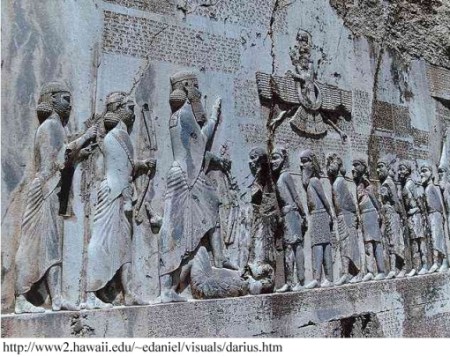
Not only did Darius stamp out these revolts, he expanded his empire in Central Asia by overthrowing King Skunkha (also later added to the Bisitun relief, depicted on the extreme right) and by annexing the Indus valley to the empire by 518 BC. Although the empire faced its first crisis at the beginning of Darius’ reign, the Persian empire reached its peak under the reign of Darius.
At one point the empire was so vast, and the Persian army so strong, that while Darius’ generals led a campaign against Cyrenaica in North Africa, Darius led armies into Europe conquering the western coast of the Euxine Sea (the Black Sea) pursuing the Scythian armies beyond the River Danube (Istros). After this campaign Darius left a strong army in Europe and charged them to annex Thrace and Macedonia. Darius’ empire was beyond anything the ancient world had seen; it was unparalleled by any empire or kingdom to this point in history.
The revolt of the Greek cities of Asia Minor in 499-493 BC did not spoil Darius’s track record. What we term the first Persian War cannot simply be reduced to the defeat at Marathon in 490 BC, since another consequence was the subjugation of the Aegean islands. By this date the empire extended from the Indus to the Balkans (13).

::: Ancient Persian Imperial History :: A Summary :: pt 1
Forgotten Empire: The World of Ancient Persia, eds. John Curtis and Nigel Tallis. Berkeley Los Angeles: University of California Press, 2005.
The following summary comes from the material on page 12.
Because Classical texts have little to say about the Persians until the heroic origins of the empire’s founder Cyrus the Great (557-530 bc) who became king of Persia around 557 bc, the origins of the Persian people remains shrouded in mystery. Cyrus descended from a line of kings who ruled the country of Anshan east of the Persian Gulf. The kings of Anshan had close ties with the kings of Susa, another great city between Anshan and Babylonia (east of Babylonia and northwest of Anshan), and maintained a cultural and political relationship with the Medes whose heartland was caught between the Persians and Babylonia (northeast of Babylonia and northwest of the Persians).
Cyrus conquered The Median Empire (625-550 bc) around 550 bc before going on to subjugate the kingdom of Lydia and Asia Minor around 546 bc, and finally the Babylonian king Nabonidus around 539 bc. After his conquest of Babylonia, Cyrus authorized the Jewish Community to return to Jerusalem and rebuild the Temple of Yahweh and expanded his kingdom to the northeast as far as Bactria-Sogdiana, establishing forts along the left bank of the River Jaxartes which would be regarded as the northern border of the empire.
Cyrus disappeared during this campaign and was buried at Pasargadae in the heart of the Persian empire. By the time of his death, Cyrus had expanded a once small kingdom of Persia into a dominant empire that encompassed most of the Ancient Middle East, although Egypt was still left as the last large independent kingdom of the Middle East. Pharaonic Egypt was soon conquered by Cyrus’ son and successor—Cambyses (530-522 bc), although Cambyses died on his way back from his victory in Egypt.
In next post we will discuss the Empire’s first major setback.
ReaD ThiS ::: No “Gospel” For Augustine
I realize we are in the middle of a book review about the ancient Persian Empire, but Perry C. Robinson (a member of the Orthodox Church) has written such a well argued post about how St. Augustine did not believe in justification by faith alone (also known as sola fide), I just had to create a link to it here. He concludes that if sola fide is the gospel, Augustine didn’t have it.
I’ve read through some of his other posts also. They are very good. I now include his blog on my blog roll.
:::::::::::::::::::: HT: Energetic Procession
Forgotten Empire: The World of Ancient Persia
The following is the first of series of posts about the Ancient Persian Empire as summarized in the following book:

Forgotten Empire: The World of Ancient Persia, eds. John Curtis and Nigel Tallis. Berkeley Los Angeles: University of California Press, 2005.
Forgotten Empire is named after an exhibition of the British Museum accomplished with the cooperation of the National Museum of Iran and therefore not only incorporates the contributions of a host of scholars, historians, archeologists, and museum directors, but also features hundreds of color photos of artifacts of some of the wonders of ancient Persia. With each contributor focusing on a different aspect of the famous Achaemenid empire, each chapter is independent, leaving the reader with the option of exploring the chapters in whatever order she prefers. Not only this, but every chapter is furnished with a multitude of visual illustrations from maps, artifacts, and reconstructive sketches. The experience is like walking through a museum with expert scholars giving live commentary; this book has all the perks one could ask for in a treatment of Ancient Persia. Because it would not be possible to summarize each chapter individually in this short review, I will focus on content from the book that I found most interesting.
It appears to be part of the conscious agenda of the various contributors to correct false impressions about ancient Persia by recognizing that the perspective of the Greeks—particularly Herodotus’ writings—about the ancient Persians was not only limited but also bias, as most ancient historians were.
Ancient Persia is perhaps best remembered in the west for its war with Greece and for the later invasion by Alexander of Macedon in 334-330 bc, culminating in the gratuitous destruction of Persepolis. For the Persians, however, the Graeco-Persian Wars were probably little more than a troublesome frontier skirmish that took place nearly 2,000 miles away from Persepolis, and native Iranian sources are largely silent on this question. Instead, our information about the wars and about much else in connection with the ancient Persians comes from Greek authors such as Herodotus. These accounts are inevitably written from a Greek rather than a Persian perspective, and it is because of them that the conflict is often represented as a contest between freedom and democracy on the one hand, and tyranny and despotism on the other. One of the aims of the exhibition will be to redress this negative Eurocentric view of the ancient Persians (9).
In our next post, we will begin to summarize the history of the Persian Empire.
::: An Islamic Europe by 2050-2100 is Inevitable :::
:::::::::::::::::::::HT: Christ, My Righteousness
Processing Critical Scholarship on King David :: McKenzie
McKenzie, Steven L. King David: A Biography. Oxford, New York: Oxford University Press, 2000.
McKenzie’s reconstruction appears thoroughly informed and contains a great deal of helpful detailed reconstructions of David’s life. For example, after reading McKenzie’s reconstruction of the early life of David it will be hard to ever imagine the young David as merely a humble shepherd boy. While Jesse was a wealthy man and David would be expected at times to tend to shepherd duties, McKenzie points out that David is described as “a man of valor” and “a man of war” before he is ever asked to be Saul’s musician or armor bearer (I Sam 16:18). “These are not qualities of a simple shepherd,” the author reminds us (49).
On the other hand, in this same section, he dismisses all the references to David as a shepherd as having “been adopted to explain David’s origins” so that David could be enshrined as the “Shepherd of Israel” (48-49). The author does not seem to consider the possibility that perhaps it would be historically plausible—given the fact that he admits David’s father Jesse would’ve owned many sheep—that David’s duties as a shepherd in his youth could have been later exploited (as opposed to being entirely made up) for the sake of the shepherd metaphor. His reasons for accepting parts of the biblical account and rejecting others do not always appear methodologically consistent and in some cases seem quite unnecessary and somewhat arbitrary.
Although as an evangelical I do not want to give up my picture of King David as an exemplary man after God’s own heart, McKenzie’s critical approach is not easily answered. He grounds his view in what appear to be contradictions in the Bible’s storyline. For example, he claims the Goliath story is legend. He starts by noting that “at the end of chapter 16, Saul and David have formed a close relationship, with David as Saul’s beloved armor bearer (16:21). Yet at the end of the Goliath story (17:55-56) Saul does not know who David is” (50). He asks, “Abner, whose son is this youth?” and asks David, “Whose son are you, young man?” McKenzie says these questions are Hebrew idioms for “Who is this?” and “Who are you.” Yet, previous to these questions, Saul was not only told exactly who David was—even whose son he was—but had loved him so much he had made him his armor bearer (I Sam 16:18)! Suddenly, after David kills Goliath, Saul wants to know who he is. Similar observations are continually made throughout his analysis of the biblical text. While some supposed contradictions are easily answered, others are not.
Forcing myself to read through McKenzie’s non-evangelical-friendly historical reconstruction of David was exactly what I needed. I now have a better understanding of how critical scholars go about their historical reconstructions of biblical figures, have a better sense of how much evidence there is for the historical David, and I am challenged to sympathize with what leads people to mistrust the biblical account. In spite of the author’s view of the biblical literature on David as being royal propaganda, I am now more informed about the biblical and historical David.
 T h e o • p h i l o g u e
